
PREMIUM LOGIN
ClassTools Premium membership gives access to all templates, no advertisements, personal branding and many other benefits!
| Username: | ||
| Password: | ||
|
Submit
Cancel
|
||
| Not a member? | ||
PREMIUM LOGIN
ClassTools Premium membership gives access to all templates, no advertisements, personal branding and many other benefits!
| Username: | ||
| Password: | ||
|
Submit
Cancel
|
||
| Not a member? | ||
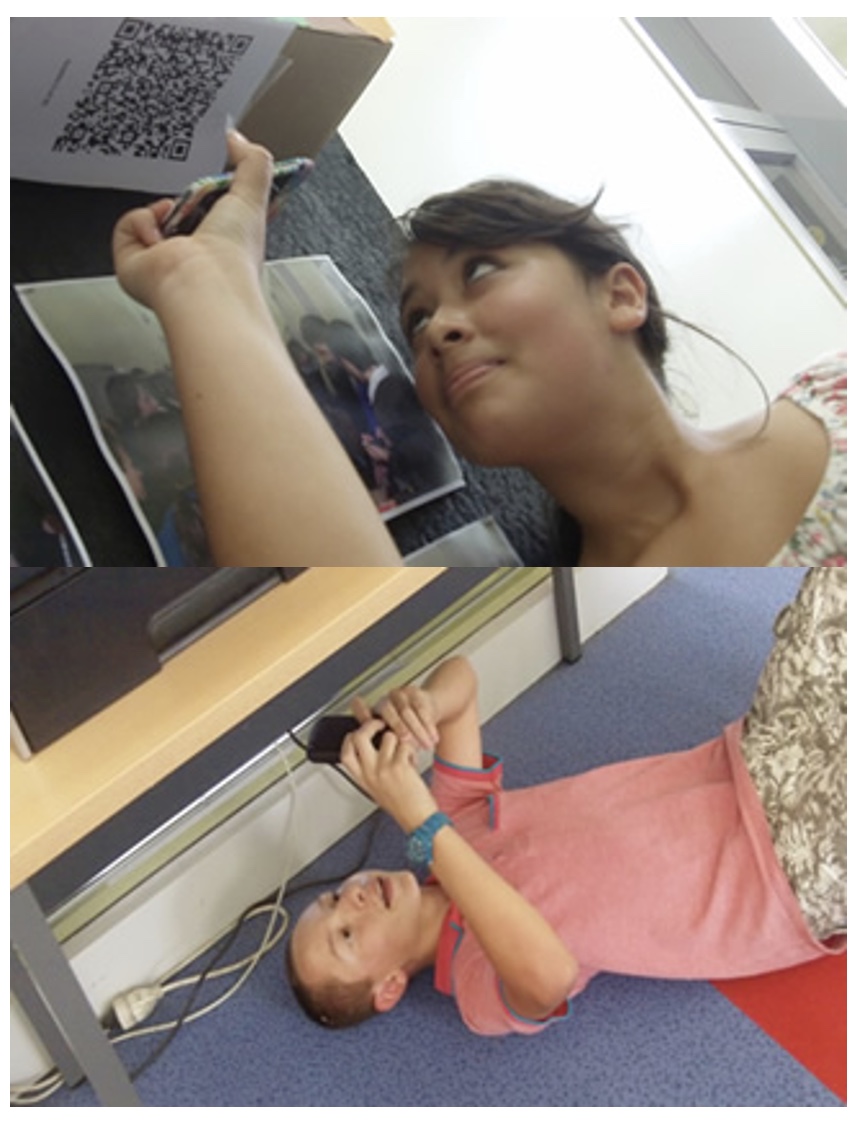
1. Arrange students into groups. Each group needs at least ONE person who has a mobile device.
2. If their phone camera doesn't automatically detect and decode QR codes, ask students to
4. Cut them out and place them around your class / school.
1. Give each group a clipboard and a piece of paper so they can write down the decoded questions and their answers to them.
2. Explain to the students that the codes are hidden around the school. Each team will get ONE point for each question they correctly decode and copy down onto their sheet, and a further TWO points if they can then provide the correct answer and write this down underneath the question.
3. Away they go! The winner is the first team to return with the most correct answers in the time available. This could be within a lesson, or during a lunchbreak, or even over several days!
4. A detailed case study in how to set up a successful QR Scavenger Hunt using this tool can be found here.
Question | Answer |
| 1. 1. What were the root causes of the hostility between the US and the SU after World War II? | the fundamental difference between the nations’ vision of the postwar world, the brutality of the Soviet government toward its own people, the Soviet mistreatment of eastern Europeans during World War II, the United States refusal to deal with the Soviet Union during the 1920s | 2. 2. Allied wartime diplomacy illustrated what? | the Big Three could not settle their basic disagreements | 3. 3. When Harry Truman assumed the Presidency after Franklin Roosevelt’s death, he believed what? | Stalin and the Soviet Union were fundamentally untrustworthy | 4. 4. In dealing with the Soviets during his first few months in office, President Truman did what? | chastised the Soviets for violating the Yalta agreements | 5. 5. Despite disagreement among historians concerning the origins of the Cold War, many of them have come to accept which post-revisionist interpretation? | both countries helped to create an atmosphere of tension and suspicion that touched off the Cold War | 6. 6. Above all other reasons, policy makers supported the Marshall Plan because they feared what? | the shaky pro-American governments in western Europe might fall under communist control | 7. 7. The Marshall Plan adopted policies toward communist countries that did what? | offered assistance to the Soviet Union and its eastern European satellites, but they refused | 8. 8. Reservations about the Marshall Plan by American leaders virtually ended when what happened? | there was a pro-Soviet coup in Czechoslovakia | 9. 9. The Economic Cooperation Administration was also known as the? | Marshall Plan | 10. 10. In 1948, Stalin initiated the Berlin Blockade in response to what? | the merging of the American, British, and French zones of Germany to create a new West German Republic | 11. 11. The history of the North Atlantic Treaty Organization involved what events? | the members declared that an armed attack against one member would be considered an attack on all, the crisis in Berlin accelerated the formation of the organization, the Soviet Union responded to its formation with the creation of the Warsaw Pact, the members agreed to maintain a standing military force in Europe | 12. 12. The National Security Council report resulted from what events? | the fleeing of Chiang Kai-shek and his followers to Taiwan (Formosa), the victory of Mao Zedong and his communist forces in China, the detonation of an atomic bomb by the Soviet Union, the general belief by the United States that the communists were expansionist | 13. 13. The National Security Council report represented what? | a strengthening of America’s containment policy | 14. 14. One major purpose of the Taft-Hartley Act was to do what? | limit the power of labor unions | 15. 15. The Taft-Hartley Act of 1947 was supported by who? | conservative Republicans in Congress | 16. 16. In the election of 1948, Truman employed what political Tactics? | becoming more aggressive in attacking his opponent, telling the public that the Republicans had abandoned the common people, recreating much of Franklin Roosevelt’s New Deal coalition, assailing the Republican Congress for its economic failures | 17. 17. In the election of 1948, Truman and the Democrats did what? | won the presidency, and the Democrats also won both houses of Congress | 18. 18. In the late 1940s, Truman managed to push through Congress which pieces of Fair Deal legislation? | a new minimum wage law to increase the rates, an expansion of the Social Security system, a National Housing Act to provide construction of low-income housing, an extension of Social Security benefits to more Americans | 19. 19. The nation’s most prominent leader of the crusade against domestic subversion was who? | Joseph McCarthy | 20. 20. The Republican candidate, Dwight Eisenhower, won the presidential election of 1952 because much of the public liked his? | geniality and statesmanlike quality of Eisenhower | 21. 21. “I believe that it must be the policy of the United States to support free peoples who are resisting attempted subjugation by armed minorities or by outside pressures.” What does this quote represent? | the Truman Doctrine | 22. 22. What were the proposed elements of Truman’s Fair Deal? | civil rights legislation, national health insurance, federal aid to education, extension of Social Security benefits | 23. 23. The main source of disagreement between Truman and General MacArthur during the Korean War arose over what issue? | Truman’s desire to avoid provoking China and widening the war | 24. 24. A key factor in Truman’s surprise victory in the 1948 election was what? | his ability to relate to ordinary voters during his “whistle-stop” campaign | 25. 25. A key difference between the immediate post-World War I and World War II periods was what? | the attitude of the American people toward membership in an international peacekeeping organization |

Question 1 (of 25)
Question 2 (of 25)
Question 3 (of 25)
Question 4 (of 25)
Question 5 (of 25)
Question 6 (of 25)
Question 7 (of 25)
Question 8 (of 25)
Question 9 (of 25)
Question 10 (of 25)
Question 11 (of 25)
Question 12 (of 25)
Question 13 (of 25)
Question 14 (of 25)
Question 15 (of 25)
Question 16 (of 25)
Question 17 (of 25)
Question 18 (of 25)
Question 19 (of 25)
Question 20 (of 25)
Question 21 (of 25)
Question 22 (of 25)
Question 23 (of 25)
Question 24 (of 25)
Question 25 (of 25)