
PREMIUM LOGIN
ClassTools Premium membership gives access to all templates, no advertisements, personal branding and many other benefits!
| Username: | ||
| Password: | ||
|
Submit
Cancel
|
||
| Not a member? | ||
PREMIUM LOGIN
ClassTools Premium membership gives access to all templates, no advertisements, personal branding and many other benefits!
| Username: | ||
| Password: | ||
|
Submit
Cancel
|
||
| Not a member? | ||
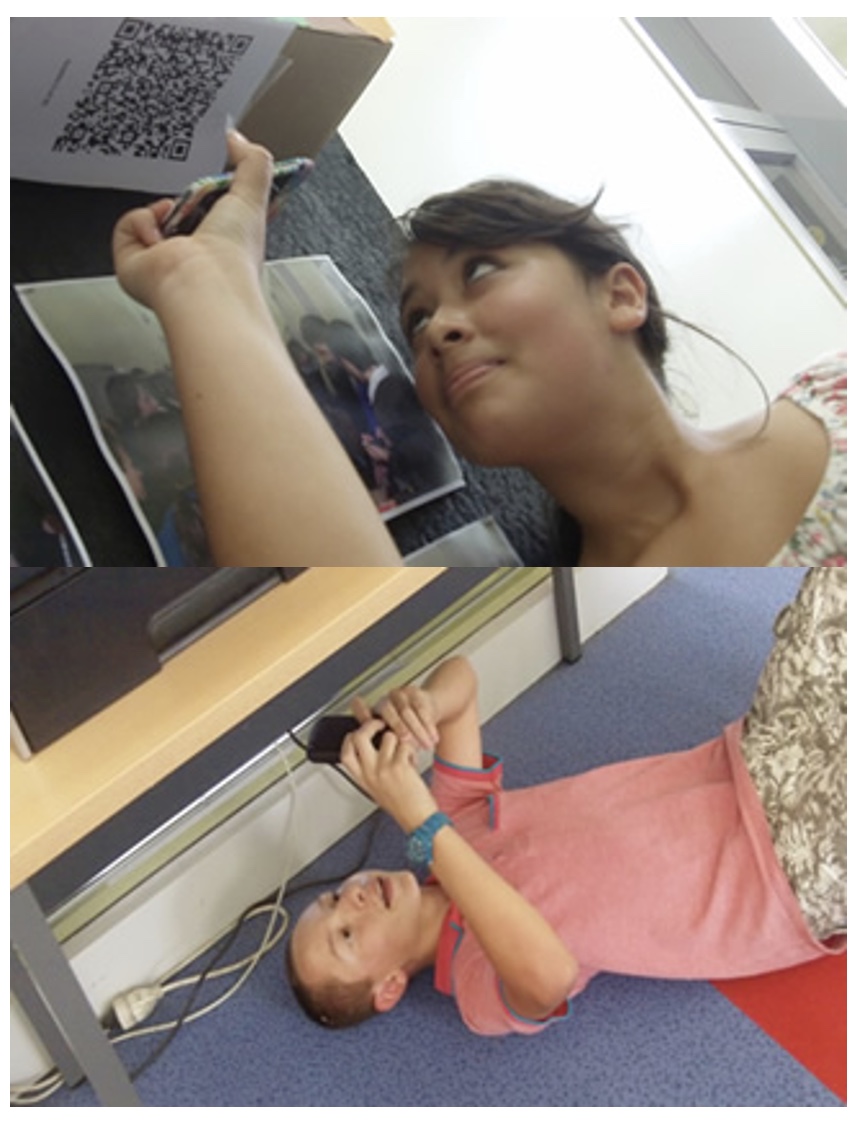
1. Arrange students into groups. Each group needs at least ONE person who has a mobile device.
2. If their phone camera doesn't automatically detect and decode QR codes, ask students to
4. Cut them out and place them around your class / school.
1. Give each group a clipboard and a piece of paper so they can write down the decoded questions and their answers to them.
2. Explain to the students that the codes are hidden around the school. Each team will get ONE point for each question they correctly decode and copy down onto their sheet, and a further TWO points if they can then provide the correct answer and write this down underneath the question.
3. Away they go! The winner is the first team to return with the most correct answers in the time available. This could be within a lesson, or during a lunchbreak, or even over several days!
4. A detailed case study in how to set up a successful QR Scavenger Hunt using this tool can be found here.
Question | Answer |
| 1. 1. How does the statistical definition of abnormality work? | Using a normal distribution, anyone who falls outside of this is 'abnormal' | 2. 2. Give one weakness of the social norms definition of abnormality | Due to multiple factors being taken into account (e.g. culture, gender, age, situation) it is difficult to find a reliable definition. | 3. 3. What is axis 2 on the DSM? | Personality disorders such as OCD | 4. 4. Evaluate Goldstein's study in terms of reliability. | Two experts re-diagnosed, good inter rater reliability. | 5. 5. Explain why the DSM might be argued to be 'reductionist.' | Because it reduces complex mental disorders into a list of symptoms/features, rather than treating the symptoms perhaps we should treat the whole person 'holism.' | 6. 6. Out of 1000 people, how many people will have schizophrenia approximately? | 1.4-4.6 | 7. 7. Name two different types of Schizophrenia | Paranoid, Disorganised, Catatonic, Residual. | 8. 8. Explain the significance of amphetamines in the dopamine hypothesis. | Amphetamines cause excess dopamine and paranoid symptoms. Supports role of dopamine in schizophrenia. | 9. 9. Name one treatment from the learning approach. | TEP, SD, Flooding | 10. 10. How many hospitals were used in Rosenhan's study and why was this a major strength? | 12 across 5 different states in USA, same findings found across all - high reliability of findings. | 11. 11. Why was the language used in your leaflet an important point to consider? | Needs to be easily understandable and sympathetic for target audience so that they can 'understand' the distressing disorder they have been diagnosed with. | 12. 12. State two contributions from the social approach and explain how they contributes. | SIT in reducing prejudice, Understanding blind obedience, care in the community. | 13. 13. What can always be used as a strength of any contribution? | Evidence!! They all have practical applications/uses in real life... | 14. 14. State one contribution from clinical psychology and explain how it contributes. | Any therapy from any approach. Free association, SD, TEP, CBT, RET etc.. | 15. 15. What can a psychologist do to ensure that they have gained informed consent? | Explain the aim and instructions for the study. Ensure P's know they can withdraw at any time. Gain written approval. Ask for parental consent for children under the age of 18. | 16. 16. Name 3 ethical guidelines for animals | Cost-benefit, minimising distress, social isolation, suitably equipped, license, number of animals, type of species. | 17. 17. What is the key study which was used for the content analysis research method and what did it investigate? | Cumberbatch & Gauntlett. Ofcom funded into how alcohol/drugs were depicted in soaps watched by 10-15 year olds. | 18. 18. Explain how scientific the psychodynamic approach is using 3 key features of science. | Looks at unconscious mind which can't be objectively measured or falsified. Case study methods are unique and non reliable. Case studies and dream analysis require subjective interpretation and are therefore not objective. No variables are manipulated or hypotheses tested. | 19. 19. Name one aspect of Psychology which is argued to be ethnocentric. | IQ tests, Milgram, DSM, Freud's Psychosexual stages. | 20. 20. Name one practical issue with using TEP's for social control purposes. | Easy to train people up, need for consistency, reinforcers must be personalised, not long lasting outside of an institution. |

Question 1 (of 20)
Question 2 (of 20)
Question 3 (of 20)
Question 4 (of 20)
Question 5 (of 20)
Question 6 (of 20)
Question 7 (of 20)
Question 8 (of 20)
Question 9 (of 20)
Question 10 (of 20)
Question 11 (of 20)
Question 12 (of 20)
Question 13 (of 20)
Question 14 (of 20)
Question 15 (of 20)
Question 16 (of 20)
Question 17 (of 20)
Question 18 (of 20)
Question 19 (of 20)
Question 20 (of 20)