
PREMIUM LOGIN
ClassTools Premium membership gives access to all templates, no advertisements, personal branding and many other benefits!
| Username: | ||
| Password: | ||
|
Submit
Cancel
|
||
| Not a member? | ||
PREMIUM LOGIN
ClassTools Premium membership gives access to all templates, no advertisements, personal branding and many other benefits!
| Username: | ||
| Password: | ||
|
Submit
Cancel
|
||
| Not a member? | ||
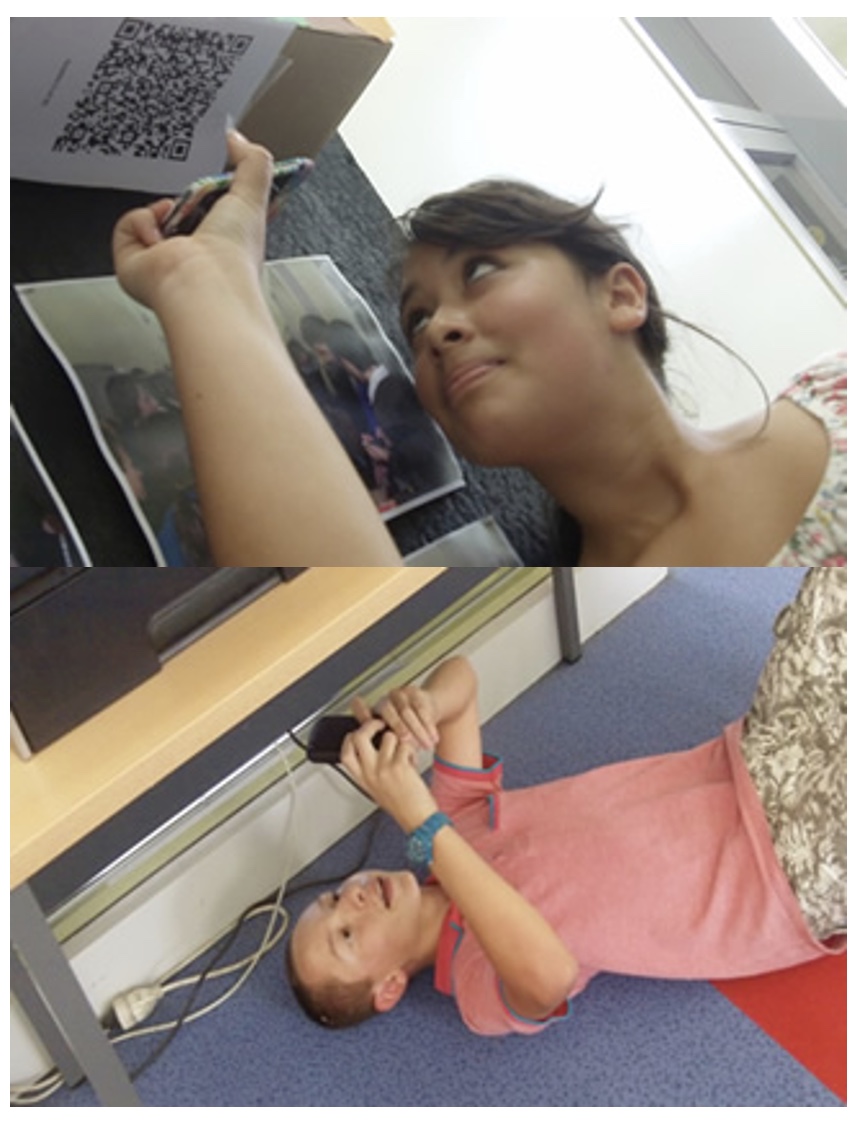
1. Arrange students into groups. Each group needs at least ONE person who has a mobile device.
2. If their phone camera doesn't automatically detect and decode QR codes, ask students to
4. Cut them out and place them around your class / school.
1. Give each group a clipboard and a piece of paper so they can write down the decoded questions and their answers to them.
2. Explain to the students that the codes are hidden around the school. Each team will get ONE point for each question they correctly decode and copy down onto their sheet, and a further TWO points if they can then provide the correct answer and write this down underneath the question.
3. Away they go! The winner is the first team to return with the most correct answers in the time available. This could be within a lesson, or during a lunchbreak, or even over several days!
4. A detailed case study in how to set up a successful QR Scavenger Hunt using this tool can be found here.
Question | Answer |
| 1. Write these numbers in order, starting with the smallest. a)310, 86, 219, 25, 501, 62, 400, 151 b)357, 740, 2053, 888, 4366, 97, 368 c)8, −6, 0, −2, 4, 2, 3, −9 | a) 25,62,86,151,219,310,400,501, b) 97,357,368,740,888,2053,4366, c)-9,-6,-2,0,2,3,4,8 | 2. An estate agent advertises the following houses: House 1 - £129 100, House 2 - £129 000, House 3 - £128 750, House 4 - £128 250 a) Which house is the cheapest? b) Which house is the most expensive? c) George has just enough money to buy the cheapest house. How much more money would he need to buy the most expensive house? | House 4, House 1, £850 | 3. Write down as many different three-digit numbers as you can, using the digits 0, 4 and 8. You may only use each digit once in each number. Do not start any number with 0. Write your numbers down in order, starting with the smallest. | 408,480,804,840 | 4. Using the digits 0, 4, 5 and 7 once only, a) how many four-digit odd numbers greater than 7000 can you make? b) How many four-digit numbers greater than 6500 can you make? | 2, 6 | 5. Nick has five number cards each with a single digit on. The digits are 3,5,7,8,9. Nick has to make a three-digit number and a two-digit number from the card. A) What is the biggest sum (addition) he can make? B) What is the smallest difference (subtraction) he can make? | 1058, 259 | 6. Write the correct symbol, > or <, between them. a)−1 … 3, b)3 … 2, c)−4 … −1, d)5 … −4, e)1 … −6, f)−3 … 0, g)−2 … −1, h)2 … −3, I)5 … −6, j)3 … 4, k)−7 … −5, l)−2 … −4 | a).−1 < 3, b.3 > 2, c.−4 < −1, d.−5 < −4, e.1 > −6, f.−3 < 0, g.−2 < −1, h.2 > −3, i.5 > −6, j.3 < 4, k.−7 < −5, l.−2 > −4 | 7. Complete the weather report below. Use these temperatures to fill the gaps: 2 °C −2 °C −4 °C 6 °C: The hottest place today is Edinburgh, with a temperature of ____, while in Eastbourne a ground frost has left the temperature just below zero, at ____. In Bristol it is even colder, at ____. Finally, in Tenby the temperature is just above freezing, at ____. | 6, -2, -4, 2 | 8. The sign ⩾ means ‘greater than or equal to’. The sign ⩽ means ‘less than or equal to’. N is a whole number. Write down all the possible values that N can have in each case. a) N ⩾ 7 and N < 12, b) N > 5 and N ⩽ 10, c) N ⩾ 2 and N ⩽ 8 | a) 7,8,9,10,11, b)6,7,8,9,10, c) 2,3,4,5,6,7,8 |

Question 1 (of 8)
Question 2 (of 8)
Question 3 (of 8)
Question 4 (of 8)
Question 5 (of 8)
Question 6 (of 8)
Question 7 (of 8)
Question 8 (of 8)