
PREMIUM LOGIN
ClassTools Premium membership gives access to all templates, no advertisements, personal branding and many other benefits!
| Username: | ||
| Password: | ||
|
Submit
Cancel
|
||
| Not a member? | ||
PREMIUM LOGIN
ClassTools Premium membership gives access to all templates, no advertisements, personal branding and many other benefits!
| Username: | ||
| Password: | ||
|
Submit
Cancel
|
||
| Not a member? | ||
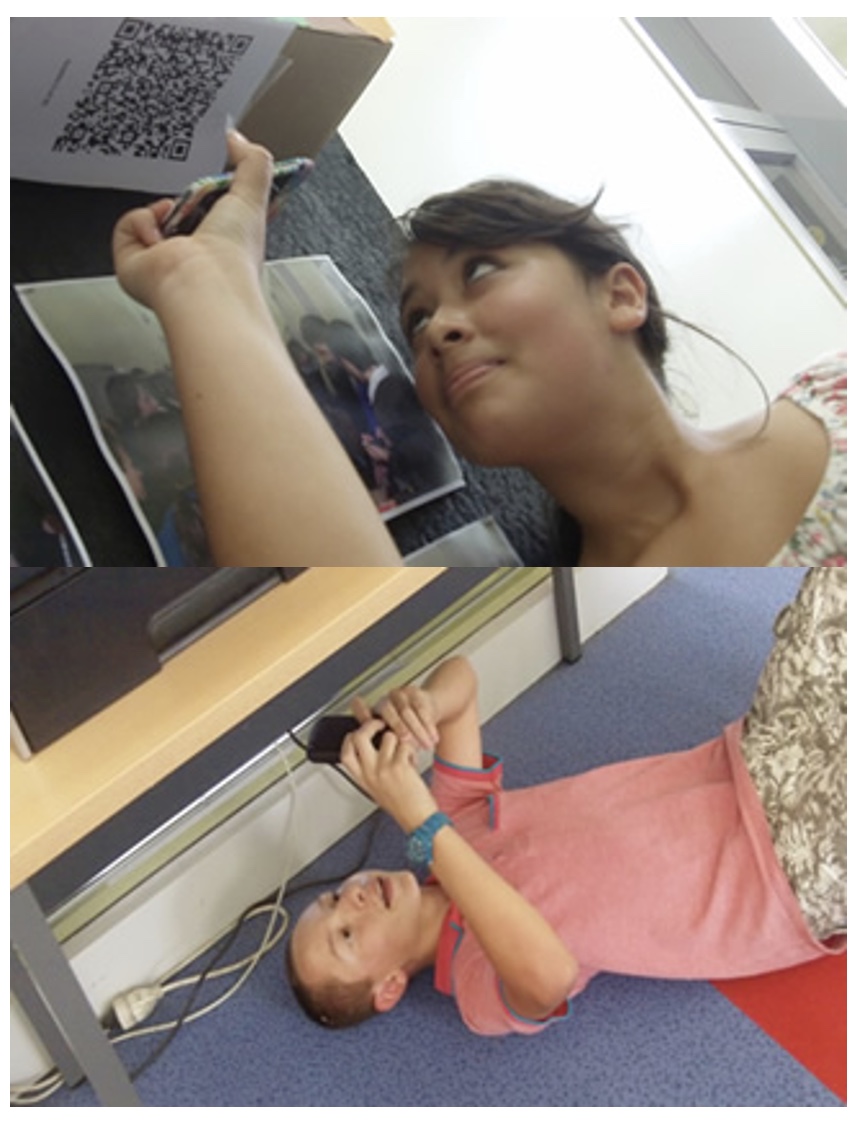
1. Arrange students into groups. Each group needs at least ONE person who has a mobile device.
2. If their phone camera doesn't automatically detect and decode QR codes, ask students to
4. Cut them out and place them around your class / school.
1. Give each group a clipboard and a piece of paper so they can write down the decoded questions and their answers to them.
2. Explain to the students that the codes are hidden around the school. Each team will get ONE point for each question they correctly decode and copy down onto their sheet, and a further TWO points if they can then provide the correct answer and write this down underneath the question.
3. Away they go! The winner is the first team to return with the most correct answers in the time available. This could be within a lesson, or during a lunchbreak, or even over several days!
4. A detailed case study in how to set up a successful QR Scavenger Hunt using this tool can be found here.
Question | Answer |
| 1. Question 1. Alliteration Definition: Alliteration is derived from Latin’s “Latira”. It means “letters of alphabet”. It is a stylistic device in which a number of words, having the same first consonant sound, occur close together in a series. Consider the following examples: But a better butter makes a batter better. A big bully beats a baby boy. Both sentences are alliterative because the same first letter of words (B) occurs close together and produces alliteration in the sentence. An important point to remember here is that alliteration does not depend on letters but on sounds. So the phrase not knotty is alliterative, but cigarette chase is not. | Answer | 2. Question 2. Definition of Metaphor: Metaphor is a figure of speech that makes an implicit, implied, or hidden comparison between two things that are unrelated, but which share some common characteristics. In other words, a resemblance of two contradictory or different objects is made based on a single or some common characteristics. In simple English, when you portray a person, place, thing, or an action as being something else, even though it is not actually that “something else,” you are speaking metaphorically. For example, the phrase, “My brother is the black sheep of the family,” is a metaphor because he is not a sheep, nor is he black. However, we can use this comparison to describe an association of a black sheep with that person. A black sheep is an unusual animal, which typically stays away from the herd, and the person being described shares similar characteristics. Furthermore, a metaphor develops a comparison that is different from a simile, in that we do not use “like” or “as” to develop a comparison in a metaphor. It actually makes an implicit or hidden comparison and not an explicit one. | Answer | 3. Question 3. Definition of Simile: A simile is a figure of speech that makes a comparison, showing similarities between two different things. Unlike a metaphor, a simile draws resemblance with the help of the words “like” or “as.” Therefore, it is a direct comparison. We can find simile examples in our daily speech. We often hear comments like, “John is as slow as a snail.” Snails are notorious for their slow pace, and here the slowness of John is compared to that of a snail. The use of “as” in the example helps to draw the resemblance. | Answer | 4. Question 4. Definition of Personification: Personification is a figure of speech in which a thing – an idea or an animal – is given human attributes. The non-human objects are portrayed in such a way that we feel they have the ability to act like human beings. For example, when we say, “The sky weeps,” we are giving the sky the ability to cry, which is a human quality. Thus, we can say that the sky has been personified in the given sentence. | Answer | 5. Question 5. Onomatopoeia Definition: Onomatopoeia is defined as a word, which imitates the natural sounds of a thing. It creates a sound effect that mimics the thing described, making the description more expressive and interesting. For instance, saying, “The gushing stream flows in the forest” is a more meaningful description than just saying, “The stream flows in the forest.” The reader is drawn to hear the sound of a “gushing stream” which makes the expression more effective. In addition to the sound they represent, many onomatopoeic words have developed meanings of their own. For example, “whisper” not only represents the sound of people talking quietly, but also describes the action of people talking quietly. | 6. Question 6. Pathetic Fallacy Definition: Pathetic fallacy is a literary device that attributes human qualities and emotions to inanimate objects of nature. The word “pathetic” in the term is not used in the derogatory sense of being miserable; rather, here, it stands for “imparting emotions to something else”. Difference between Pathetic Fallacy and Personification. Generally, Pathetic fallacy is confused with personification. The fact is that they differ in their function. Pathetic fallacy is a kind of personification that gives human emotions to inanimate objects of nature for example referring to weather features reflecting a mood. Personification, on the other hand, is a broader term. It gives human attributes to abstract ideas, animate objects of nature or inanimate non-natural objects. For example, the sentence “The somber clouds darkened our mood” is a pathetic fallacy as human attributes are given to an inanimate object of nature reflecting a mood. But, “The sparrow talked to us” is a personification because the animate object of nature “sparrow” is given the human quality of “talking”. | Answer | 7. Question 7. Assonance Definition: Assonance takes place when two or more words, close to one another repeat the same vowel sound, but start with different consonant sounds. For instance, in the following sentence: “Men sell the wedding bells.” The same vowel sound of the short vowel “-e-” repeats itself in almost all the words, excluding the definite article. The words do share the same vowel sounds, but start with different consonant sounds – unlike alliteration, which involves repetition of the same consonant sounds. | Answer | 8. Question 8. Definition of Sibilance: Sibilance is a literary device where strongly stressed consonants are created deliberately by producing air from vocal tracts through the use of lips and tongue. Such consonants produce hissing sounds. However, in poetry, it is used as a stylistic device, and sibilants are used more than twice in quick succession. Most of the times, the “s” sound is the sibilant. Difference Between Alliteration and Sibilance: Alliteration is produced by the repetition of first consonant sounds in the words, generally the first one or two letters, such as in “A big bully beats a baby boy.” However, sibilance is also a specific type of alliteration that uses the soft consonants. In sibilance, hissing sounds are created. These soft consonants are s, with sh, ch, and th, including three others such as z, x, f and soft c. For instance, “Sing a Song of Sixpence” is the title of a famous nursery rhyme, which can be considered as a good example of sibilance. | Answer |

Question 1 (of 8)
Question 2 (of 8)
Question 3 (of 8)
Question 4 (of 8)
Question 5 (of 8)
Question 6 (of 8)
Question 7 (of 8)
Question 8 (of 8)