
PREMIUM LOGIN
ClassTools Premium membership gives access to all templates, no advertisements, personal branding and many other benefits!
| Username: | ||
| Password: | ||
|
Submit
Cancel
|
||
| Not a member? | ||
PREMIUM LOGIN
ClassTools Premium membership gives access to all templates, no advertisements, personal branding and many other benefits!
| Username: | ||
| Password: | ||
|
Submit
Cancel
|
||
| Not a member? | ||
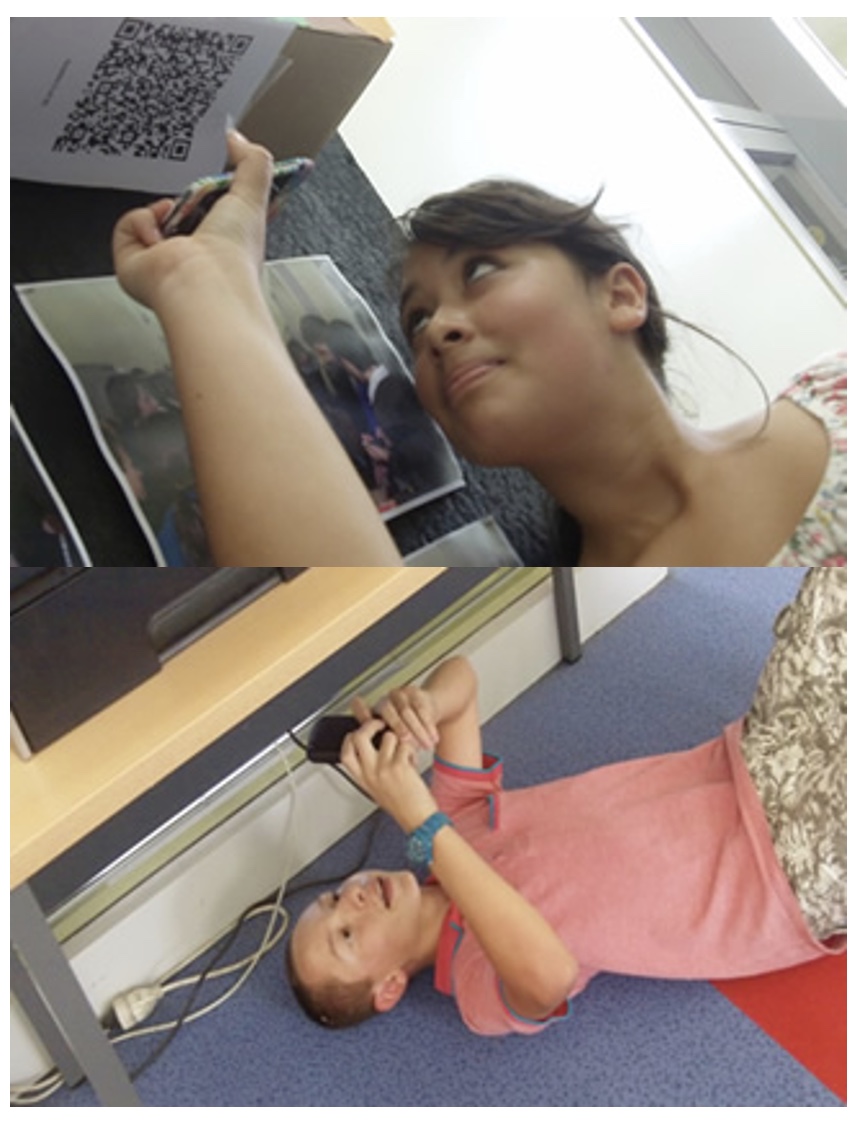
1. Arrange students into groups. Each group needs at least ONE person who has a mobile device.
2. If their phone camera doesn't automatically detect and decode QR codes, ask students to
4. Cut them out and place them around your class / school.
1. Give each group a clipboard and a piece of paper so they can write down the decoded questions and their answers to them.
2. Explain to the students that the codes are hidden around the school. Each team will get ONE point for each question they correctly decode and copy down onto their sheet, and a further TWO points if they can then provide the correct answer and write this down underneath the question.
3. Away they go! The winner is the first team to return with the most correct answers in the time available. This could be within a lesson, or during a lunchbreak, or even over several days!
4. A detailed case study in how to set up a successful QR Scavenger Hunt using this tool can be found here.
Question | Answer |
| 1. The theorist who believed that a child's mind develops through a series of stages, as he straggles to make sense of his experiences | Jean Piaget | 2. In this stage, Piaget believes the child experiences the world through senses and actions, such as touching, mouthing, and grasping. Stranger anxiety and object permanence are new developments | Sensorimotor stage | 3. In this stage, Piaget believes a person can reason abstractly, leading to the potential for mature moral reasoning | Formal operational | 4. In this stage, Piaget believed pretend play was important and egocentrism was typical | Preoperational Stage | 5. Very young children lack this concept: that quantity may stay the same even if the shape of the object changes | Conservation | 6. The awareness that objects continue to exist even when they are out of our sight | Object Permanence | 7. Preschoolers begin to develop the ability to imagine another person's viewpoint. What is this called? | Theory of Miind | 8. During this stage, Piaget believed children have developed conservation and can think logically about concrete events. They can understand analogies and manage mathematical operations | Concrete operational | 9. An emotional tie to another person; shown in Harlow's monkey experiments by the monkeys' preference for a cloth mother over a wire one | Attachment | 10. A child plays comfortably in a playroom. When her mother leaves, she becomes upset. When her mother returns, she seeks contact with her. This child is demonstrating what kind of attachment? | Secure Attachment | 11. Another child in the playroom seems anxious and avoids contact with her mother, and does not actively explore her surroundings. Other times she is excessively clingy to her mother. When her mother leaves, the child seems not to care. This child is demonstrating what kind of attachment? | Insecure attachment | 12. These types of parents are both demanding and responsive. They set rules and enforce them, but also explain the reasons for them. What type of parenting is this? | Authoritative | 13. Lawrence Kohlberg said that young children (under age 9) were primarily focused on self-interest. They obey rules only to avoid punishment or gain rewards. He called this: | Preconventional Morality | 14. By early adolescence, Kohlberg said morality is more focused on caring for others and upholding laws because they are the rules. They want social approval or order. He called this what? | Conventional Morality | 15. According to Kohlberg, with abstract reasoning, comes the higher moral level in which individuals may consider morality and ethical principles. What did he call this stage? | Postconventional Morality | 16. This theorist believed that in order to develop, each of us must resolve a specific crisis at each stage of life. Therefore, each stage has its own psychosocial task. | Erk Erikson | 17. According to Erikson, older adults, when reflecting back on their lives, may feel a sense of satisfaction or failure. This task is called: | Integrity vs despair |

Question 1 (of 17)
Question 2 (of 17)
Question 3 (of 17)
Question 4 (of 17)
Question 5 (of 17)
Question 6 (of 17)
Question 7 (of 17)
Question 8 (of 17)
Question 9 (of 17)
Question 10 (of 17)
Question 11 (of 17)
Question 12 (of 17)
Question 13 (of 17)
Question 14 (of 17)
Question 15 (of 17)
Question 16 (of 17)
Question 17 (of 17)