
PREMIUM LOGIN
ClassTools Premium membership gives access to all templates, no advertisements, personal branding and many other benefits!
| Username: | ||
| Password: | ||
|
Submit
Cancel
|
||
| Not a member? | ||
PREMIUM LOGIN
ClassTools Premium membership gives access to all templates, no advertisements, personal branding and many other benefits!
| Username: | ||
| Password: | ||
|
Submit
Cancel
|
||
| Not a member? | ||
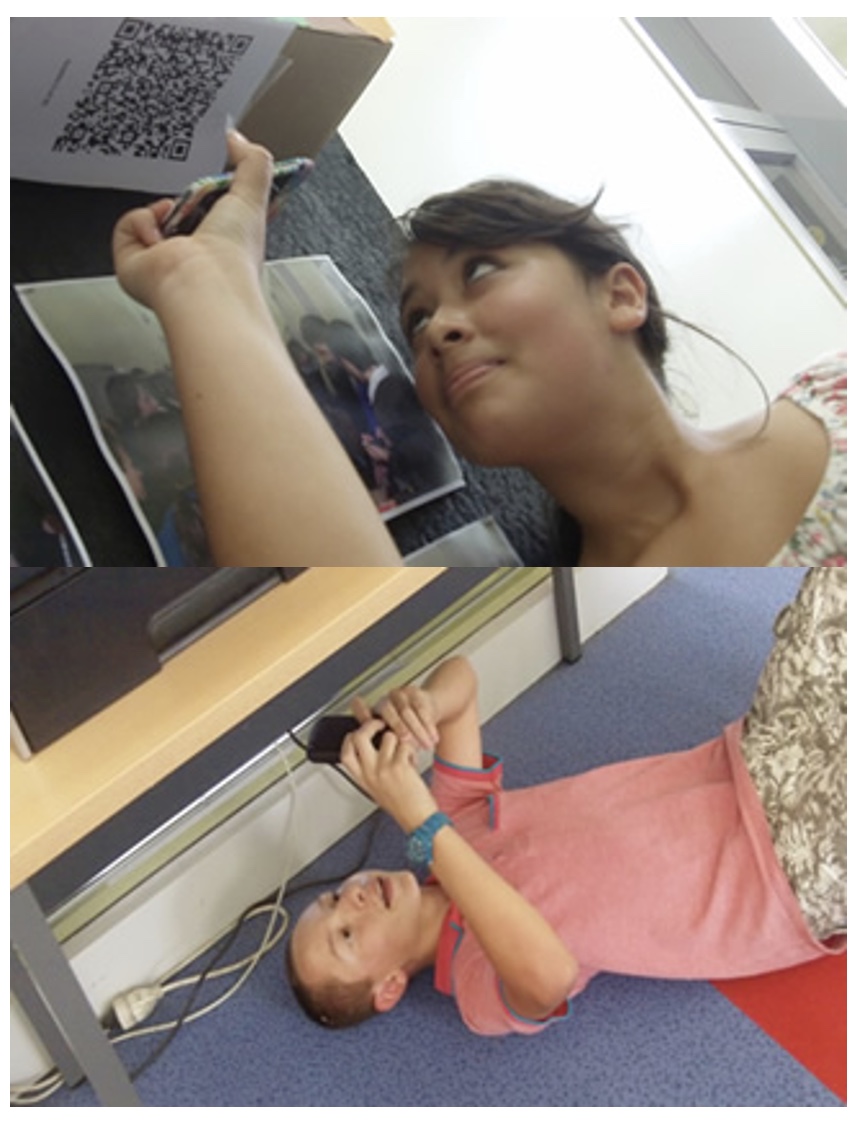
1. Arrange students into groups. Each group needs at least ONE person who has a mobile device.
2. If their phone camera doesn't automatically detect and decode QR codes, ask students to
4. Cut them out and place them around your class / school.
1. Give each group a clipboard and a piece of paper so they can write down the decoded questions and their answers to them.
2. Explain to the students that the codes are hidden around the school. Each team will get ONE point for each question they correctly decode and copy down onto their sheet, and a further TWO points if they can then provide the correct answer and write this down underneath the question.
3. Away they go! The winner is the first team to return with the most correct answers in the time available. This could be within a lesson, or during a lunchbreak, or even over several days!
4. A detailed case study in how to set up a successful QR Scavenger Hunt using this tool can be found here.
Question | Answer |
| 1. process by which an unstable nucleus emits one or more particles or energy in the form of electromagnetic radiation | radioactivity | 2. positively charged particle, emitted by some radioactive nuclei; particle consisting of 2 protons and 2 neutrons | alpha particle | 3. Process in which the atomic nuclei of radioactive isotopes release fast-moving particles and energy; the identity of an atom changes | radioactive decay | 4. electron emitted during the radioactive decay of a neutron in an unstable nucleus | beta particle | 5. high-energy electromagnetic radiation emitted by a nucleus during radioactive decay | gamma ray | 6. time required for half a sample of radioactive nuclei to decay | half-life | 7. interaction that binds protons and neutrons together in a nucleus | strong (nuclear) force | 8. process by which a nucleus splits into two or more smaller fragments | fission | 9. series of fission processes | chain reaction | 10. minimum mass of a fissionable isotope in which a chain reaction can occur | critical mass | 11. nuclear radiation that arise naturally from cosmic rays and isotopes in soil and air | background radiation | 12. radioactive material added to a substance so that the substance's location can be detected later | tracer | 13. A reaction involving the particles in the nucleus of an atom that can change one element into another element | nuclear reaction | 14. Process by which atomic nuclei join together; process that powers the sun | fusion |

Question 1 (of 14)
Question 2 (of 14)
Question 3 (of 14)
Question 4 (of 14)
Question 5 (of 14)
Question 6 (of 14)
Question 7 (of 14)
Question 8 (of 14)
Question 9 (of 14)
Question 10 (of 14)
Question 11 (of 14)
Question 12 (of 14)
Question 13 (of 14)
Question 14 (of 14)