
PREMIUM LOGIN
ClassTools Premium membership gives access to all templates, no advertisements, personal branding and many other benefits!
| Username: | ||
| Password: | ||
|
Submit
Cancel
|
||
| Not a member? | ||
PREMIUM LOGIN
ClassTools Premium membership gives access to all templates, no advertisements, personal branding and many other benefits!
| Username: | ||
| Password: | ||
|
Submit
Cancel
|
||
| Not a member? | ||
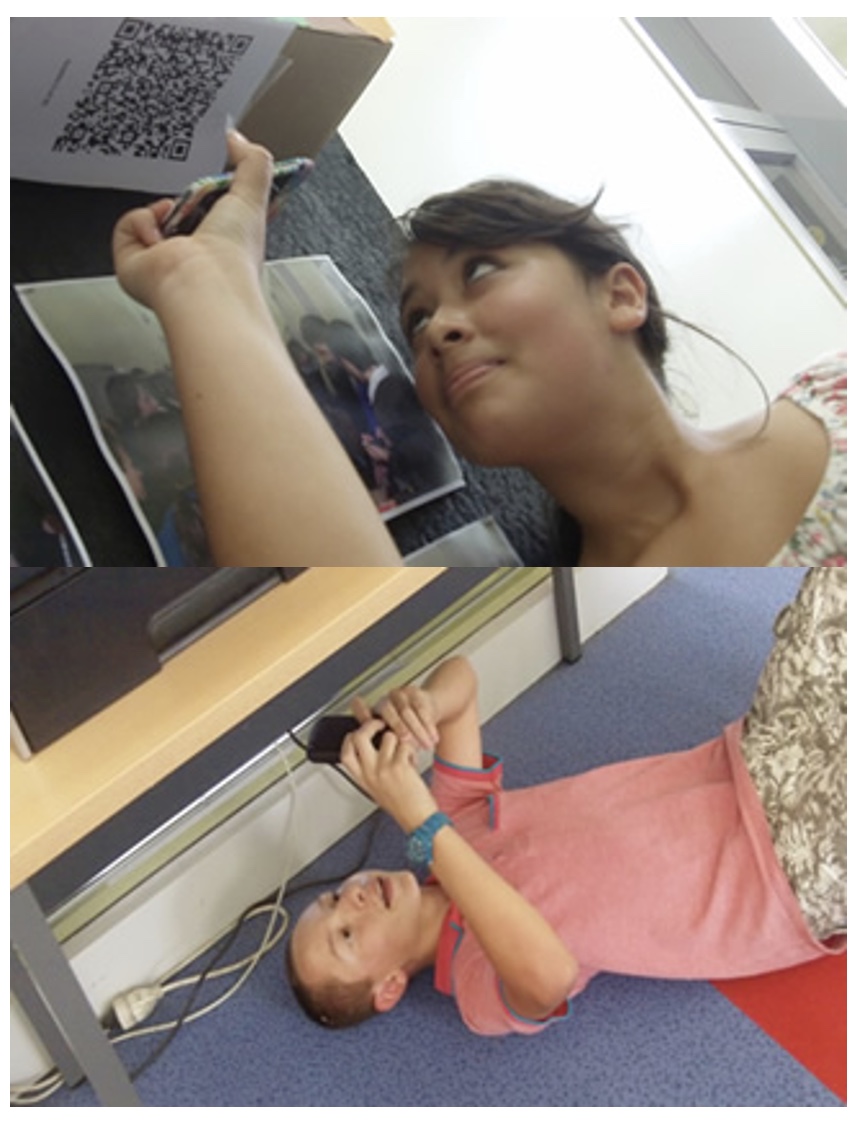
1. Arrange students into groups. Each group needs at least ONE person who has a mobile device.
2. If their phone camera doesn't automatically detect and decode QR codes, ask students to
4. Cut them out and place them around your class / school.
1. Give each group a clipboard and a piece of paper so they can write down the decoded questions and their answers to them.
2. Explain to the students that the codes are hidden around the school. Each team will get ONE point for each question they correctly decode and copy down onto their sheet, and a further TWO points if they can then provide the correct answer and write this down underneath the question.
3. Away they go! The winner is the first team to return with the most correct answers in the time available. This could be within a lesson, or during a lunchbreak, or even over several days!
4. A detailed case study in how to set up a successful QR Scavenger Hunt using this tool can be found here.
Question | Answer |
| 1. What type of disorder leads to pain caused by an overreactive nervous system? | complex regional pain syndrome | 2. List 3 characteristics of c-fibers. | associated with chronic pain, small, un-myelinated, slow, throbbing/aching/burning, located in viscera/organs/joints, lateral spinothalamic tract | 3. What pain theory is modulated at the spinal cord? | gate control theory | 4. Draw a diagram of the pain-spasm cycle | pain/trauma-->mm contraction-->motion restriction-->decreased blood flow/waste build up-->pain | 5. Which pain scale uses a range of numbers for patients to rate their pain? | numeric pain scale | 6. List 3 characteristics of A-delta fibers. | small, myelinated, acute pain, intense mechanical or thermal stimuli, sharp/stabbing/prickling, lateral spinothalamic tract | 7. Describe the endogenous opiate theory in 4 steps. | non-noxious stimuli/bearable levels of pain stimulate thalamus, thalamus releases opiopeptins, bind to specific binding sites in CNS or PNS, decreased pain/increased euphoria | 8. List 3 examples of non-noxious stimuli. | vibration, light touch, compression, rubbing, gentle warmth | 9. What is a common presentation of referred pain from the heart? | left shoulder, jaw, neck,scapula | 10. How would you describe muscle tone that is velocity-dependent when resisting stretch? | spasticity | 11. What type of hypertonicity is often associated with Parkinson's disease? | rigidity | 12. Name on type of physical agent that can help to treat hypertonicity? | heat, prolonged ice, hydrotherapy, e-stim | 13. List 3 factors that can restrict AROM. | weakness, abnormal tone, pain, tightness, inflammation | 14. Describe how a physical agent can increase soft tissue extensibility for increased ROM | applying heat can decrease viscosity in the tissue which allows improved pliability and elongation during stretching |

Question 1 (of 14)
Question 2 (of 14)
Question 3 (of 14)
Question 4 (of 14)
Question 5 (of 14)
Question 6 (of 14)
Question 7 (of 14)
Question 8 (of 14)
Question 9 (of 14)
Question 10 (of 14)
Question 11 (of 14)
Question 12 (of 14)
Question 13 (of 14)
Question 14 (of 14)