
PREMIUM LOGIN
ClassTools Premium membership gives access to all templates, no advertisements, personal branding and many other benefits!
| Username: | ||
| Password: | ||
|
Submit
Cancel
|
||
| Not a member? | ||
PREMIUM LOGIN
ClassTools Premium membership gives access to all templates, no advertisements, personal branding and many other benefits!
| Username: | ||
| Password: | ||
|
Submit
Cancel
|
||
| Not a member? | ||
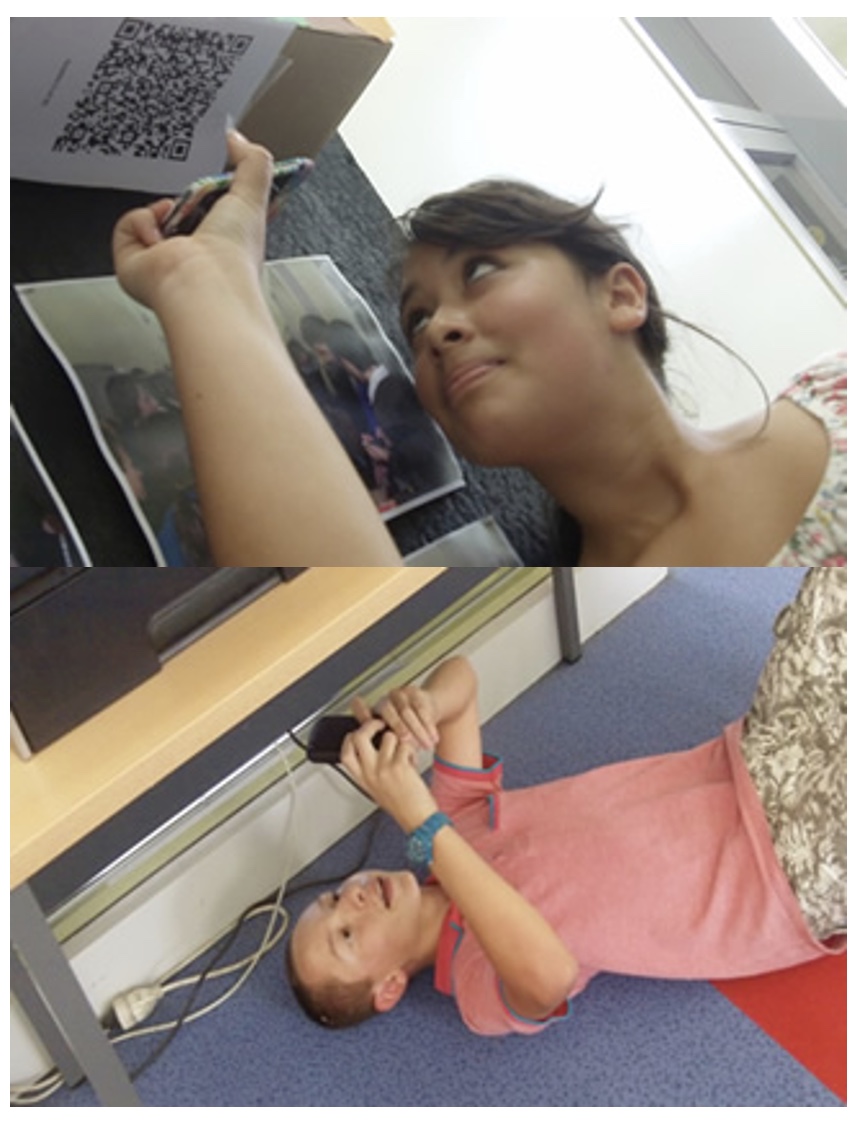
1. Arrange students into groups. Each group needs at least ONE person who has a mobile device.
2. If their phone camera doesn't automatically detect and decode QR codes, ask students to
4. Cut them out and place them around your class / school.
1. Give each group a clipboard and a piece of paper so they can write down the decoded questions and their answers to them.
2. Explain to the students that the codes are hidden around the school. Each team will get ONE point for each question they correctly decode and copy down onto their sheet, and a further TWO points if they can then provide the correct answer and write this down underneath the question.
3. Away they go! The winner is the first team to return with the most correct answers in the time available. This could be within a lesson, or during a lunchbreak, or even over several days!
4. A detailed case study in how to set up a successful QR Scavenger Hunt using this tool can be found here.
Question | Answer |
| 1. 1.What is the outer layer of Earth made of? | hard solid rock | 2. 2.What is the layer under the outer layer of Earth Like? | soft solid rock | 3. 3. The outer layer of earth is one solid piece or broken into pieces? | broken into pieces | 4. 4. The pieces of the outer layer of earth are called ________________. | tectonic plates | 5. 5. The tectonic plates are still or always moving? | Always moving | 6. 6. The tectonic plates are always moving fast or slow | slow | 7. 7. The tectonic plates can move because _________________. | the mantle is moving | 8. 8. Where two tectonic plates meet, When plates move apart it is a ____BLANK____________ plate boundary | divergent | 9. 9. When plates move together it is a .___BLANK_________________ plate boundary | convergent | 10. 10. At a divergent boundary, crust is __________________________ | created | 11. 11. At a convergent boundary, crust is ___________________________ | destroyed | 12. 12. A mid ocean ridge hqppens at a _____________B________________ | divergent boundary | 13. 13. A trench happens at a ______BLANK____________________________ | convergent boundary | 14. 14. I can't feel the tectonic plates moving because they are moving so _____________. | slow | 15. 15. Continents float on top of ____BLANK_____________________(the ocean or the mantle) | the mantle | 16. 16. If continents are farther apart, it is because there was a _____BLANK__________ boundary and the plates moved away from each other on top of the ___BLANK___________________(mantle or ocean) | divergent/mantle | 17. 17. If the same fossil was found on different continents, I can make a theory that_____BLANK__________________ | the continents used to be connected | 18. 18. Wegener noticed that the edges of the continents matched up similar to how the pieces of a ________________BLANK____ fit. | puzzle | 19. 19. Wegener noticed that mountains on different continents had the __BLANK________________ shape and type of rocks | same | 20. 20. Wegener's theory was not a fact because noone______________ | observed it | 21. 21. Wegener theory is trustworthy because it has a lot of ____BLANK___________ | evidence | 22. 22. Which is true- Volcanoes and Earthquakes cause plate movement or Plate movement causes earthquakes | plate movement causes earthquakes | 23. 23. If two continents are closer together than they were 100 million years ago, then the continents were on different plates at a ___BLANK____ boundary, and the plates moved towards eachother on top of the (ocean/mantle) | convergent/mantle | 24. 24. It shows the inside of something. | cross section | 25. 25. under the ocean is ___BLANK____(sand, solid rock, dirt) | solid rock | 26. 26. Under continents is ___BLANK_______(sand, ocean, solid rock) | solid rock |

Question 1 (of 26)
Question 2 (of 26)
Question 3 (of 26)
Question 4 (of 26)
Question 5 (of 26)
Question 6 (of 26)
Question 7 (of 26)
Question 8 (of 26)
Question 9 (of 26)
Question 10 (of 26)
Question 11 (of 26)
Question 12 (of 26)
Question 13 (of 26)
Question 14 (of 26)
Question 15 (of 26)
Question 16 (of 26)
Question 17 (of 26)
Question 18 (of 26)
Question 19 (of 26)
Question 20 (of 26)
Question 21 (of 26)
Question 22 (of 26)
Question 23 (of 26)
Question 24 (of 26)
Question 25 (of 26)
Question 26 (of 26)