
PREMIUM LOGIN
ClassTools Premium membership gives access to all templates, no advertisements, personal branding and many other benefits!
| Username: | ||
| Password: | ||
|
Submit
Cancel
|
||
| Not a member? | ||
PREMIUM LOGIN
ClassTools Premium membership gives access to all templates, no advertisements, personal branding and many other benefits!
| Username: | ||
| Password: | ||
|
Submit
Cancel
|
||
| Not a member? | ||
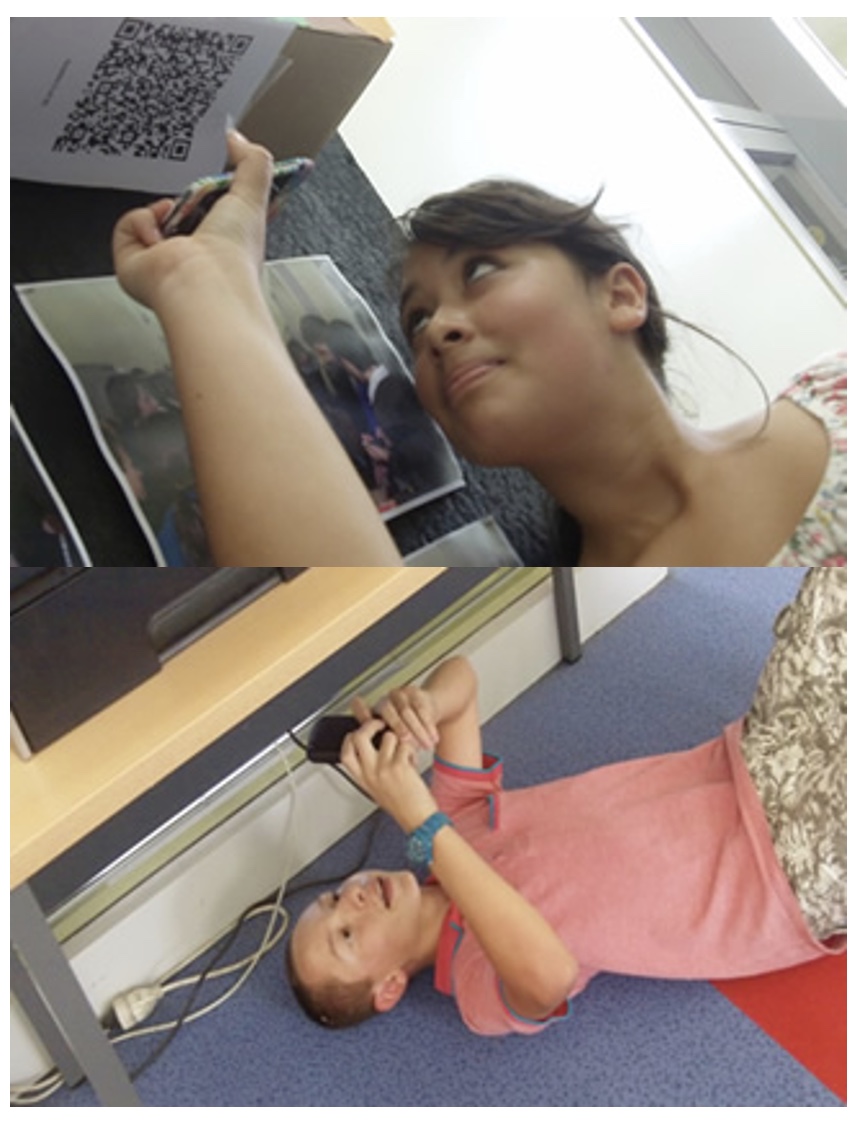
1. Arrange students into groups. Each group needs at least ONE person who has a mobile device.
2. If their phone camera doesn't automatically detect and decode QR codes, ask students to
4. Cut them out and place them around your class / school.
1. Give each group a clipboard and a piece of paper so they can write down the decoded questions and their answers to them.
2. Explain to the students that the codes are hidden around the school. Each team will get ONE point for each question they correctly decode and copy down onto their sheet, and a further TWO points if they can then provide the correct answer and write this down underneath the question.
3. Away they go! The winner is the first team to return with the most correct answers in the time available. This could be within a lesson, or during a lunchbreak, or even over several days!
4. A detailed case study in how to set up a successful QR Scavenger Hunt using this tool can be found here.
Question | Answer |
| 1. Pi is the number of times a circle's diameter will fit around its circumference. | 1 | 2. In 1706 William Jones first gave the Greek letter its current mathematical definition. | 1 | 3. In 1897 the State House of Representatives of Indiana unanimously passed a bill setting pi equal to 16/(sqrt 3), which approximately equals 9.2376!...fail | 1 | 4. It is impossible to 'square the circle'. I.e.: You can't draw a square with the same area as a circle using standard / Euclidean straightedge and compass construction in a finite number of steps. The Greeks were obsessed with trying to do this. | 1 | 5. In 1949 it took ENIAC (Electronic Numerical Integrator and Computer) 70 hours to calculate 2,037 decimal places of Pi. | 1 | 6. In the Greek alphabet, pi is the 16th letter (and 16 is the square of 4). In the English alphabet, p is also the 16th letter, and I is the 9th letter (the square of 3). Add them up (16 +9), and you get 25 (the square of 5). Multiply them (16 x 9), and you get 144 (the square of 12), divide 9/16, and you get .5625 (the square of .75). It’s no wonder that they say, Pi are squared. | 1 | 7. The fraction (22 / 7) is a well-used number for Pi. It is accurate to 0.04025%. | 1 | 8. There is no zero in the first 31 digits of Pi. | 1 | 9. In 1991, the Chudnovsky brothers in New York, using their computer, m zero, calculated pi to two billion two hundred sixty million three hundred twenty one thousand three hundred sixty three digits (2, 260, 321, 363). They halted the program that summer. | 1 | 10. The Pi memory champion is Hiroyoki Gotu, who memorized an amazing 42,000 digits. | 1 | 11. At position 763 there are six nines in a row. This is known as the Feynman Point | 1 | 12. Pi day is celebrated on March 14 at the Exploratorium in San Francisco (March 14 is 3/14) at 1:59 PST, which is 3.14159 | 1 | 13. Here's a pi day limerick: Three point one four one five nine two/ It’s been around forever - its not new /It appears everywhere in here and in there/Its irrational I know but its true! | 1 | 14. In the Star Trek episode “Wolf in the Fold,” Spock foils the evil computer by commanding it to “compute to last digit the value of pi." | 1 | 15. The symbol for pi (π) has been used regularly in its mathematical sense only for the past 250 years. | 1 | 16. Egyptologists and followers of mysticism have been fascinated for centuries by the fact that the Great Pyramid at Giza seems to approximate pi. The vertical height of the pyramid has the same relationship to the perimeter of its base as the radius of a circle has to its circumference. | 1 | 17. If the circumference of the earth were calculated using π rounded to only the ninth decimal place, an error of no more than one quarter of an inch in 25,000 miles would result. | 1 | 18. Pi has been studied by the human race for almost 4,000 years. By 2000 B.C., Babylonians established the constant circle ratio as 3-1/8 or 3.125. The ancient Egyptians arrived at a slightly different value of 3-1/7 or 3.143 | 1 | 19. A Web site titled “The Pi-Search Page” finds a person’s birthday and other well known numbers in the digits of pi. | 1 |

Question 1 (of 19)
Question 2 (of 19)
Question 3 (of 19)
Question 4 (of 19)
Question 5 (of 19)
Question 6 (of 19)
Question 7 (of 19)
Question 8 (of 19)
Question 9 (of 19)
Question 10 (of 19)
Question 11 (of 19)
Question 12 (of 19)
Question 13 (of 19)
Question 14 (of 19)
Question 15 (of 19)
Question 16 (of 19)
Question 17 (of 19)
Question 18 (of 19)
Question 19 (of 19)