
PREMIUM LOGIN
ClassTools Premium membership gives access to all templates, no advertisements, personal branding and many other benefits!
| Username: | ||
| Password: | ||
|
Submit
Cancel
|
||
| Not a member? | ||
PREMIUM LOGIN
ClassTools Premium membership gives access to all templates, no advertisements, personal branding and many other benefits!
| Username: | ||
| Password: | ||
|
Submit
Cancel
|
||
| Not a member? | ||
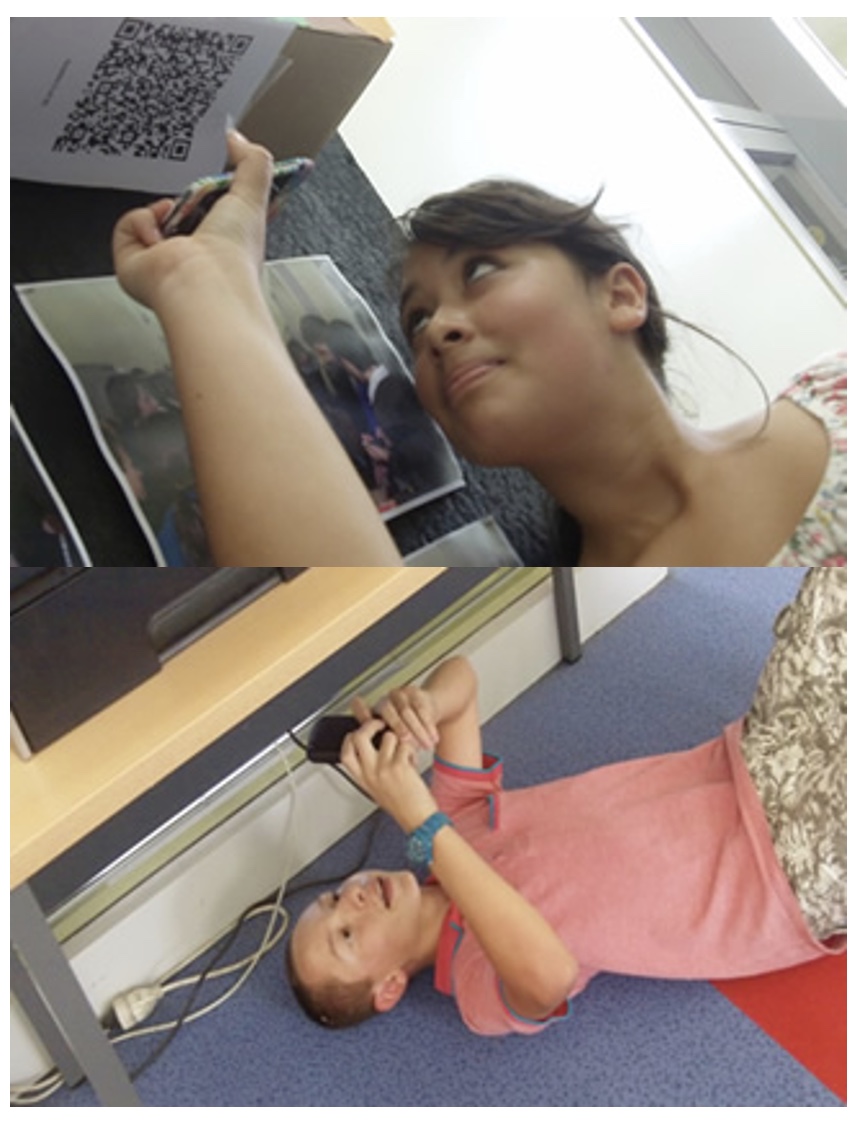
1. Arrange students into groups. Each group needs at least ONE person who has a mobile device.
2. If their phone camera doesn't automatically detect and decode QR codes, ask students to
4. Cut them out and place them around your class / school.
1. Give each group a clipboard and a piece of paper so they can write down the decoded questions and their answers to them.
2. Explain to the students that the codes are hidden around the school. Each team will get ONE point for each question they correctly decode and copy down onto their sheet, and a further TWO points if they can then provide the correct answer and write this down underneath the question.
3. Away they go! The winner is the first team to return with the most correct answers in the time available. This could be within a lesson, or during a lunchbreak, or even over several days!
4. A detailed case study in how to set up a successful QR Scavenger Hunt using this tool can be found here.
Question | Answer |
| 1. Photosynthesis is the process during which plants make their food from sunlight. What are products of the photosynthesis reaction? | sugar or glucose and oxygen | 2. Plants perform both photosynthesis and respiration within their cells. How is cellular respiration different from photosynthesis? | Photosynthesis releases oxygen and cellular respiration releases energy | 3. A freshwater marsh is a type of ecosystem containing organisms such as grasses, birds, and alligators. Decaying material from these organisms sinks to the bottom of the marsh. In which of these places can carbon be found in the marsh? | In the atmosphere, water, living things, and decaying materials | 4. One of the most important processes that takes place within a plant is photosynthesis. What are the reactants of photosynthesis | carbon dioxide, water, and light | 5. Cellular respiration is a critical part of organisms maintaining homeostasis. Describe the purpose of cellular respiration | it releases the energy store in sugars | 6. Explain how carbon moves from a cow to the atmosphere. | the cow breaks down sugars and releases carbon dioxide | 7. Explain the differences between fermentation and cellular respiration | fermentation happens in the absence of oxygen, cellular respiration occurs when there is plenty of oxygen. | 8. Write the equation for photosynthesis. | light energy+6CO2 +6H2O-->C6H12O6+6O2 | 9. Write the equation for cellular respiration. | C6H12O6+6O2--->6CO2 +6H2O + ATP | 10. In what condition is lactic acid fermentation more likely to occur? | fast running | 11. How do consumers obtain nitrogen? | they eat nitrogen compounds in plants | 12. Explain the two stages of photosynthesis. | The first stage involves capturing the energy in sunlight. The second stage (Calvin Cycle) involves using the energy to produce sugars. | 13. Explain the two stages of cellular respiration | Glycolysis which happens in the cytoplasm and releases a little energy and the Krebs Cycle where sugars are converted into ATP in the presence of oxygen. |

Question 1 (of 13)
Question 2 (of 13)
Question 3 (of 13)
Question 4 (of 13)
Question 5 (of 13)
Question 6 (of 13)
Question 7 (of 13)
Question 8 (of 13)
Question 9 (of 13)
Question 10 (of 13)
Question 11 (of 13)
Question 12 (of 13)
Question 13 (of 13)