
PREMIUM LOGIN
ClassTools Premium membership gives access to all templates, no advertisements, personal branding and many other benefits!
| Username: | ||
| Password: | ||
|
Submit
Cancel
|
||
| Not a member? | ||
PREMIUM LOGIN
ClassTools Premium membership gives access to all templates, no advertisements, personal branding and many other benefits!
| Username: | ||
| Password: | ||
|
Submit
Cancel
|
||
| Not a member? | ||
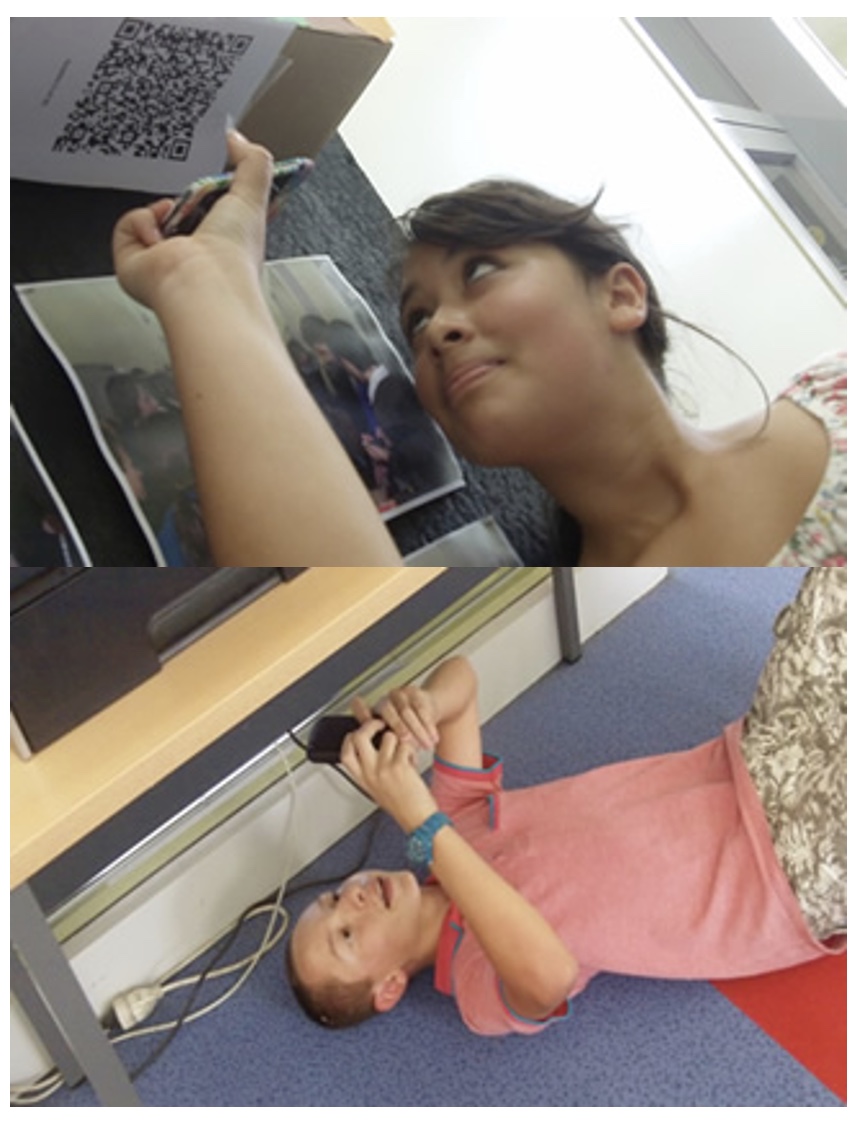
1. Arrange students into groups. Each group needs at least ONE person who has a mobile device.
2. If their phone camera doesn't automatically detect and decode QR codes, ask students to
4. Cut them out and place them around your class / school.
1. Give each group a clipboard and a piece of paper so they can write down the decoded questions and their answers to them.
2. Explain to the students that the codes are hidden around the school. Each team will get ONE point for each question they correctly decode and copy down onto their sheet, and a further TWO points if they can then provide the correct answer and write this down underneath the question.
3. Away they go! The winner is the first team to return with the most correct answers in the time available. This could be within a lesson, or during a lunchbreak, or even over several days!
4. A detailed case study in how to set up a successful QR Scavenger Hunt using this tool can be found here.
Question | Answer |
| 1. Bending the elbow is correctly known as | flexion | 2. The agonist for elbow extension is- | triceps | 3. What movement occurs at the shoulder in the upwards phase of a push up and what muscles are the agonists | flexion, anterior deltoid and pectoralis major | 4. When performing the downwards phase of a squat what movements occur at the hip and knee, what are the agonists for these movements? | flexion, hamstrings for knee, and ilipsoas and quadriceps for hip. | 5. What are the three skill phases in a movement | preparation, execution and follow through | 6. What are the three antagonist muscles for internal shoulder rotation? | infraspinatus, Teresa minor, posterior deltoid. | 7. What is the movement called when you point your toes? And what muscle is the agonist? | Planterflexion and gastrocnemius | 8. What is Newton's first law of motion and how does it relate in a rugby game? | Inertia, larger the mass the bigger inertia an object has in rugby this could be a forward/prop has larger interim making them hard to stop. | 9. What is newtons 2nd law? | F=M times A, | 10. What is the 3rd law and how does it relate in rugby? | action/reaction could be ground force. You apply to the ground and it applies equal and opposite force back | 11. What are th 6 principles of projectile motion | gravity,air resistance, spin, angle, speed and heaight of release. |

Question 1 (of 11)
Question 2 (of 11)
Question 3 (of 11)
Question 4 (of 11)
Question 5 (of 11)
Question 6 (of 11)
Question 7 (of 11)
Question 8 (of 11)
Question 9 (of 11)
Question 10 (of 11)
Question 11 (of 11)