
PREMIUM LOGIN
ClassTools Premium membership gives access to all templates, no advertisements, personal branding and many other benefits!
| Username: | ||
| Password: | ||
|
Submit
Cancel
|
||
| Not a member? | ||
PREMIUM LOGIN
ClassTools Premium membership gives access to all templates, no advertisements, personal branding and many other benefits!
| Username: | ||
| Password: | ||
|
Submit
Cancel
|
||
| Not a member? | ||
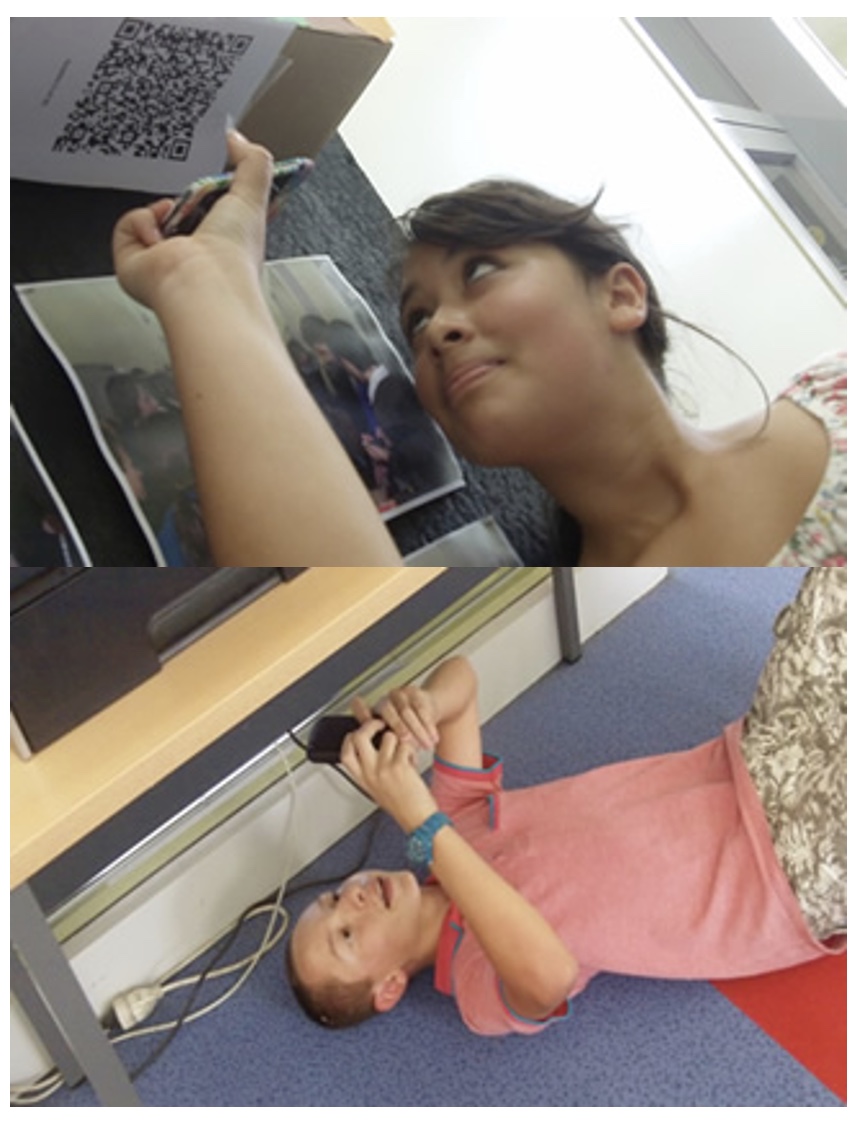
1. Arrange students into groups. Each group needs at least ONE person who has a mobile device.
2. If their phone camera doesn't automatically detect and decode QR codes, ask students to
4. Cut them out and place them around your class / school.
1. Give each group a clipboard and a piece of paper so they can write down the decoded questions and their answers to them.
2. Explain to the students that the codes are hidden around the school. Each team will get ONE point for each question they correctly decode and copy down onto their sheet, and a further TWO points if they can then provide the correct answer and write this down underneath the question.
3. Away they go! The winner is the first team to return with the most correct answers in the time available. This could be within a lesson, or during a lunchbreak, or even over several days!
4. A detailed case study in how to set up a successful QR Scavenger Hunt using this tool can be found here.
Question | Answer |
| 1. What was Robert Hooke's contribution to the study of cells? | He was the first to see the actual "cell" | 2. What was Leeuwenhoek the first to see? | Living cells | 3. What are the 3 main parts of cell theory? | All living things are made of cells; Cells are the basic unit of structure and function for an organism;Cells come only from pre-existing cells | 4. What was Matthais Schleiden's contribution to cell theory? | All plants are composed of cells | 5. What was Theodor Schwann's contribution to the study of cells? | All animals are composed of cells | 6. What was Rudolf Virchow's contribution to cell theory? | All cells come from preexisting cells | 7. List 8 characteristics that all living things share? | 8. What does the diversity in cell shapes reflect? | 9. What is the cell's outer boundary called and what is it's function? | Acts as a barrier and regulates entry/exit | 10. What is the difference between cytoplasm and cytosol? | cytoplasm includes everything; cytosol is just the fluid | 11. What is the membrane bound structure that contains the cell's DNA? | Nucleus | 12. Explain the difference between eukaryotes and prokaryotes and give an example of each. | People and bacteria | 13. What are the two domains of Prokaryotes? | Archae and Bacteria | 14. What is a colonial organism? | A group of genetically identical cells that live together as a group | 15. List the levels of organization from cell to organism. | cell, tissue, organ, organ system, organism | 16. What are the three main parts of a eukaryotic cell? | 17. Draw and label a phospholipid bilayer. | 18. What is the purpose of integral proteins?Give two examples of integral proteins. | 19. What is the purpose of the nuclear envelope? | 20. What happens inside the nucleolus? | Ribosomes are made | 21. What is the function the mitochondria? | Energy | 22. What do mitochondria contain that is very different from other organelles? | 23. Which organelle is responsible for the building of proteins? | 24. What is the difference is the structure and function of smooth and rough endoplasmic reticulum? | 25. What is the task of the Golgi apparatus? | 26. List 3 types of vesicles and their tasks. | 27. Describe two functions of the cytoskeleton. | 28. Describe the difference between cilia and flagella. | 29. Make a venn diagram comparing plant and animal cells | 30. How is the cell wall different from the cell membrane in function? | 31. What is the function of chloroplasts? | 32. Which organelle in an animal cell is the chloroplast most like; why? | 33. Name 3 functions of plastids? |

Question 1 (of 33)
Question 2 (of 33)
Question 3 (of 33)
Question 4 (of 33)
Question 5 (of 33)
Question 6 (of 33)
Question 7 (of 33)
Question 8 (of 33)
Question 9 (of 33)
Question 10 (of 33)
Question 11 (of 33)
Question 12 (of 33)
Question 13 (of 33)
Question 14 (of 33)
Question 15 (of 33)
Question 16 (of 33)
Question 17 (of 33)
Question 18 (of 33)
Question 19 (of 33)
Question 20 (of 33)
Question 21 (of 33)
Question 22 (of 33)
Question 23 (of 33)
Question 24 (of 33)
Question 25 (of 33)
Question 26 (of 33)
Question 27 (of 33)
Question 28 (of 33)
Question 29 (of 33)
Question 30 (of 33)
Question 31 (of 33)
Question 32 (of 33)
Question 33 (of 33)