
PREMIUM LOGIN
ClassTools Premium membership gives access to all templates, no advertisements, personal branding and many other benefits!
| Username: | ||
| Password: | ||
|
Submit
Cancel
|
||
| Not a member? | ||
PREMIUM LOGIN
ClassTools Premium membership gives access to all templates, no advertisements, personal branding and many other benefits!
| Username: | ||
| Password: | ||
|
Submit
Cancel
|
||
| Not a member? | ||
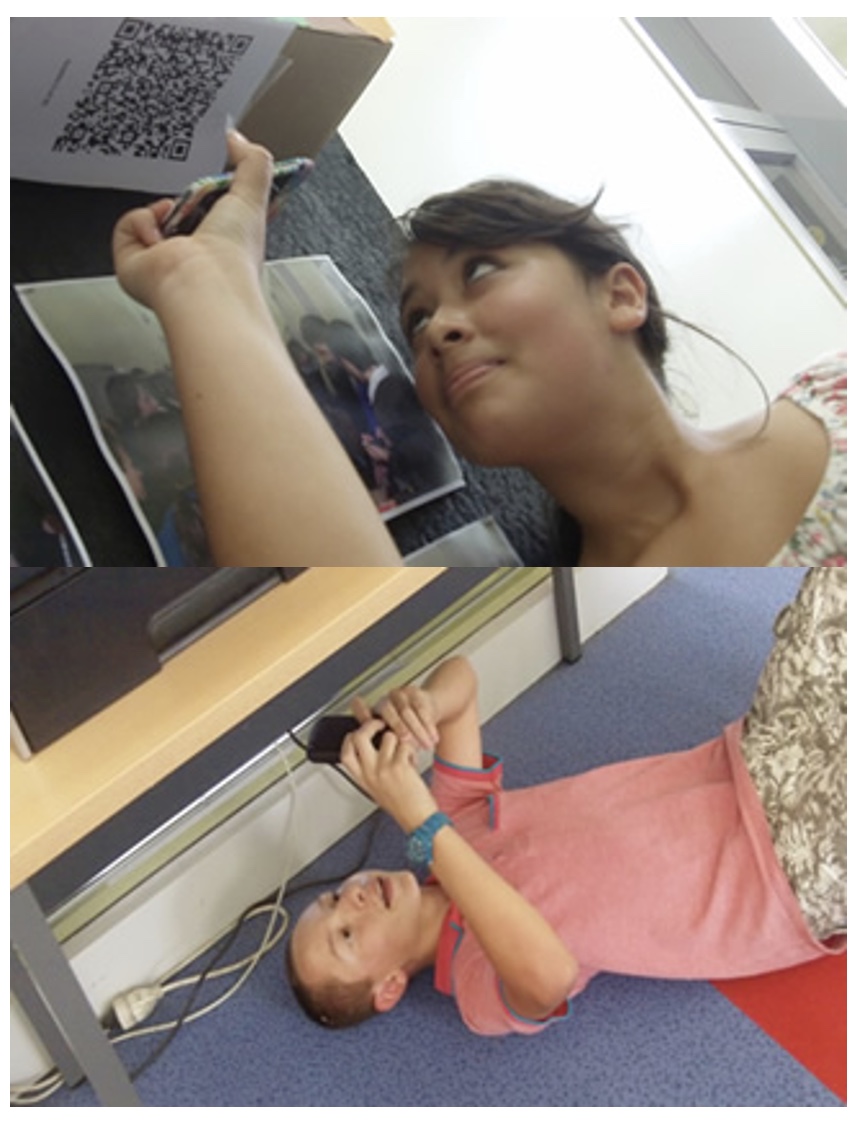
1. Arrange students into groups. Each group needs at least ONE person who has a mobile device.
2. If their phone camera doesn't automatically detect and decode QR codes, ask students to
4. Cut them out and place them around your class / school.
1. Give each group a clipboard and a piece of paper so they can write down the decoded questions and their answers to them.
2. Explain to the students that the codes are hidden around the school. Each team will get ONE point for each question they correctly decode and copy down onto their sheet, and a further TWO points if they can then provide the correct answer and write this down underneath the question.
3. Away they go! The winner is the first team to return with the most correct answers in the time available. This could be within a lesson, or during a lunchbreak, or even over several days!
4. A detailed case study in how to set up a successful QR Scavenger Hunt using this tool can be found here.
Question | Answer |
| 1. 1. Group of men in the colonies who joined together to protest the Stamp Act and later organized the Boston Tea Party | Sons of Liberty | 2. 2. He was considered to be the father of the Constitution because he took such good notes at the convention in Philadelphia | James Madison | 3. 3. Free black sailor killed at the Boston Massacre | Crispus Attucks | 4. 4. 1st major battle in the Revolutionary War | Bunker Hill | 5. 5. Leader of the Continental army during the Revolutionary War | George Washington | 6. 6. Large estate farmed by many workers and devoted to one main cash crop | plantation | 7. 7. In terms of population counts for representation in Congress, a compromise was reached where slaves would be counted as what fraction of a person? | 3/5ths | 8. 8. A(n)____ is a change or addition to the Constitution. | amendment | 9. 9. The Great _____ was a religious revival | Awakening | 10. 10. This act said the British soldiers could be housed in colonists’ homes. What was it? | Quartering Act | 11. 11. These were written to support passage of the Constitution by Alexander Hamilton, James Madison, and John Jay | Federalist Papers | 12. 12. The first 10 amendments to the Constitution are also called | The Bill of Rights | 13. 13. Gutenberg invented this which made the publication of books faster and cheaper. Since more people had access to books, more people learned how to read | the printing press | 14. 14. Marbury v Madison established the Supreme Court’s power of ______ which is the power of the Supreme Court to examine the constitutionality of laws passed by Congress | judicial review | 15. 15. Where was the shot heard round the world fired at? | Lexington and Concord | 16. 16. The place where George Washington trained his troops during a harsh and brutal winter | Valley Forge | 17. 17. Congress can make any laws it deems necessary to carry out laws. It is also called the Necessary and Proper Clause. It allows Congress to stretch its powers. This is called what? | the Elastic Clause | 18. 18. He was a Frenchman who, in his book The Spirit of the Laws, came up with the 3 branches of government and separation of powers | Montesquieu | 19. 19. He began a movement to change the Catholic Church and stop some of their abuses. It grew into the Protestant Reformation | Martin Luther | 20. 20. What was the first cash crop to be grown on plantations in the English colonies? | Tobacco | 21. 21. The type of government where powers are divided between the national government and the state government. | federalism | 22. 22. The Renaissance- a renewed interest in learning- began where? | Italy | 23. 23. “We the People” are the first 3 words of the Constitution. These words express that the people rule this country. What is this concept- the people rule- also known as? | popular sovereignty | 24. 24. The swapping of goods (crops, plants, animals, and diseases) between Europe and the Americas in the late 1400s and early 1500s | Columbian Exchange | 25. 25. What disease carried by the Europeans killed many Native Americans? | smallpox | 26. 26. European Christians travelled to the Holy Land to take back the land from the Muslims. This series of wars were better known as what? | The Crusades | 27. 27. What was the name of the first American settlement in 1565 by Europeans? | St. Augustine | 28. 28. A tax on glass, lead, paper, tea, and paint. What was it called? | Townshend Acts | 29. 29. Volunteer soldiers trained to be ready at a moment’s notice. Paul Revere, who rode to warn the British were coming, was one of these. | Minutemen | 30. 30. The first English settlement in the New World established by Sir Walter Raleigh. | Roanoke | 31. 31. Spanish explorers (Balboa, de Leon, Cortez, Pizarro, DeSoto) who searched for “Gold, God and Glory” were called… | conquistadors | 32. 32. Our first written plan of government, before the Constitution, was called what? | Articles of Confederation | 33. 33. Who wrote the words the “Star Spangled Banner” which later became our national anthem while watching the British bomb Fort McHenry during the war of 1812? | Francis Scott Key | 34. 34. Spanish conquistador who conquered the Aztecs? | Cortez | 35. 35. The opening paragraph of the Constitution tells its purpose and outlines the goals of the Constitution. What is this opening paragraph called? | the Preamble | 36. 36. He wrote these lines “We hold these truths to be self-evident, that all men are created equal…”- these are the first lines of the Declaration of Independence? | Thomas Jefferson | 37. 37. What was the legislature in the Virginia colony called? (the first representative government in the New World) | House of Burgesses | 38. 38. The act of seizing men from a ship or village and forcing them to serve in a foreign navy; was a cause of the War of 1812 | Impressment | 39. 39. Acted as a government for the colonies | 2nd Continental Congress | 40. 40. The French came to the new world to do what? | trap fur |

Question 1 (of 40)
Question 2 (of 40)
Question 3 (of 40)
Question 4 (of 40)
Question 5 (of 40)
Question 6 (of 40)
Question 7 (of 40)
Question 8 (of 40)
Question 9 (of 40)
Question 10 (of 40)
Question 11 (of 40)
Question 12 (of 40)
Question 13 (of 40)
Question 14 (of 40)
Question 15 (of 40)
Question 16 (of 40)
Question 17 (of 40)
Question 18 (of 40)
Question 19 (of 40)
Question 20 (of 40)
Question 21 (of 40)
Question 22 (of 40)
Question 23 (of 40)
Question 24 (of 40)
Question 25 (of 40)
Question 26 (of 40)
Question 27 (of 40)
Question 28 (of 40)
Question 29 (of 40)
Question 30 (of 40)
Question 31 (of 40)
Question 32 (of 40)
Question 33 (of 40)
Question 34 (of 40)
Question 35 (of 40)
Question 36 (of 40)
Question 37 (of 40)
Question 38 (of 40)
Question 39 (of 40)
Question 40 (of 40)