
PREMIUM LOGIN
ClassTools Premium membership gives access to all templates, no advertisements, personal branding and many other benefits!
| Username: | ||
| Password: | ||
|
Submit
Cancel
|
||
| Not a member? | ||
PREMIUM LOGIN
ClassTools Premium membership gives access to all templates, no advertisements, personal branding and many other benefits!
| Username: | ||
| Password: | ||
|
Submit
Cancel
|
||
| Not a member? | ||
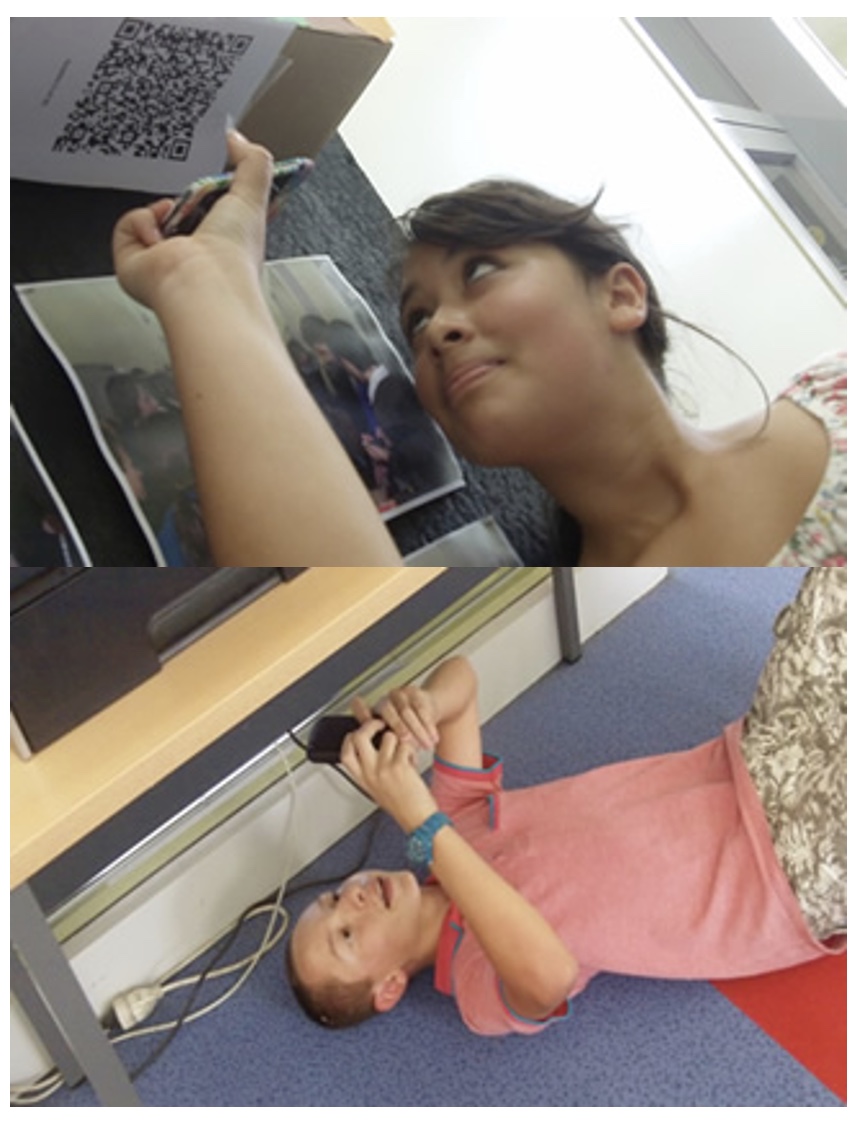
1. Arrange students into groups. Each group needs at least ONE person who has a mobile device.
2. If their phone camera doesn't automatically detect and decode QR codes, ask students to
4. Cut them out and place them around your class / school.
1. Give each group a clipboard and a piece of paper so they can write down the decoded questions and their answers to them.
2. Explain to the students that the codes are hidden around the school. Each team will get ONE point for each question they correctly decode and copy down onto their sheet, and a further TWO points if they can then provide the correct answer and write this down underneath the question.
3. Away they go! The winner is the first team to return with the most correct answers in the time available. This could be within a lesson, or during a lunchbreak, or even over several days!
4. A detailed case study in how to set up a successful QR Scavenger Hunt using this tool can be found here.
Question | Answer |
| 1. The numeric age of a layer of rocks or fossils. It can be determined using radiometric dating. | Absolute age | 2. | 3. The second largest division of time in the Geologic Time Scale, e.g., Mesozoic. | Era | 4. | 5. The largest division of time in the Geologic Time Scale, e.g., Phanerozoic. | Eon | 6. | 7. The animals of a given region or period. | Fauna | 8. | 9. The plants of a given region or period. | Flora | 10. | 11. All of the fossils that have existed throughout Earth’s history, whether they are in the ground or are in a museum. | Fossil Record | 12. | 13. A vertical timeline representing events in Earth’s history. It is divided into blocks of time that represent great changes in Earth’s biodiversity. | Geologic Time Scale | 14. | 15. The formation of new rock layers on top of older ones. This allows us to determine the relative age of rocks and fossils. \"Super\" refers to over and \"position\" refers to place. | Law of Superposition | 16. | 17. The third largest division of time in the Geologic Time Scale, e.g., Cretaceous. | Period | 18. | 19. A method used to determine the absolute age of a rock by using the rock\'s chemistry. | Radiometric dating | 20. | 21. The age of a rock layer, or the fossils it contains, compared to other layers. | Relative age |

Question 1 (of 21)
Question 2 (of 21)
Question 3 (of 21)
Question 4 (of 21)
Question 5 (of 21)
Question 6 (of 21)
Question 7 (of 21)
Question 8 (of 21)
Question 9 (of 21)
Question 10 (of 21)
Question 11 (of 21)
Question 12 (of 21)
Question 13 (of 21)
Question 14 (of 21)
Question 15 (of 21)
Question 16 (of 21)
Question 17 (of 21)
Question 18 (of 21)
Question 19 (of 21)
Question 20 (of 21)
Question 21 (of 21)