
PREMIUM LOGIN
ClassTools Premium membership gives access to all templates, no advertisements, personal branding and many other benefits!
| Username: | ||
| Password: | ||
|
Submit
Cancel
|
||
| Not a member? | ||
PREMIUM LOGIN
ClassTools Premium membership gives access to all templates, no advertisements, personal branding and many other benefits!
| Username: | ||
| Password: | ||
|
Submit
Cancel
|
||
| Not a member? | ||
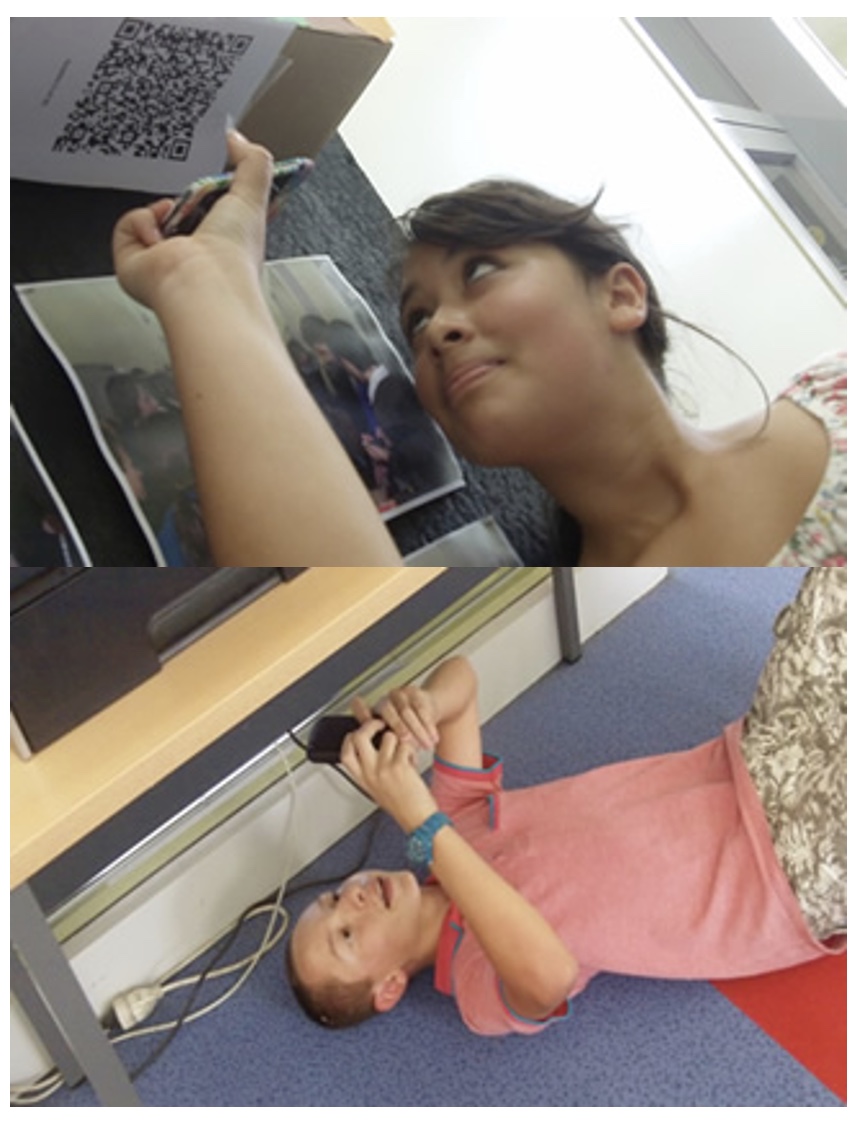
1. Arrange students into groups. Each group needs at least ONE person who has a mobile device.
2. If their phone camera doesn't automatically detect and decode QR codes, ask students to
4. Cut them out and place them around your class / school.
1. Give each group a clipboard and a piece of paper so they can write down the decoded questions and their answers to them.
2. Explain to the students that the codes are hidden around the school. Each team will get ONE point for each question they correctly decode and copy down onto their sheet, and a further TWO points if they can then provide the correct answer and write this down underneath the question.
3. Away they go! The winner is the first team to return with the most correct answers in the time available. This could be within a lesson, or during a lunchbreak, or even over several days!
4. A detailed case study in how to set up a successful QR Scavenger Hunt using this tool can be found here.
Question | Answer |
| 1. What do arrows in a food chain show? | flow/transfer of energy | 2. Any biotic or abiotic resource in the environment that causes population size to decrease | Limiting factor | 3. What does the term run-off mean? | pollutions, sewage, and fertilizers have made their way into the ocean | 4. When organisms work together toward a common goal | cooperation | 5. _________ is when two organisms use the same resources at the same time. | competition | 6. living factors in an ecosystem | biotic factors | 7. what are some ways that oceans are used by humans? | fishing, mining, transportation, and recreation | 8. What is overfishing? | catching more fish than the ecosystem can replenish | 9. what is the amount of energy that is passed to the next trophic level? | 10% | 10. What is the original source of almost all the energy most ecosystems? | sun | 11. Diagram which shows how energy moves through an entire ecosystem | food web | 12. In a food pyramid, which organism gets the most energy from the sun? | producers | 13. Why is ocean pollution a global problem? | because ocean currents affect global weather patterns | 14. What trophic level contains the greatest amount of energy? | producers, first trophic level | 15. What is the difference between obmivore and carnivore? | Omnivores eat both plants and animals, carnivores eat only other animals. | 16. What is an example of parasitism? | Flea and god, human and tick | 17. As energy moves up a food chain, the energy available always___? | decreases | 18. What is an example of mutualism? | flower and bee | 19. A hawk that eats a mouse that eats a cricket that feeds on grass is a _____-level______ | Third level consumer | 20. Branch of biology that deals with interactions among organisms and their environment | ecology | 21. Organism that obtains nutrients by breaking down dead and decaying organisms into smaller forms of matter | decomposers | 22. What is a population? | Group of organisms of the same species in the same ecosystem | 23. What is the difference between population and community? | a population is always the same species; a community is made up of different populations | 24. What is the difference between a community and an ecosystem? | a community only includes organisms; ecosystems include interactions between living and non-living organisms | 25. What is an example of commensalism? | shark and remora | 26. Compare and contrast food chains and food webs. | Food webs show interconnected food chains | 27. An ecosystem supports 5,000 tuna. This is an example of a ______ | carrying capacity |

Question 1 (of 27)
Question 2 (of 27)
Question 3 (of 27)
Question 4 (of 27)
Question 5 (of 27)
Question 6 (of 27)
Question 7 (of 27)
Question 8 (of 27)
Question 9 (of 27)
Question 10 (of 27)
Question 11 (of 27)
Question 12 (of 27)
Question 13 (of 27)
Question 14 (of 27)
Question 15 (of 27)
Question 16 (of 27)
Question 17 (of 27)
Question 18 (of 27)
Question 19 (of 27)
Question 20 (of 27)
Question 21 (of 27)
Question 22 (of 27)
Question 23 (of 27)
Question 24 (of 27)
Question 25 (of 27)
Question 26 (of 27)
Question 27 (of 27)