
PREMIUM LOGIN
ClassTools Premium membership gives access to all templates, no advertisements, personal branding and many other benefits!
| Username: | ||
| Password: | ||
|
Submit
Cancel
|
||
| Not a member? | ||
PREMIUM LOGIN
ClassTools Premium membership gives access to all templates, no advertisements, personal branding and many other benefits!
| Username: | ||
| Password: | ||
|
Submit
Cancel
|
||
| Not a member? | ||
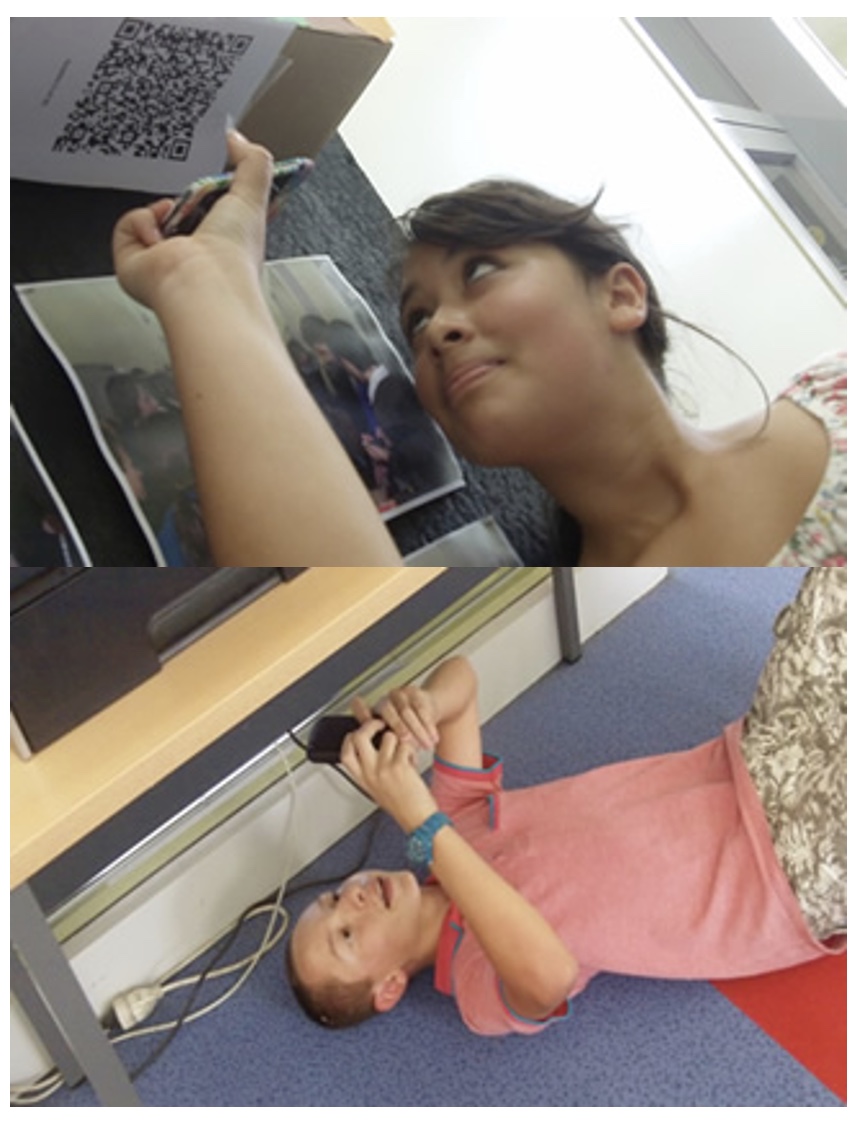
1. Arrange students into groups. Each group needs at least ONE person who has a mobile device.
2. If their phone camera doesn't automatically detect and decode QR codes, ask students to
4. Cut them out and place them around your class / school.
1. Give each group a clipboard and a piece of paper so they can write down the decoded questions and their answers to them.
2. Explain to the students that the codes are hidden around the school. Each team will get ONE point for each question they correctly decode and copy down onto their sheet, and a further TWO points if they can then provide the correct answer and write this down underneath the question.
3. Away they go! The winner is the first team to return with the most correct answers in the time available. This could be within a lesson, or during a lunchbreak, or even over several days!
4. A detailed case study in how to set up a successful QR Scavenger Hunt using this tool can be found here.
Question | Answer |
| 1. Small openings called ____________________ allow carbon dioxide to enter a leaf | stomata | 2. Plants make their own food using energy that comes from the ____________________ | sun | 3. Almost all living things depend on the process of ____________________ to supply them with the energy they need | photosynthesis | 4. | 5. During respiration, molecules of ____________________ are first broken down in the cytoplasm | glucose | 6. Energy from glucose is released in the process of ____________________ | respiration | 7. The main difference between respiration and fermentation is that respiration uses ____________________ to obtain energy from food | oxygen | 8. The process in which yeasts break down sugars and produce carbon dioxide and alcohol is called ____________________ fermentation | alcoholic | 9. The products of respiration are energy, carbon dioxide, and ____________________ | water | 10. A cell’s nucleus divides to form two identical nuclei during the stage of the cell cycle known as ____________________ | mitosis | 11. The final stage of the cell cycle, during which the cytoplasm divides, is called ____________________ | cytokinesis | 12. The sides of the DNA ladder are made of molecules of deoxyribose and ____________________ | phosphate | 13. | 14. A change in DNA is called a(n) ____________________ | mutation | 15. When a mutation disturbs the cell cycle, the result can be ____________________, or uncontrolled cell division | cancer | 16. | 17. The most common treatments for cancer include drugs, surgery, and ____________________ | radiation | 18. Cancer can spread when cells break off a tumor and are carried through the body by the ____________________ | bloodstream | 19. A form of treatment in which drugs destroy cancer cells is called ____________________ | chemotherapy | 20. Many cancer deaths are caused by unhealthful diets or by the use of ____________________ | tobacco | 21. Chloroplasts contain a pigment called ____________________ that captures the energy in light | chlorophyll | 22. During cytokinesis in plant cells, a(n) ____________________ forms across the middle of the cell | cell plate | 23. ____________________ is the process by which a cell makes an exact copy of its DNA | Replication |

Question 1 (of 23)
Question 2 (of 23)
Question 3 (of 23)
Question 4 (of 23)
Question 5 (of 23)
Question 6 (of 23)
Question 7 (of 23)
Question 8 (of 23)
Question 9 (of 23)
Question 10 (of 23)
Question 11 (of 23)
Question 12 (of 23)
Question 13 (of 23)
Question 14 (of 23)
Question 15 (of 23)
Question 16 (of 23)
Question 17 (of 23)
Question 18 (of 23)
Question 19 (of 23)
Question 20 (of 23)
Question 21 (of 23)
Question 22 (of 23)
Question 23 (of 23)