
PREMIUM LOGIN
ClassTools Premium membership gives access to all templates, no advertisements, personal branding and many other benefits!
| Username: | ||
| Password: | ||
|
Submit
Cancel
|
||
| Not a member? | ||
PREMIUM LOGIN
ClassTools Premium membership gives access to all templates, no advertisements, personal branding and many other benefits!
| Username: | ||
| Password: | ||
|
Submit
Cancel
|
||
| Not a member? | ||
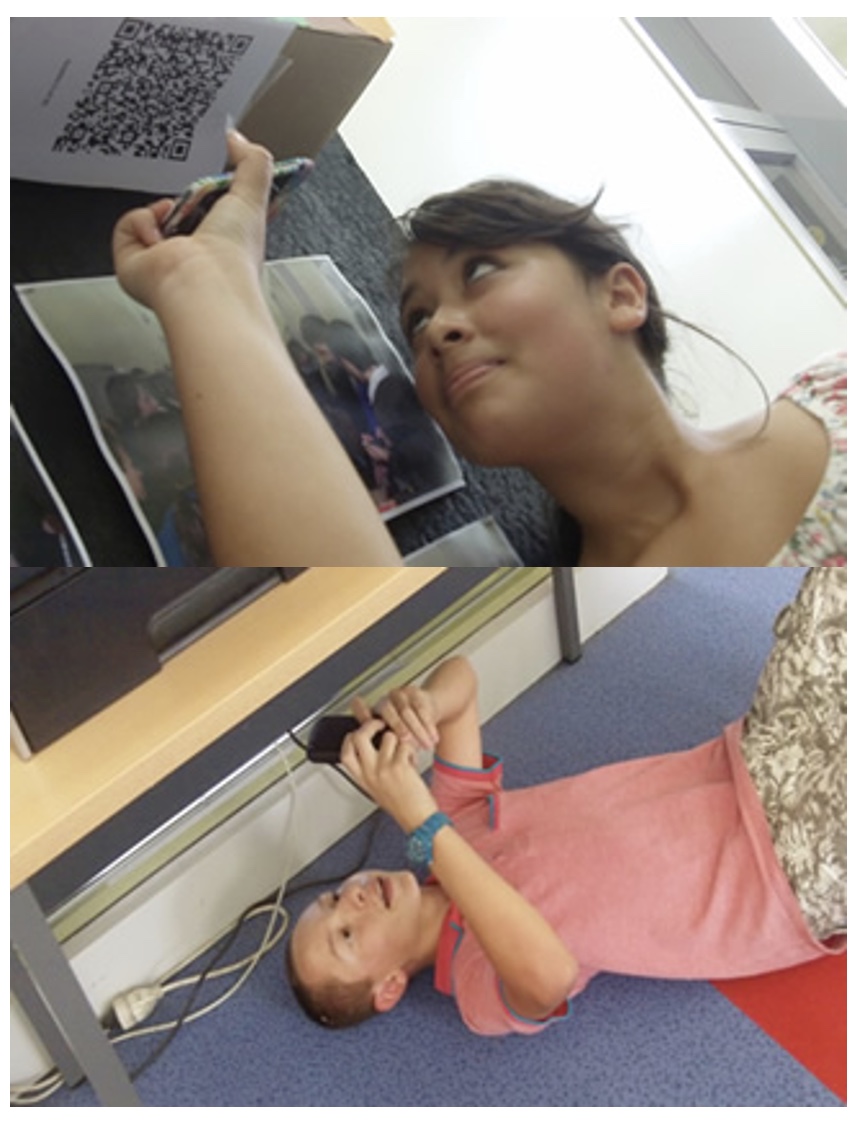
1. Arrange students into groups. Each group needs at least ONE person who has a mobile device.
2. If their phone camera doesn't automatically detect and decode QR codes, ask students to
4. Cut them out and place them around your class / school.
1. Give each group a clipboard and a piece of paper so they can write down the decoded questions and their answers to them.
2. Explain to the students that the codes are hidden around the school. Each team will get ONE point for each question they correctly decode and copy down onto their sheet, and a further TWO points if they can then provide the correct answer and write this down underneath the question.
3. Away they go! The winner is the first team to return with the most correct answers in the time available. This could be within a lesson, or during a lunchbreak, or even over several days!
4. A detailed case study in how to set up a successful QR Scavenger Hunt using this tool can be found here.
Question | Answer |
| 1. This object is used during electrophoresis to measure very small quanitities of liquid | micropipette | 2. This object is used to determine concentration using light | spectrophotometer | 3. This tool is used to measure something in grams | scale | 4. This tool is used to hold something too hot for bare hands | hot hand | 5. This is used to disinfect lab equipment and sterilize agar | autoclave | 6. This is used during PCR to maintain a sterile environment | PCR Workstation | 7. This is used to create a sterile environment during culturing and to mitigate fumes | Hood | 8. This is used to spread a bacteria culture | innoculating loop | 9. This is used to create deionized or distilled water | Deionizer | 10. These are used to mix or separate substances at very high speeds | microcentrifuge | 11. These contain deionized water | wash bottles | 12. These hold agarose gels | Electrophoresis trays | 13. These contain agar | petri dishes | 14. This is used during an experiment to keep time | timer | 15. These is used during PCR to manipulate temperature | thermocycler | 16. These are used to incubate chicks | incubator | 17. This is used to grow bacteria quickly | incubator | 18. These are used to magnify images and have two eyepieces | binocular microscope | 19. These are used to magnify images without passing light through the sample | macroscopic microscope | 20. Samples are placed on these and then a coverslip is applied | slides | 21. These are part of your standard PPE | gloves | 22. These are less accurate than graduated cylinders, but measure substances | beaker | 23. Use these to accurately measure liquids | graduated cylinder | 24. Before weighing out materials use one of these to contain them | weigh boat | 25. This cabinet contains all of the flammable materials | flammable cabinet | 26. This cabinet has a tray to contain any acid spills | acid cabinet | 27. These are used to handle small tissue samples during tissue cultures | forceps | 28. Often these are used for sampling and chemical reactions | Test tube | 29. This is where clean glass is placed to dry | drying rack | 30. This is where clean dishes are placed and heated to ensure no bacterial growth | oven | 31. This holds test tubes | Test tube rack | 32. You should use this if you get something in your eye | eyewash station | 33. If there is a fire in the lab you should use this | fire extinguisher | 34. If clothing catches on fire you should wrap someone in this | fire blanket | 35. These are placed on the end of a micropipette | tips | 36. This measures 200 microliters | 20-200 micropipette | 37. This measures 1000 microliters | 100-1000 micropipette |

Question 1 (of 37)
Question 2 (of 37)
Question 3 (of 37)
Question 4 (of 37)
Question 5 (of 37)
Question 6 (of 37)
Question 7 (of 37)
Question 8 (of 37)
Question 9 (of 37)
Question 10 (of 37)
Question 11 (of 37)
Question 12 (of 37)
Question 13 (of 37)
Question 14 (of 37)
Question 15 (of 37)
Question 16 (of 37)
Question 17 (of 37)
Question 18 (of 37)
Question 19 (of 37)
Question 20 (of 37)
Question 21 (of 37)
Question 22 (of 37)
Question 23 (of 37)
Question 24 (of 37)
Question 25 (of 37)
Question 26 (of 37)
Question 27 (of 37)
Question 28 (of 37)
Question 29 (of 37)
Question 30 (of 37)
Question 31 (of 37)
Question 32 (of 37)
Question 33 (of 37)
Question 34 (of 37)
Question 35 (of 37)
Question 36 (of 37)
Question 37 (of 37)