
PREMIUM LOGIN
ClassTools Premium membership gives access to all templates, no advertisements, personal branding and many other benefits!
| Username: | ||
| Password: | ||
|
Submit
Cancel
|
||
| Not a member? | ||
PREMIUM LOGIN
ClassTools Premium membership gives access to all templates, no advertisements, personal branding and many other benefits!
| Username: | ||
| Password: | ||
|
Submit
Cancel
|
||
| Not a member? | ||
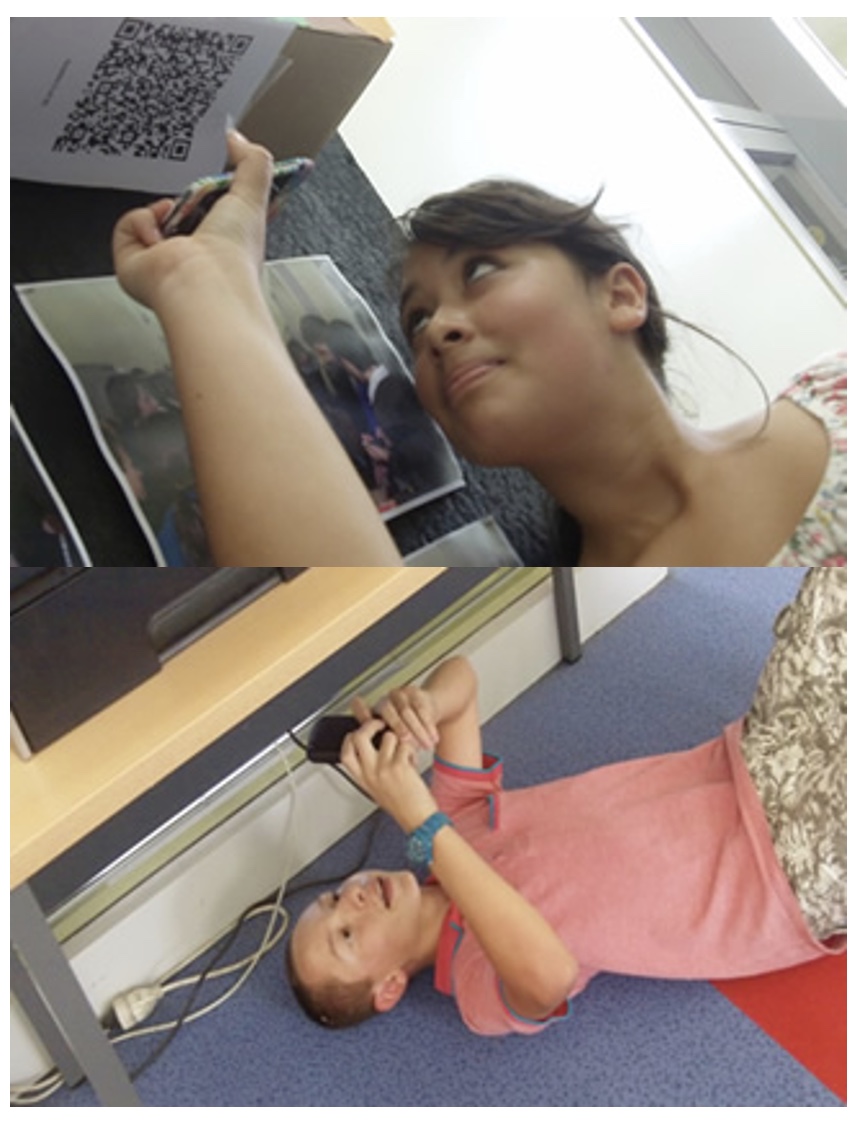
1. Arrange students into groups. Each group needs at least ONE person who has a mobile device.
2. If their phone camera doesn't automatically detect and decode QR codes, ask students to
4. Cut them out and place them around your class / school.
1. Give each group a clipboard and a piece of paper so they can write down the decoded questions and their answers to them.
2. Explain to the students that the codes are hidden around the school. Each team will get ONE point for each question they correctly decode and copy down onto their sheet, and a further TWO points if they can then provide the correct answer and write this down underneath the question.
3. Away they go! The winner is the first team to return with the most correct answers in the time available. This could be within a lesson, or during a lunchbreak, or even over several days!
4. A detailed case study in how to set up a successful QR Scavenger Hunt using this tool can be found here.
Question | Answer |
| 1. What are the types of data identified in the syllabus | primary and secondary, qualitative and quantitative | 2. Outline ethical behaviour | respect, integrity, privacy, bias | 3. What are the 5 research methods | questionnaires, interviews, case studies, observations, literature reviews | 4. What are the steps in interpreting research | presenting research findings, analysing research results, drawing conclusions from research | 5. What are two priority needs for the disabled | health, safety and security | 6. What are the aspects of the services that may impact on ability to access services | opening hours, confidentiality, location, staffing | 7. Outline one equity issue for GLBTI | marriage | 8. What is advocacy | speaking up for a groups needs and concerns | 9. What does advocacy involve | raising awareness, educating, promoting rights | 10. What are the types of social parents | adoption, fostering, step and surrogacy | 11. What are the roles of parents and carers | satisfying needs, building pos relationships, promoting wellbeing | 12. What are preparations for becoming a parent or carer | changing health behaviours, enhancing knowledge and skills, modifying physical environment, organising finances | 13. what characteristics of the dependant can influence parenting and caring roles | age, skills, special needs | 14. What are the types of informal support for parents and carers | relatives, friends, neighbours | 15. What are the styles of parenting and caring | authoritarian, democratic, permissive, negligent | 16. What are the factors affecting access to and acceptance of technology | age, culture, ed, SES, disability, geo loco, gender, religion | 17. Technology and the community includes | ed and training, transport and travel, health and med, food, leisure and ent. | 18. What are issues related to technology | privacy and safety, security of information, accuracy of info, info overload, copyright |

Question 1 (of 18)
Question 2 (of 18)
Question 3 (of 18)
Question 4 (of 18)
Question 5 (of 18)
Question 6 (of 18)
Question 7 (of 18)
Question 8 (of 18)
Question 9 (of 18)
Question 10 (of 18)
Question 11 (of 18)
Question 12 (of 18)
Question 13 (of 18)
Question 14 (of 18)
Question 15 (of 18)
Question 16 (of 18)
Question 17 (of 18)
Question 18 (of 18)