
PREMIUM LOGIN
ClassTools Premium membership gives access to all templates, no advertisements, personal branding and many other benefits!
| Username: | ||
| Password: | ||
|
Submit
Cancel
|
||
| Not a member? | ||
PREMIUM LOGIN
ClassTools Premium membership gives access to all templates, no advertisements, personal branding and many other benefits!
| Username: | ||
| Password: | ||
|
Submit
Cancel
|
||
| Not a member? | ||
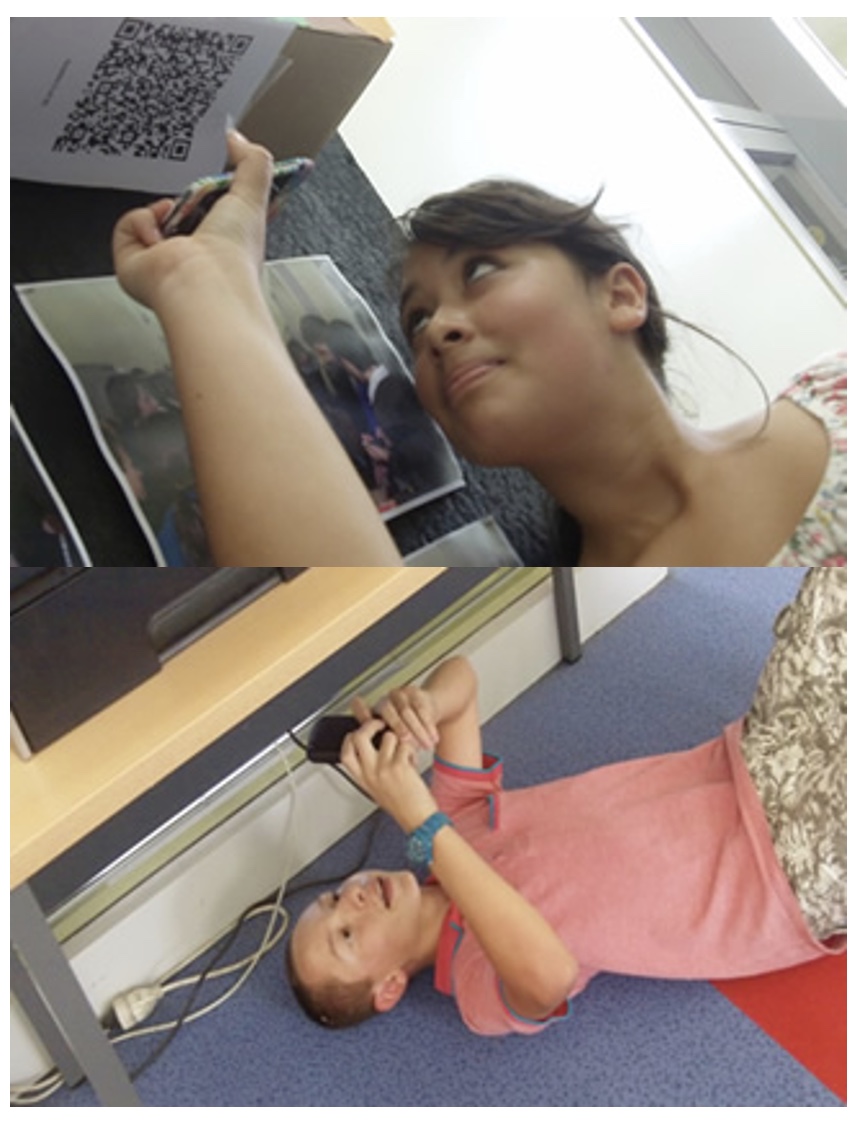
1. Arrange students into groups. Each group needs at least ONE person who has a mobile device.
2. If their phone camera doesn't automatically detect and decode QR codes, ask students to
4. Cut them out and place them around your class / school.
1. Give each group a clipboard and a piece of paper so they can write down the decoded questions and their answers to them.
2. Explain to the students that the codes are hidden around the school. Each team will get ONE point for each question they correctly decode and copy down onto their sheet, and a further TWO points if they can then provide the correct answer and write this down underneath the question.
3. Away they go! The winner is the first team to return with the most correct answers in the time available. This could be within a lesson, or during a lunchbreak, or even over several days!
4. A detailed case study in how to set up a successful QR Scavenger Hunt using this tool can be found here.
Question | Answer |
| 1. An animal without a backbone | invertebrate | 2. An animal that belongs to the phylum Chordata | vetebrate | 3. The process by which plants make their own food | photosynthesis | 4. Plant cells have this structure but animal cells do not | cell walls | 5. Animals must do this to other organisms to get energy | consume | 6. Class of animal that has skin with fur or hair and feeds their young milk | mammals | 7. Class of animal that has skin with feathers, lays eggs, and has a beak | birds | 8. Class of animal that has scales, lays eggs, and does not maintain constant body temperature | reptiles | 9. Class of animal found only in water, has skin with scales, and breathes through gills | fish | 10. Class of animal that has soft skin without scales, lays eggs in water, and lives in the water when young but on land when mature | amphibian | 11. A specialized structure or behavior that helps an organism survive | adaptation | 12. A series of opposing descriptions of basic features of an organism | dichotomous key | 13. The organ system that provides structure and support | skeletal system | 14. The organ system that removes waster from the body | excretory | 15. The body system that breaks down food to be absorbed | digestive | 16. Two organ systems that work together to enable the body to move | skeletal and muscular | 17. The body system that includes bronchi and alveoli | respiratory | 18. The body system with glands that produce hormones | endocrine |

Question 1 (of 18)
Question 2 (of 18)
Question 3 (of 18)
Question 4 (of 18)
Question 5 (of 18)
Question 6 (of 18)
Question 7 (of 18)
Question 8 (of 18)
Question 9 (of 18)
Question 10 (of 18)
Question 11 (of 18)
Question 12 (of 18)
Question 13 (of 18)
Question 14 (of 18)
Question 15 (of 18)
Question 16 (of 18)
Question 17 (of 18)
Question 18 (of 18)