
PREMIUM LOGIN
ClassTools Premium membership gives access to all templates, no advertisements, personal branding and many other benefits!
| Username: | ||
| Password: | ||
|
Submit
Cancel
|
||
| Not a member? | ||
PREMIUM LOGIN
ClassTools Premium membership gives access to all templates, no advertisements, personal branding and many other benefits!
| Username: | ||
| Password: | ||
|
Submit
Cancel
|
||
| Not a member? | ||
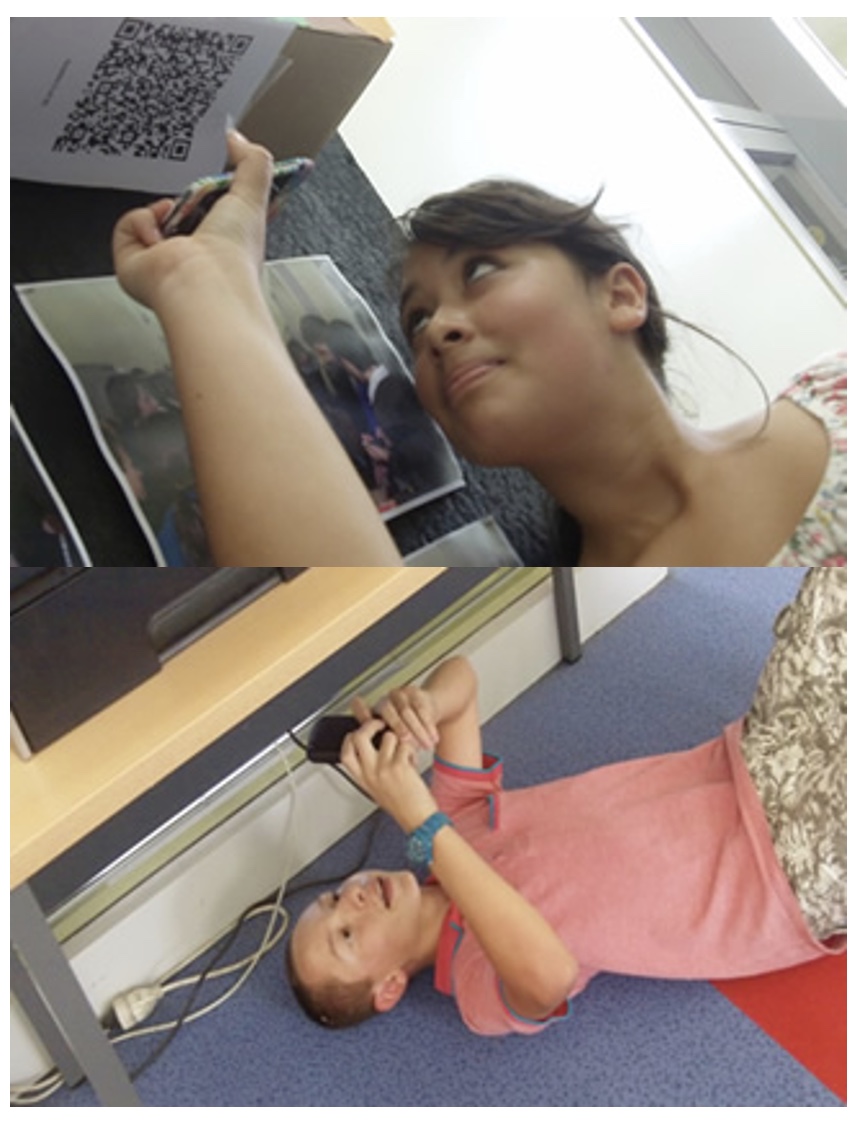
1. Arrange students into groups. Each group needs at least ONE person who has a mobile device.
2. If their phone camera doesn't automatically detect and decode QR codes, ask students to
4. Cut them out and place them around your class / school.
1. Give each group a clipboard and a piece of paper so they can write down the decoded questions and their answers to them.
2. Explain to the students that the codes are hidden around the school. Each team will get ONE point for each question they correctly decode and copy down onto their sheet, and a further TWO points if they can then provide the correct answer and write this down underneath the question.
3. Away they go! The winner is the first team to return with the most correct answers in the time available. This could be within a lesson, or during a lunchbreak, or even over several days!
4. A detailed case study in how to set up a successful QR Scavenger Hunt using this tool can be found here.
Question | Answer |
| 1. QUESTION: Which country was Thailand's biggest weapons supplier in 1939? | Japan | 2. QUESTION: Who was the Thai Prime Minister during WW2? | Phibun | 3. INFO: In Phuket, the war in Europe meant that Phuket's tin trade was being badly affected by a lack of shipping. When Italy joined the war on the German side, two Italian cargo ships escaped the British near India and scuttled their ships in Ao Makham Bay in Phuket. The sailors stayed on in Phuket and, consequently, their half Thai-Italian descendents are still on the island today. | no answer. | 4. INFO: Major Warren Parsons was an ex Australian army soldier. He worked for a tin mining company and was given the responsibility for evacuating and protecting foreign people working in Phuket. He worked for the Tongka Mining Company. The company smuggled radios and weapons disguised as mining equipment which was distributed to the local foreigner population in case the Japanese invaded. | no answer | 5. INFO: Many Japanese started to move to Phuket in the early 1940s as tourists and businessmen. Businessmen set up shops, and some even became dentists and doctors and became part of the community. They were in fact agents working for the Japanese Army who were instructed to put on army uniforms when the Japanese were to invade. They aso smuggled weapons into Phuket | no answer | 6. INFO: Late at night, on December 7th, 1941, the Japanese invaded Thailand. The first landing craft landed on a beach in Songkla. In 2005, 75 year old Saman Mahanpan who was 12 years old at the time, remembers that the Japanese climbed up the telephone poles to cut the telephone wires. The Thai place shot at them, killing one who fell to the ground. They then invaded other parts of Thailand on the East coast, including Cambodia. Later on they would attack the American navy at Pearl Harbor, Hawaii. | no answer | 7. INFO: The Japanese gave the Thai government three choices: 1. Fight them and be at war. 2. Join them to fight the British. 3. Don't resist and let them pass through to Singapore. The Thai leader, Phibun, chose option 3. A few days later, he declared war on the allies. | no answer | 8. CHALLENGE: find a map online that shows all the different points where the Japanese invaded Thailand in 1941 | no answer. | 9. INFO: because Phibun announced Thailand's position regarding the Japanese too late, hundreds of Thai school boys and police officers died fighting the invading Japanese. | no answer | 10. INFO: After the Japanese invaded, Major Warren Parsons led 60 foreigners to the airfield in Northern Phuket. They made it to the airfield with 20 other foreigners joining them. They waited to be picked up but the unfortunate news was that the British planes wouldn't come because they had been attacked in Malaya. | no answer | 11. INFO: After realizing that the allied foreigner's escape party would not be collected by the British air force from the Phuket airfield, some of the farangs (mainly British, Australian and Dutch) decided to drive south to Phuket Town where they negotiated with the Sino-Thai civilians who lent them the ship "Tong Ho". On the morning of 9th December, the foreigners went to Naiyang beach where the ship was delivered to them. They then spent the next few days picking up stranded foreigners on the western coast of Thailand until making their way to Nai Thon Beach where they picked up the remaining foreigners. All in all, 112 foreigners made it to Singapore. | no answer. | 12. INFO: After leading the rescue of 111 foreigners from Phuket and the west coast of Thailand, Major Warren Parsons left Singapore to lead a guerilla force against the Japanese in Myanmar. He led many daring operations for about two years. He was awarded the Distinguished Service Order for his leadership | no answer | 13. INFO: SHORTLY AFTER THE FOREIGNERS ESCAPED PHUKET, 400 JAPANESE INVADED AND SET UP THREE CAMPS IN PHUKET. One was in Phuket Town (near the Phang Nga Road bus station), the airport and Sapam Bay. | no answer | 14. INFO: When the Japanese arrived, the local Chinese population moved north to Theppabutr forest and cleared the rainforest to create rubber plantations and pretended to be Thai peasants. | no answer | 15. INFO: Major Warren Parsons was helped a lot by a very loyal Thai man in Phuket called Khun Lert of the Hongsyok family. This man was tortured by the Japanese because he hid special allied documents but he never gave away any information. Khun Lert was rewarded by Parsons by arranging tin rich land to be sold to him cheaply. He made a lot of money from this tin and opened The Pearl Hotel in Phuket town in 1970. | no answer | 16. INFO: In 1944 the youngest submarine captain in the Royal Navy, 21-year-old Captain Tony Troup, brought his submarine Strongbow from Ceylon (Sri Lanka) to patrol around Phuket and Penang. He torpedoed the 800-ton Japanese coaster Toso Maru as it was leaving Phuket harbor. He also recorded sinking nine local junks, a tug and two cargo lighters between Phuket and Penang. | no answer | 17. INFO: Being part of Japan's "Greater East Asia Co-prosperity Sphere" soon palled for most Thais, as the relationship quickly became one of typical colonial exploitation, with Japanese policy being to force Thailand to sell its primary produce - rubber, tin, rice, etc. at low prices and in turn to buyJapanese manufactured higher prices. Japan also forced Thailand to give it large loans, cleaning out the Thai treasury and collapsing the baht. In addition Japan made it promised delivery of the "lost territories" in the Malay Peninsula conditional on Thai cooperation with its demands. | no answer | 18. INFO: In early 1945, the British were beginning a plan to invade Phuket from their bases in India. As a lead-in to this planned Allied invasion of Phuket, many local fishermen were captured at sea by the British submarine HMS Clyde in early 1945 for to get information on the Japanese. | no answer | 19. INFO: In late 1944, the British received intelligence reports that the Japanese, now critically short of ships, had re-floated the two Italian ships that had been scuttled in Ao Makham Bay in Phuket at the beginning of the war and were about to sail them to Singapore to refit them as troop transports. The British decided to go in and blow them up. The submarine HMS Trenchant crossed from Ceylon and moored off Ko Dok Mai Island. Explosives were attached to the hulls and both were sent back to the ocean floor. | no answer | 20. In 2004 HMS Vestal was located by divers from a Phuket recreational dive company. She lies 72 meters down on a sandy bottom a mile off Cape Promthep. 20 British sailors lost their lives | no answer | 21. INFO: The Americans dropped the atom bombs on Hiroshima and Nagasaki in August 1945, ending WW2. Phuket and its people, most of whom had had no idea they were about to be invaded in just two days' time, were saved at the last gasp from the death, destruction and horrors of war by those two diabolical bombs. | no answer |

Question 1 (of 21)
Question 2 (of 21)
Question 3 (of 21)
Question 4 (of 21)
Question 5 (of 21)
Question 6 (of 21)
Question 7 (of 21)
Question 8 (of 21)
Question 9 (of 21)
Question 10 (of 21)
Question 11 (of 21)
Question 12 (of 21)
Question 13 (of 21)
Question 14 (of 21)
Question 15 (of 21)
Question 16 (of 21)
Question 17 (of 21)
Question 18 (of 21)
Question 19 (of 21)
Question 20 (of 21)
Question 21 (of 21)