
PREMIUM LOGIN
ClassTools Premium membership gives access to all templates, no advertisements, personal branding and many other benefits!
| Username: | ||
| Password: | ||
|
Submit
Cancel
|
||
| Not a member? | ||
PREMIUM LOGIN
ClassTools Premium membership gives access to all templates, no advertisements, personal branding and many other benefits!
| Username: | ||
| Password: | ||
|
Submit
Cancel
|
||
| Not a member? | ||
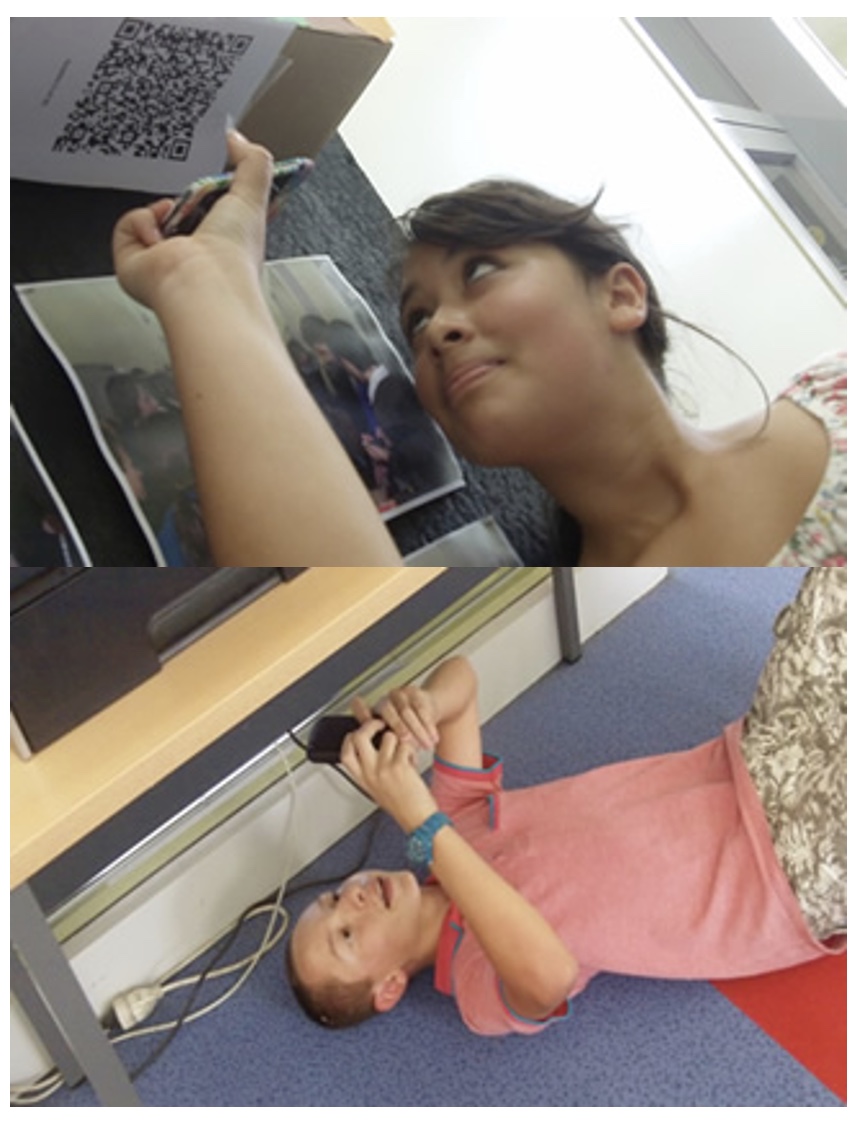
1. Arrange students into groups. Each group needs at least ONE person who has a mobile device.
2. If their phone camera doesn't automatically detect and decode QR codes, ask students to
4. Cut them out and place them around your class / school.
1. Give each group a clipboard and a piece of paper so they can write down the decoded questions and their answers to them.
2. Explain to the students that the codes are hidden around the school. Each team will get ONE point for each question they correctly decode and copy down onto their sheet, and a further TWO points if they can then provide the correct answer and write this down underneath the question.
3. Away they go! The winner is the first team to return with the most correct answers in the time available. This could be within a lesson, or during a lunchbreak, or even over several days!
4. A detailed case study in how to set up a successful QR Scavenger Hunt using this tool can be found here.
Question | Answer |
| 1. Identify the number of significant figures in 0.000769 meters | 3 | 2. A chemistry student measures a length of 423mm, yet the lab she's working on requires that it be in kilometers. What is the length in kilometers? | 4.23x10⁻⁴km | 3. Identify the term described: A three-dimensional structure that crystalline solids occupy. | crystal lattice | 4. If an atom has 71 protons, 71 electrons, and 104 neutrons, how many particles reside in the nucleus, and how many are out side of the nucleus? | 175-inside, 71-outside | 5. Write the proper chemical symbol for an atom of bismuth with a mass of 209 amu. | 209 Bi 83 | 6. Draw the electron dot structure of potassium fluoride and show how the electron is transferred between the elements potassium and fluorine to create the ionic compound. | K will give an electron. | 7. Chlorine occurs in two common isotopes. It appears as 35-Cl 75.8% of the time and as 37-Cl 24.2% of the time. What is its average atomic mass? | 35.5amu | 8. Name four physical properties of metals. | solid, shiny, conductor of electricity and heat, give up electrons, malleable, ductile, forms salts | 9. Why are the noble gases referred to as “noble”? | The noble gases are described as “noble” because they seem to consider it beneath themselves to react with other elements. Because these elements have completely filled valence shells, they have no energetic reason to react. They’re already as stable as they can be. | 10. Why are valence electrons important? | The number of valence electrons in an atom largely determines the chemical reactivity of the atom and many other properties. | 11. What is the energy of emitted light with a frequency of 6.88 x 10¹⁴ Hz? | 4.56 x 10⁻¹⁹J | 12. Classify these as either metal, nonmetal, or metalloid. a-Selenium, b-Fluorine, c-Chromium. | a-nonmetal, b-nonmetal, c-metal | 13. Identify the term described: A chemical formula of a compound that indicates what atoms are present and the simplest whole-number ratio of the elements. | empirical formula | 14. Name the compound and state what type of compound: LiBr | lithium bromide, ionic cmpd | 15. The hydrogen lamp emits blue light at a wavelength of 487 nanometers (nm). What is the frequency in hertz? | 6.16x10¹⁴ s-1 | 16. Name the compound and state what type of compound: Mn2O3 | Manganese(III) oxide, ionic cmpd | 17. Write the proper formulas for the following compound: Disulfur decafluoride. | S2F10 | 18. If you have 7.9 x 1024 molecules of methane (CH4), how many moles of methane are present? | 13 mol CH4 | 19. Identify the term described: States that the electrons in an atom fill the lowest energy levels first. | aufbau principle |

Question 1 (of 19)
Question 2 (of 19)
Question 3 (of 19)
Question 4 (of 19)
Question 5 (of 19)
Question 6 (of 19)
Question 7 (of 19)
Question 8 (of 19)
Question 9 (of 19)
Question 10 (of 19)
Question 11 (of 19)
Question 12 (of 19)
Question 13 (of 19)
Question 14 (of 19)
Question 15 (of 19)
Question 16 (of 19)
Question 17 (of 19)
Question 18 (of 19)
Question 19 (of 19)