
PREMIUM LOGIN
ClassTools Premium membership gives access to all templates, no advertisements, personal branding and many other benefits!
| Username: | ||
| Password: | ||
|
Submit
Cancel
|
||
| Not a member? | ||
PREMIUM LOGIN
ClassTools Premium membership gives access to all templates, no advertisements, personal branding and many other benefits!
| Username: | ||
| Password: | ||
|
Submit
Cancel
|
||
| Not a member? | ||
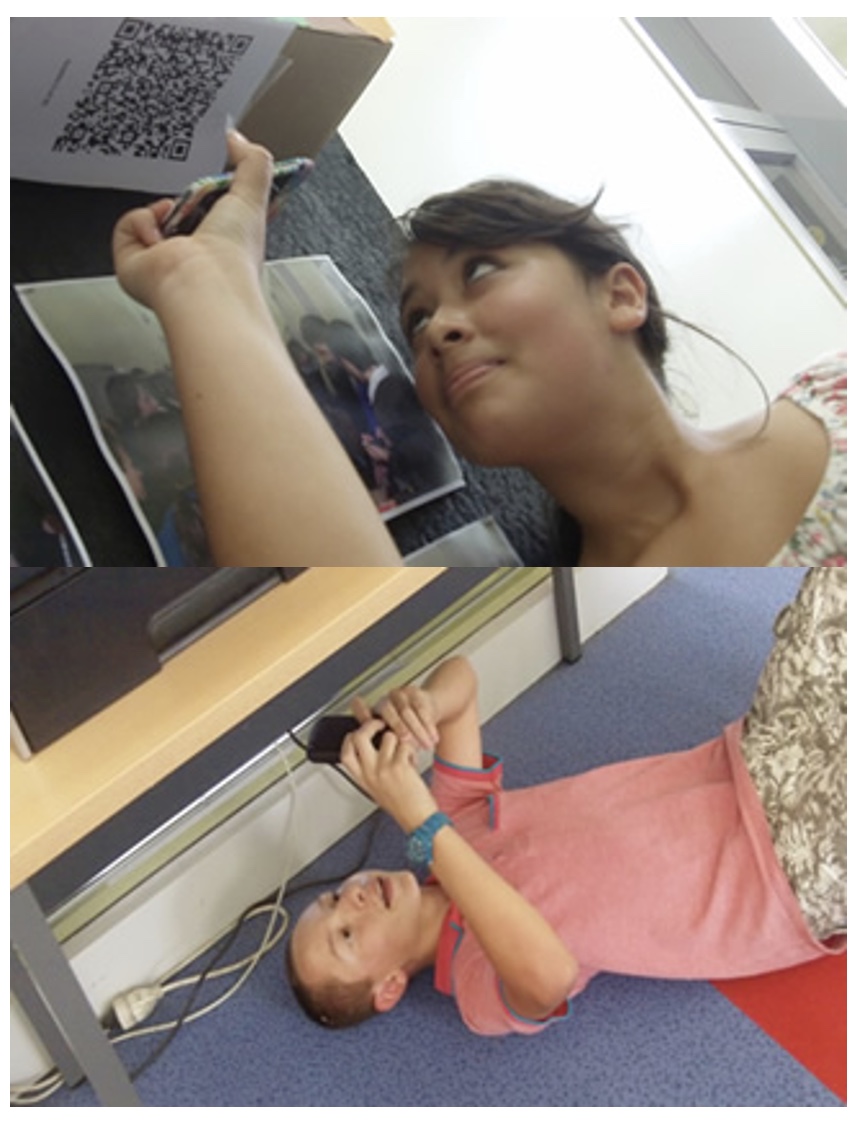
1. Arrange students into groups. Each group needs at least ONE person who has a mobile device.
2. If their phone camera doesn't automatically detect and decode QR codes, ask students to
4. Cut them out and place them around your class / school.
1. Give each group a clipboard and a piece of paper so they can write down the decoded questions and their answers to them.
2. Explain to the students that the codes are hidden around the school. Each team will get ONE point for each question they correctly decode and copy down onto their sheet, and a further TWO points if they can then provide the correct answer and write this down underneath the question.
3. Away they go! The winner is the first team to return with the most correct answers in the time available. This could be within a lesson, or during a lunchbreak, or even over several days!
4. A detailed case study in how to set up a successful QR Scavenger Hunt using this tool can be found here.
Question | Answer |
| 1. D. Is created by and for the people. | A democracy is a government that: | 2. C. Global economy | Which of the following is the largest economy? | 3. A. Barter | Trading goods and services is known as: | 4. B. It has a temperate climate | Which is a physical charcterisitc of Kentucky? | 5. D. All of the above | Why did the Civil War break out? | 6. C. Both A and B | Over time, the facts of a historical event? | 7. B. Location B | Which location would be best to build a settlement? | 8. A. Building a dam | Which activity at location 1 would have the greatest impact on location 2? | 9. C. Must make choices about using resources | When there is scarcity, people: | 10. B. Building a dam | Which is an example of modifying the environment to meet human needs? | 11. A. Serve to define specific groups | Elements of culture: | 12. C. Compete | Prejudice and stereotypes emerge when cultures: | 13. D. Germany | Which location has the largest population? | 14. B. City | The need for human interaction would best be met by settling in which type of location? | 15. B. National, state, and local | The three levels of government are: | 16. A. $2.00 | MaryAnn makes and sells flowerpots. If it costs her three dollars to produce a flowerpot, and she sells it for five dollars, wht would be the profit? | 17. D. To identify and map trade routes | Which is a reason why people came to explore America? | 18. C. Henry Clay Monument | Which is a symbol of Kentucky history? | 19. B. Producer | A person that manufactures something is called a: | 20. C. Bank | Which is an example of a financial institution? | 21. D. Westward Expansion | Manifest Destiny is most strongly associated with which era? | 22. D. Opportunity to buy the meatball sandwich | For lunch today, the cafeteria was serving meatball sandwiches for $1.00 and chicken salad sandwiches for $1.25. Terrel decided to buy the chicken salad sandwich. What was his opportunity cost? | 23. B. Preamble of the U.S. Constitution | One of the basic purposes of the government of the United States is the attainment of common goals as specifically listed in the: | 24. C. Family | Various human needs are met through interaction in and among social groups. Which of the following is an example of a social group? | 25. D. Opportunity Cost | Which refers to what is given up when an economic choice is made? | 26. C. Location | Latitude and longitude are used to identify: | 27. A. A soldier's diary | If you wanted to read a first-hand account of a Civil War battle, which of the following primary sources would you use? | 28. C. Governor | Which of the following is a state official? | 29. B. Free enterprise | In the United States, businesses seek to make profits by producing or selling goods or services. This economic system is known as: | 30. B. Easter time zone | Regions are areas that have one or more physical or human characteristics in common. Which of the following is a region based on human characteristic | 31. C. "African-Americans are all good athletes." | Which statement is an example of a stereotype? | 32. A. The U.S. Supreme Court | Who has the power to find a law unconstitutional? | 33. B. Music | Which is an element of culture? | 34. C. $3.00 | If it cost you $2.00 to make a widget, and you sell it for $5.00, what would be your profit? | 35. D. September | According to this graph, in what month is there the most rainfall? | 36. B. Continent | The United States, Canada, and Mexico share a common: | 37. C. Family Organization | Native American cultures and modern Kentucky culture share which of the following? | 38. B. Voting | One way whereby citizens play an active role in government is: | 39. C. Groceries | Taxes pay for all BUT which of the following? | 40. D. A vast mountain range | Which of the following would present the biggest obstacle to a person on horseback? | 41. A. Purchased a product | You would be a consumer if you: | 42. B. The Bill of Rights | The right to speak your mind, freedom of speech, is guaranteed by which document? | 43. D. Compromise | Which of the following is a tool for social interaction? | 44. C. Air conditioning | Which invention had the greatest influence on the rate of population growth in the American South and Southwest in the twentieth century? | 45. A. Industrialization | Which era took place during and after the Civil War? | 46. C. The fifty states | The stars on the American flag represent: |

Question 1 (of 46)
Question 2 (of 46)
Question 3 (of 46)
Question 4 (of 46)
Question 5 (of 46)
Question 6 (of 46)
Question 7 (of 46)
Question 8 (of 46)
Question 9 (of 46)
Question 10 (of 46)
Question 11 (of 46)
Question 12 (of 46)
Question 13 (of 46)
Question 14 (of 46)
Question 15 (of 46)
Question 16 (of 46)
Question 17 (of 46)
Question 18 (of 46)
Question 19 (of 46)
Question 20 (of 46)
Question 21 (of 46)
Question 22 (of 46)
Question 23 (of 46)
Question 24 (of 46)
Question 25 (of 46)
Question 26 (of 46)
Question 27 (of 46)
Question 28 (of 46)
Question 29 (of 46)
Question 30 (of 46)
Question 31 (of 46)
Question 32 (of 46)
Question 33 (of 46)
Question 34 (of 46)
Question 35 (of 46)
Question 36 (of 46)
Question 37 (of 46)
Question 38 (of 46)
Question 39 (of 46)
Question 40 (of 46)
Question 41 (of 46)
Question 42 (of 46)
Question 43 (of 46)
Question 44 (of 46)
Question 45 (of 46)
Question 46 (of 46)