
PREMIUM LOGIN
ClassTools Premium membership gives access to all templates, no advertisements, personal branding and many other benefits!
| Username: | ||
| Password: | ||
|
Submit
Cancel
|
||
| Not a member? | ||
PREMIUM LOGIN
ClassTools Premium membership gives access to all templates, no advertisements, personal branding and many other benefits!
| Username: | ||
| Password: | ||
|
Submit
Cancel
|
||
| Not a member? | ||
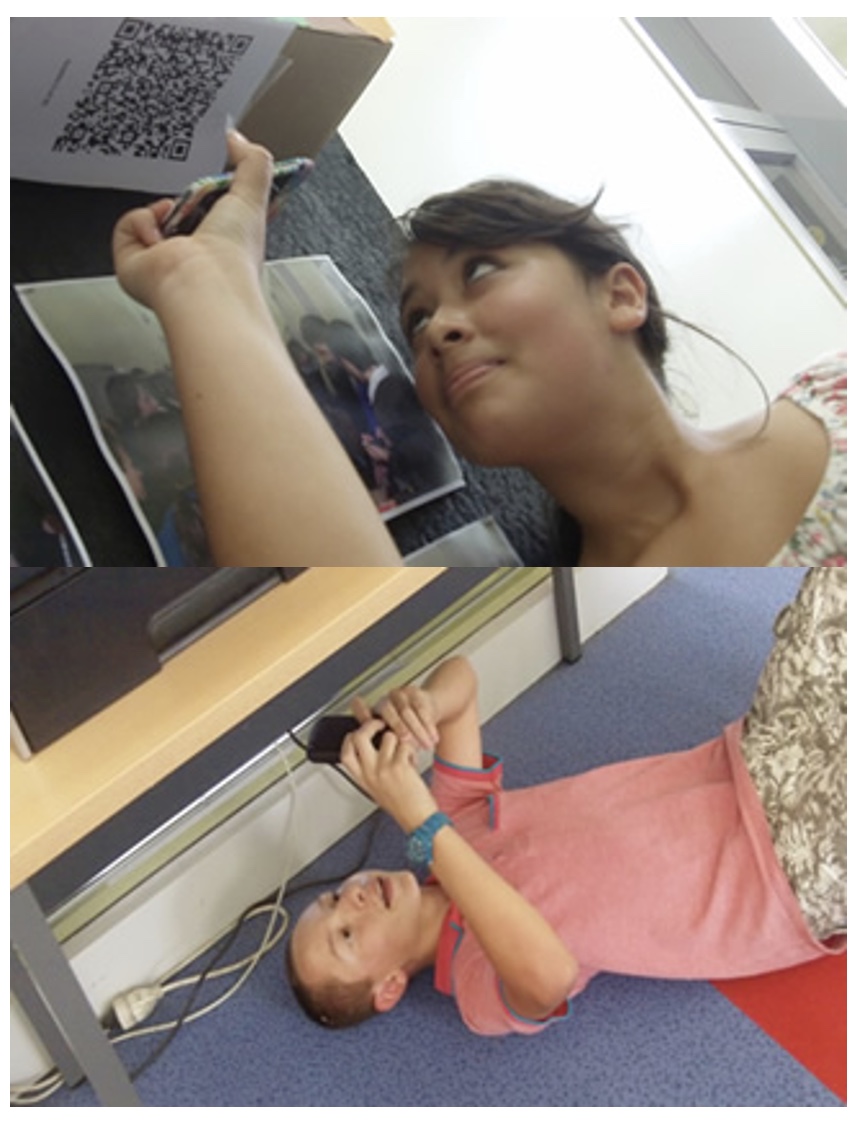
1. Arrange students into groups. Each group needs at least ONE person who has a mobile device.
2. If their phone camera doesn't automatically detect and decode QR codes, ask students to
4. Cut them out and place them around your class / school.
1. Give each group a clipboard and a piece of paper so they can write down the decoded questions and their answers to them.
2. Explain to the students that the codes are hidden around the school. Each team will get ONE point for each question they correctly decode and copy down onto their sheet, and a further TWO points if they can then provide the correct answer and write this down underneath the question.
3. Away they go! The winner is the first team to return with the most correct answers in the time available. This could be within a lesson, or during a lunchbreak, or even over several days!
4. A detailed case study in how to set up a successful QR Scavenger Hunt using this tool can be found here.
Question | Answer |
| 1. ____________________________ acts as transport system of the body. | Circulatory system | 2. Blood carries _________________ from lungs, that is excreted through expiration. | Oxygen and Carbo-di-oxide | 3. _____________________ provides nutrients to all cells of the body | Blood | 4. _______________ is a pumping organ. | Heart | 5. Heart consists of ____________ chambers. | 4 | 6. Blood is carried from different body parts through veins and open through ________________ and _________________. | Superior venacava and Inferior venacava | 7. __________________ receives deoxygenated blood and _______________________ receives oxygenated blood. | Right atrium and left atrium | 8. _________________ is the largest artery of body. | Aorta | 9. The functioning of heart beat (origin and contraction) is carried out through ________________________, ______________________, ___________________, _____________________ and _______________________. | Sino-auricular node (SA node); Atrio-ventricular node (AV node); Bundle of His and Purkinje fibres | 10. In cardiac cycle, the contraction phase is __________________________ and relaxation phase is _______________________. | Systole and diastole | 11. ___________ is the normal heart beat of adults and ______________ for a infant child. | 72-80; 130 beats | 12. Severe crushing pain spreading upto neck and arms (left), sweating, nausea, vomiting and anxiety of dying were symptoms of _____________________. | Myocardial infarction | 13. ______________________ is also known as "silent infarction". | Myocardial infarction | 14. Chest pain is caused by ______________________ to heart muscle, usually a result of poor blood supply. | Insufficient supply of oxygen | 15. _____________________________ is done to detect abnormality in blood vessel. | Angiogram | 16. __________________ is an operation to circumvent narrowed or blocked coronary arteries by grafting blood vessels. | Coronary bypass surgery | 17. ______________________ refers to narrowing of arteries caused by plaques in their inner feelings. | Artherosclerosis | 18. Congestive heart failure (CHF) occurs when ____________________. | Heart's delivery of oxygen to body is inadequate | 19. Irregular beating of heart is called __________________. | Arrhythmia | 20. ____________________________ is special ward/unit suitable for critical heart patients. | Intensive Coronary Care Unit (ICCU) | 21. An adult has _________________ litres of blood. | 5 litres | 22. Blood has main components like _________________, _____________________, ____________________ and _________________. | Plasma, RBC, WBC and platelets | 23. The normal blood pressure is ___________________. | 120/80 mm/Hg | 24. ____________________ play an important role in blood clotting. | Platelets | 25. ____________________ refers to deficiency of white blood corpuscles and _____________________ refers to excess of white blood corpuscles. | Leukopenia; leukocytosis | 26. ______________________ is disease of bone marrow and common type of cancer. | Leukemia | 27. Blood flow in skin is regulated by __________________. | Catecholamines | 28. _______________________ refers to below normal blood corpuscles and _____________________ refers to excess of blood corpuscles. | Anemia; erythrocytosis | 29. ______________________ is responsible for sickle cell anemia. | RBC (sickle shaped cells - abnormal hemoglobin protein molecules) | 30. The iron content in blood is ____________________ that gives red colour to blood. | Haem/ hemo (globin is protein) | 31. ___________________ play important role in combating foreign substances. | Lympocytes | 32. The life span of RBC is _______________; WBC is _________________ and platelets is _________________. | 90-120 days (RBC); 2-3 weeks (WBC); 5-8 minutes (platelets) | 33. The clotting of blood within intact blood vessel to heart is ______________________ and to brain is ________________________. | Coronary thrombosis; cerebral thrombosis | 34. When a portion of thrombus clot becomes fragmented and enters the circulating blood, it is called _____________________. | Embolus | 35. ___________________ involves replacement of damaged heart by healthy human heart from a brain-dead patient. | Heart transplantation | 36. Circulatory system was first discovered by _______________________ in year of ____________________. | William Harvey in 1628. | 37. _________________________ is characterized by lack of blood flow and oxygen to heart muscles. | Ischemia | 38. The heart is protected by double walled sac membrane called _____________________. | Pericardium | 39. ______________________ is used to measure blood pressure. | Sphygmomanometer | 40. ____________________ is called as "river of life". | Blood | 41. The hormones secreted by different gland is transported through _______________ to some other part of body, evoking chemical signals. | Blood | 42. _____________________ is condition of narrowing of aorta valve. | Valve stenosis | 43. ___________________ is called as "silent killer". | Hypertension | 44. The condition that makes blood arteries lose their elasticity is _________________. | Hypertension | 45. Erythrocyte refers to ______________________ and thrombocyte refers to _______________________. | RBC and WBC | 46. The final branches of arteries are ______________________. | Capillaries | 47. _____________________ can be used to hear heart beat. | Stethoscope | 48. The first sound of heart beat with a long and dull sound is _____________ because of ________________________ and second sound of heart beat with a short and sharp sound is ________________ and is caused by _________________________. | Lub-closure of tricupsid and bicupsid valve; dub-closure of semilunar valve and ventricular diastole | 49. _________________________ is the pacemaker of heart. | Sino-atrial node (SA node) | 50. First heart transplantation in human was carried by and on ______________________________________________. | Prof. Christian Bernard in South Africa (1967) |

Question 1 (of 50)
Question 2 (of 50)
Question 3 (of 50)
Question 4 (of 50)
Question 5 (of 50)
Question 6 (of 50)
Question 7 (of 50)
Question 8 (of 50)
Question 9 (of 50)
Question 10 (of 50)
Question 11 (of 50)
Question 12 (of 50)
Question 13 (of 50)
Question 14 (of 50)
Question 15 (of 50)
Question 16 (of 50)
Question 17 (of 50)
Question 18 (of 50)
Question 19 (of 50)
Question 20 (of 50)
Question 21 (of 50)
Question 22 (of 50)
Question 23 (of 50)
Question 24 (of 50)
Question 25 (of 50)
Question 26 (of 50)
Question 27 (of 50)
Question 28 (of 50)
Question 29 (of 50)
Question 30 (of 50)
Question 31 (of 50)
Question 32 (of 50)
Question 33 (of 50)
Question 34 (of 50)
Question 35 (of 50)
Question 36 (of 50)
Question 37 (of 50)
Question 38 (of 50)
Question 39 (of 50)
Question 40 (of 50)
Question 41 (of 50)
Question 42 (of 50)
Question 43 (of 50)
Question 44 (of 50)
Question 45 (of 50)
Question 46 (of 50)
Question 47 (of 50)
Question 48 (of 50)
Question 49 (of 50)
Question 50 (of 50)