
PREMIUM LOGIN
ClassTools Premium membership gives access to all templates, no advertisements, personal branding and many other benefits!
| Username: | ||
| Password: | ||
|
Submit
Cancel
|
||
| Not a member? | ||
PREMIUM LOGIN
ClassTools Premium membership gives access to all templates, no advertisements, personal branding and many other benefits!
| Username: | ||
| Password: | ||
|
Submit
Cancel
|
||
| Not a member? | ||
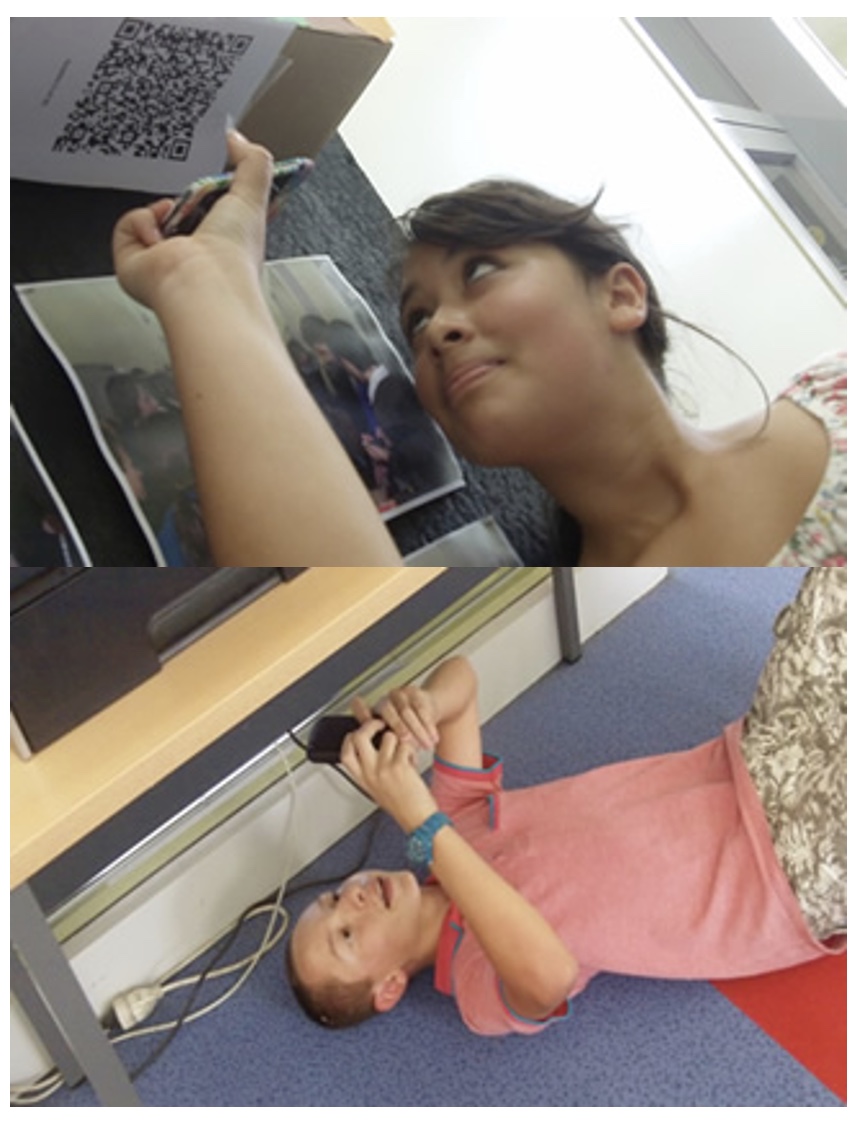
1. Arrange students into groups. Each group needs at least ONE person who has a mobile device.
2. If their phone camera doesn't automatically detect and decode QR codes, ask students to
4. Cut them out and place them around your class / school.
1. Give each group a clipboard and a piece of paper so they can write down the decoded questions and their answers to them.
2. Explain to the students that the codes are hidden around the school. Each team will get ONE point for each question they correctly decode and copy down onto their sheet, and a further TWO points if they can then provide the correct answer and write this down underneath the question.
3. Away they go! The winner is the first team to return with the most correct answers in the time available. This could be within a lesson, or during a lunchbreak, or even over several days!
4. A detailed case study in how to set up a successful QR Scavenger Hunt using this tool can be found here.
Question | Answer |
| 1. 1. Who is the scientist who believed in the “theory of acquired characteristics,” which suggested that organisms can pass on their ACQUIRED traits to their offspring? (See picture below for an example). Today we know this theory is incorrect. | (Jean-Baptiste Lamarck) | 2. 2. Who is the scientist who wrote The Origin of the Species and proposed the theory of natural selection that scientists believe today? (An example of natural selection is shown in the picture). | (Charles Darwin) | 3. 3. During his travels on the HMS Beagle, Charles Darwin visited many places, including this famous island chain off the coast of Ecuador. | (The Galapagos Islands) | 4. 4. Name two of the animals that Darwin observed in the Galapagos. The variations between these organisms on different islands helped inspire his theory of natural selection. | (tortoises, finches, etc.) | 5. 5. When organisms are better adapted to their environment, they will survive and reproduce more successfully than organisms less adapted to the environment. This process is called… | (natural selection) | 6. 6. What process (the gradual change of a species over time) happens as a result of natural selection? | (evolution) | 7. 7. What do you call a structure or behavior that helps an organism better survive in its environment? | (an adaptation) | 8. 8. List some examples of evidence scientists have for evolution. | (homologous structures, DNA evidence, analogous structures, embryonic development, fossils, the fossil record, etc.) | 9. 9. The petrified (turned to stone) remains of once-living organisms are called… | (fossils) | 10. 10. Where in the rock layer would you find the oldest fossils? | (In the lowest layers. As time passes, more sediment is layered on top, kind of like how the oldest trash in a trashcan is at the bottom and the newest is on the top.) | 11. 11. When an organism no longer has any living members of its species on Earth, it is said to be… | (extinct) | 12. 12. Match the adaptation to the environment in which it would be the most beneficial. Adaptation choices: thick blubber, large ears to disperse heat, deep roots to reach scarce water, gills. Environment choices: a river, a desert, a rainforest, the tundra. | (thick blubber-the tundra, large ears to disperse heat-a rainforest, deep roots to reach scarce water-a desert, gills-a river.) | 13. 13. Human tailbones, human tonsils, and whale pelvises are examples of once-useful structures that ancestor species needed that are no longer useful in the same way today. These are called… | (vestigial structures) | 14. 14. List the four tenets of Darwin’s theory of natural selection in order. Next, explain them. | (overproduction-more offspring are born than will survive to adulthood and reproduce, genetic variation-each offspring has slight genetic differences that might help or hurt their chances for survival, competition for resources/struggle to survive-all members of a species are competing for limited resources in order to survive, successful reproduction-only the organisms that are best suited to survive in their environment will be able to live to adulthood and pass on their genes.) | 15. 15. A tree has several apples on it, each containing many apple seeds (which could each potentially grow into their own apple trees). However, only a few of the seeds from this tree (if any) will successfully grow into offspring trees. This is an example of which part of Darwin’s theory of natural selection? | (overproduction) | 16. 16. In a litter of wolf pups, no two pups are exactly alike. They have slight differences in fur color, size, etc., which might give them advantages or disadvantages in their environment. This is an example of which part of Darwin’s theory of natural selection? | (genetic variation) | 17. 17. All the rabbits in an area are competing to get enough food, avoid predators, survive natural disasters, etc. This is an example of which part of Darwin’s theory of natural selection? | (struggle to survive/competition for resources) | 18. 18. Only the sea turtles that successfully survive in their environment long enough to reach reproductive age will be able to mate and pass on their traits. The assumption is that if they survived to reproductive age, their traits are well-suited for the environment and will benefit their offspring. This is an example of which part of Darwin’s theory of natural selection? | (successful reproduction) | 19. 19. When would a variation be considered an adaptation? | (A variation is any genetic difference: positive, negative, or neutral. A variation would be considered an adaptation if it provides an advantage for survival in an organism’s environment. For example, having thicker fur than another organism might make surviving in a cold environment a little bit easier.) | 20. 20. True or false: Humans are descended from monkeys. | (False. Humans and present-day monkeys and other primates share common ancestors. Over time, different groups of these ancestor species differentiated into new species that we see today). |

Question 1 (of 20)
Question 2 (of 20)
Question 3 (of 20)
Question 4 (of 20)
Question 5 (of 20)
Question 6 (of 20)
Question 7 (of 20)
Question 8 (of 20)
Question 9 (of 20)
Question 10 (of 20)
Question 11 (of 20)
Question 12 (of 20)
Question 13 (of 20)
Question 14 (of 20)
Question 15 (of 20)
Question 16 (of 20)
Question 17 (of 20)
Question 18 (of 20)
Question 19 (of 20)
Question 20 (of 20)