
PREMIUM LOGIN
ClassTools Premium membership gives access to all templates, no advertisements, personal branding and many other benefits!
| Username: | ||
| Password: | ||
|
Submit
Cancel
|
||
| Not a member? | ||
PREMIUM LOGIN
ClassTools Premium membership gives access to all templates, no advertisements, personal branding and many other benefits!
| Username: | ||
| Password: | ||
|
Submit
Cancel
|
||
| Not a member? | ||
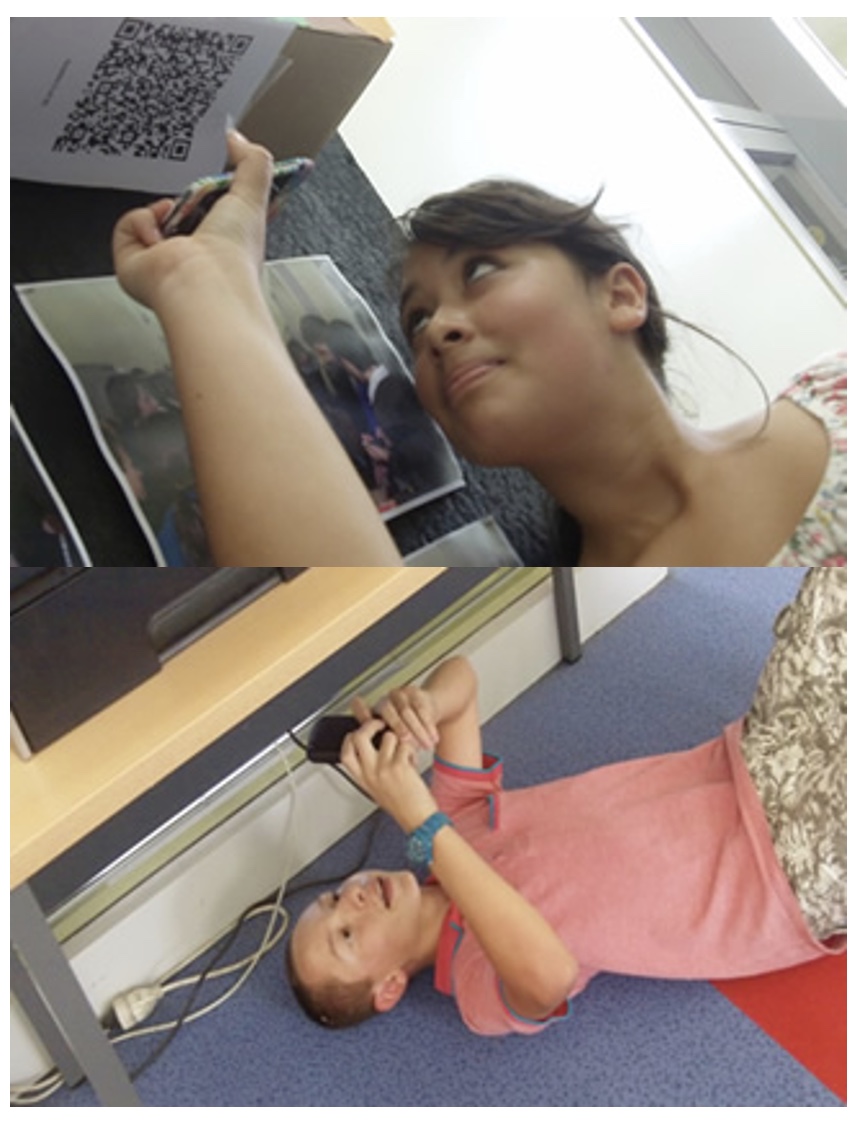
1. Arrange students into groups. Each group needs at least ONE person who has a mobile device.
2. If their phone camera doesn't automatically detect and decode QR codes, ask students to
4. Cut them out and place them around your class / school.
1. Give each group a clipboard and a piece of paper so they can write down the decoded questions and their answers to them.
2. Explain to the students that the codes are hidden around the school. Each team will get ONE point for each question they correctly decode and copy down onto their sheet, and a further TWO points if they can then provide the correct answer and write this down underneath the question.
3. Away they go! The winner is the first team to return with the most correct answers in the time available. This could be within a lesson, or during a lunchbreak, or even over several days!
4. A detailed case study in how to set up a successful QR Scavenger Hunt using this tool can be found here.
Question | Answer |
| 1. First, work out the relative formula mass of the compound, using the Ar values for each element. In the case of sodium hydroxide, these are Na = 23, O = 16, H = 1.Next, divide the Ar of oxygen by the Mr of NaOH, and multiply by 100 to get a percentage. | yeah | 2. A chemist determines that 1.26 g of iron reacts with 0.54 g of oxygen to form rust. What is the percent composition of each element in the new compound | Fe=70% O=30% | 3. In the lab, a chemist analyzed a sample of methanol and found that it was made of 6.2 g of carbon, 4.1 g of hydrogen, and 15.9 g of oxygen. What is the percent composition of each element? | C=23.7% H=15.6% O=60.7% | 4. each element in the table salt? | Na=57.4% Cl=42.6% | 5. In an experiment, 2.0 moles of oxygen atoms reacts with 80.1 g of calcium to form a new compound. What is the percent composition by mass of each element in the new compound? | 5% |

Question 1 (of 5)
Question 2 (of 5)
Question 3 (of 5)
Question 4 (of 5)
Question 5 (of 5)