
PREMIUM LOGIN
ClassTools Premium membership gives access to all templates, no advertisements, personal branding and many other benefits!
| Username: | ||
| Password: | ||
|
Submit
Cancel
|
||
| Not a member? | ||
PREMIUM LOGIN
ClassTools Premium membership gives access to all templates, no advertisements, personal branding and many other benefits!
| Username: | ||
| Password: | ||
|
Submit
Cancel
|
||
| Not a member? | ||
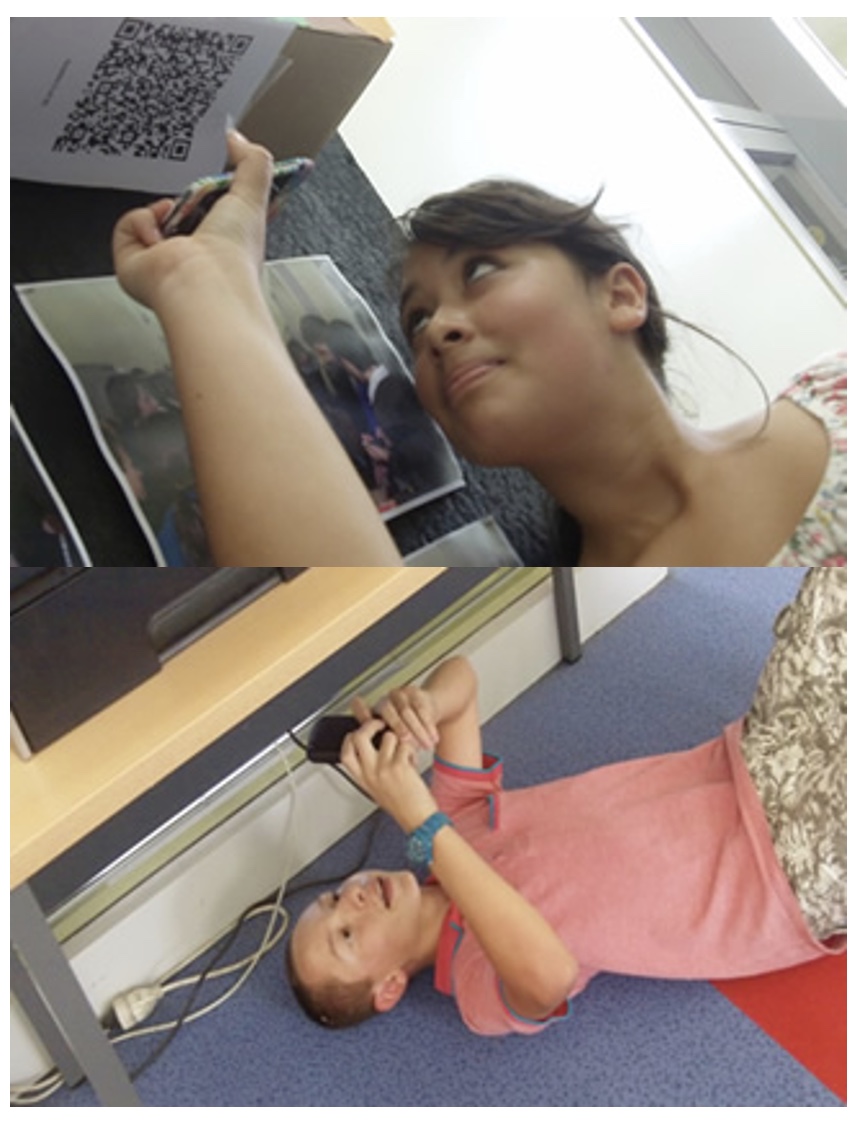
1. Arrange students into groups. Each group needs at least ONE person who has a mobile device.
2. If their phone camera doesn't automatically detect and decode QR codes, ask students to
4. Cut them out and place them around your class / school.
1. Give each group a clipboard and a piece of paper so they can write down the decoded questions and their answers to them.
2. Explain to the students that the codes are hidden around the school. Each team will get ONE point for each question they correctly decode and copy down onto their sheet, and a further TWO points if they can then provide the correct answer and write this down underneath the question.
3. Away they go! The winner is the first team to return with the most correct answers in the time available. This could be within a lesson, or during a lunchbreak, or even over several days!
4. A detailed case study in how to set up a successful QR Scavenger Hunt using this tool can be found here.
Question | Answer |
| 1. Who carried out a famous study on obedience? | Milgram | 2. Explain the difference between compliance & internalisation? | Compliance is public but not private & internalisation is both private & public and have adopted the belief of the majority. | 3. In Jenness's jellybean study what happened to the guesses people made after discussing with the group? | second guesses were closer to the group guesses. | 4. How many participants did Asch have? | 123. | 5. How many trials were critical trials in Asch's study? | 12. | 6. Zimbardo et al investigated conformity into what? | social roles. | 7. Give one ethical issue with studies on social influence? | experiments involved deception. | 8. What was the name of the scale devised by Adorno to test for authoritarian personality? | F scale. | 9. Give one example of social change in real life. | Suffragettes, legalisation of homosexuality, greenpeace... | 10. What does the multi-store model of memory explain? | Flow of information between 3 storage systems - sensory, short-term & long-term. | 11. What is the duration of STM? | 30 seconds. | 12. What is the capacity of LTM? | unlimited. | 13. Which famous case study explores amnesia and memory loss? | HM. | 14. What are the 3 types of LTM? | Episodic, semantic & procedural. | 15. Which 2 people carried out core animal studies in attachment? | Harlow & Lorenz. | 16. What are the 5 concepts/parts to Bowlby's theory? | Adaptive, social releasers, critical period, monotropy & internal working model. | 17. What did Schaffer & Emerson conclude from their study? | multiple attachments. | 18. Which Psychologist studied the strange situation and were they male or female? | Ainsworth, female. | 19. How many thieves were there in Bowlby's study on maternal deprivation? | 44 | 20. What does privation mean? | children who have never formed an attachment bond. | 21. There are 4 definitions of abnormality - what are they? | Deviation from social norms; Deviation from ideal mental health; Failure to function adequately & statistical infrequency. | 22. Name one treatment for phobias based on the learning theory? | SD or Flooding. | 23. What does the ABC stand for in Ellis' model? | Activating event, beliefs & consequences. | 24. What is the genetic explanation of OCD? | concordance rate in twins, heredity, passed through genes - SERT/COMPT. | 25. Who is the founding father of Psychology? | Wundt. | 26. Explain the difference between a genotype & phenotype? | genotype = genes & phenotype = product of environment. | 27. Who came up with classical conditioning? | Pavlov & dogs. | 28. What happens to the NS at the end of classical conditioning? | NS = CS. | 29. Who came up with the social learning theory? | Bandura. | 30. What is a schema? | framework of experience/ideas which helps individuals. | 31. There are two parts to the nervous system - what are they? | Central & peripheral nervous system. | 32. What are the 3 types of neurons? | sensory, relay & motor. | 33. What happens to the breathing rate during flight or fight? | faster. | 34. The case study of Phineas Gage is evidence for what function in the brain? | localisation. | 35. What are the 2 language centres? | Broca & Wernickes. | 36. Why was split-brain surgery introduced? | control epilepsy. | 37. Name one scientific way of studying the brain? | MRI, FMRI, brain scan. |

Question 1 (of 37)
Question 2 (of 37)
Question 3 (of 37)
Question 4 (of 37)
Question 5 (of 37)
Question 6 (of 37)
Question 7 (of 37)
Question 8 (of 37)
Question 9 (of 37)
Question 10 (of 37)
Question 11 (of 37)
Question 12 (of 37)
Question 13 (of 37)
Question 14 (of 37)
Question 15 (of 37)
Question 16 (of 37)
Question 17 (of 37)
Question 18 (of 37)
Question 19 (of 37)
Question 20 (of 37)
Question 21 (of 37)
Question 22 (of 37)
Question 23 (of 37)
Question 24 (of 37)
Question 25 (of 37)
Question 26 (of 37)
Question 27 (of 37)
Question 28 (of 37)
Question 29 (of 37)
Question 30 (of 37)
Question 31 (of 37)
Question 32 (of 37)
Question 33 (of 37)
Question 34 (of 37)
Question 35 (of 37)
Question 36 (of 37)
Question 37 (of 37)