
PREMIUM LOGIN
ClassTools Premium membership gives access to all templates, no advertisements, personal branding and many other benefits!
| Username: | ||
| Password: | ||
|
Submit
Cancel
|
||
| Not a member? | ||
PREMIUM LOGIN
ClassTools Premium membership gives access to all templates, no advertisements, personal branding and many other benefits!
| Username: | ||
| Password: | ||
|
Submit
Cancel
|
||
| Not a member? | ||
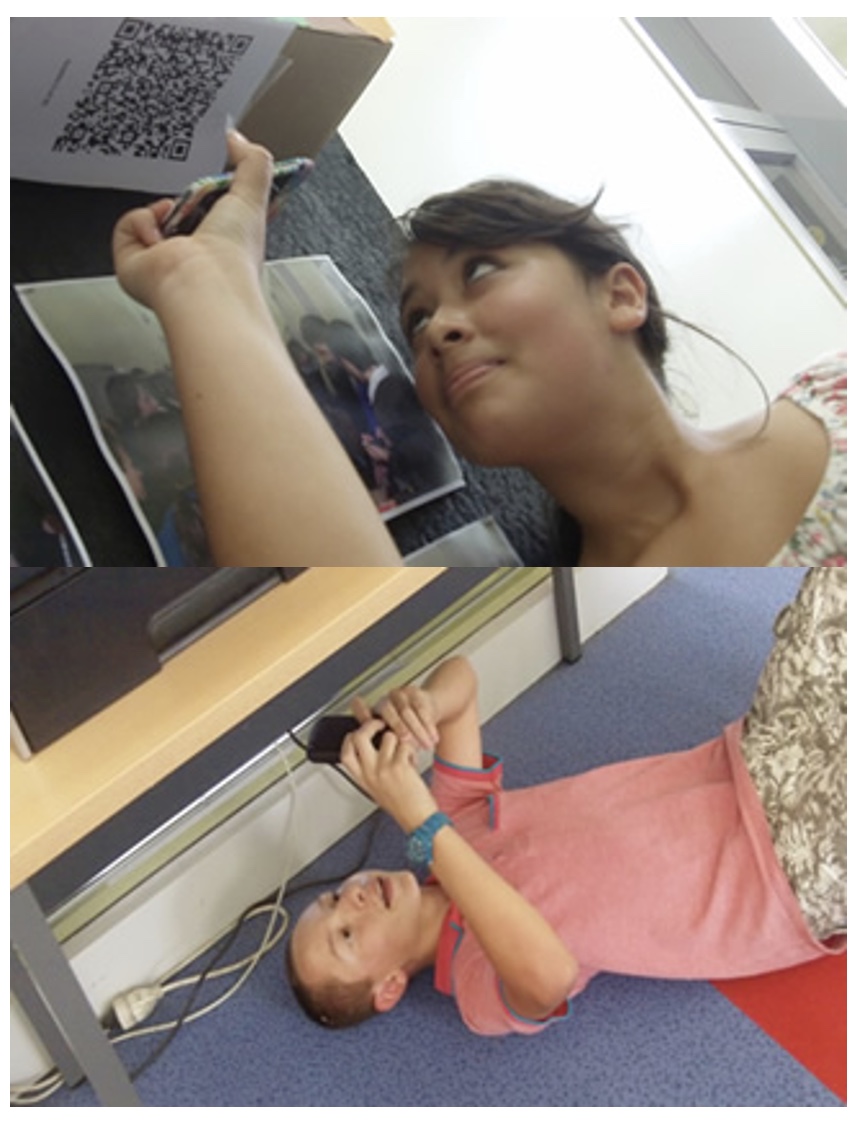
1. Arrange students into groups. Each group needs at least ONE person who has a mobile device.
2. If their phone camera doesn't automatically detect and decode QR codes, ask students to
4. Cut them out and place them around your class / school.
1. Give each group a clipboard and a piece of paper so they can write down the decoded questions and their answers to them.
2. Explain to the students that the codes are hidden around the school. Each team will get ONE point for each question they correctly decode and copy down onto their sheet, and a further TWO points if they can then provide the correct answer and write this down underneath the question.
3. Away they go! The winner is the first team to return with the most correct answers in the time available. This could be within a lesson, or during a lunchbreak, or even over several days!
4. A detailed case study in how to set up a successful QR Scavenger Hunt using this tool can be found here.
Question | Answer |
| 1. How many planets are in the solar system? | 8 | 2. What celestial body is made of gas and gives its own light and heat? | Star | 3. How long does it take the moon to orbit the earth? | 28 days/1 month | 4. How long does it take the earth to orbit the sun? | 365 days | 5. Name the only process in the Carbon cycle that absorbs Carbon Dioxide from the atmosphere. | photosynthesis | 6. Name the model that describes how the universe was formed. | The Big Bang Theory | 7. What is the scientific term for burning | combustion | 8. Name a process that releases carbon dioxide into the air | respiration or combustion | 9. Global warming is partially caused by too much Carbon Dioxide in the air. Name 2 effects of global warming | ice melting/habitat loss | 10. Draw a labelled picture of the Carbon cycle | picture | 11. What is the difference between a comet and an asteroid | answer | 12. Draw a picture of a lunar eclipse | drawing | 13. Name the gas giant planets | J,S,U,N | 14. Draw out the lunar cycle starting from a New Moon to a Full Moon | picture |

Question 1 (of 14)
Question 2 (of 14)
Question 3 (of 14)
Question 4 (of 14)
Question 5 (of 14)
Question 6 (of 14)
Question 7 (of 14)
Question 8 (of 14)
Question 9 (of 14)
Question 10 (of 14)
Question 11 (of 14)
Question 12 (of 14)
Question 13 (of 14)
Question 14 (of 14)