
PREMIUM LOGIN
ClassTools Premium membership gives access to all templates, no advertisements, personal branding and many other benefits!
| Username: | ||
| Password: | ||
|
Submit
Cancel
|
||
| Not a member? | ||
PREMIUM LOGIN
ClassTools Premium membership gives access to all templates, no advertisements, personal branding and many other benefits!
| Username: | ||
| Password: | ||
|
Submit
Cancel
|
||
| Not a member? | ||
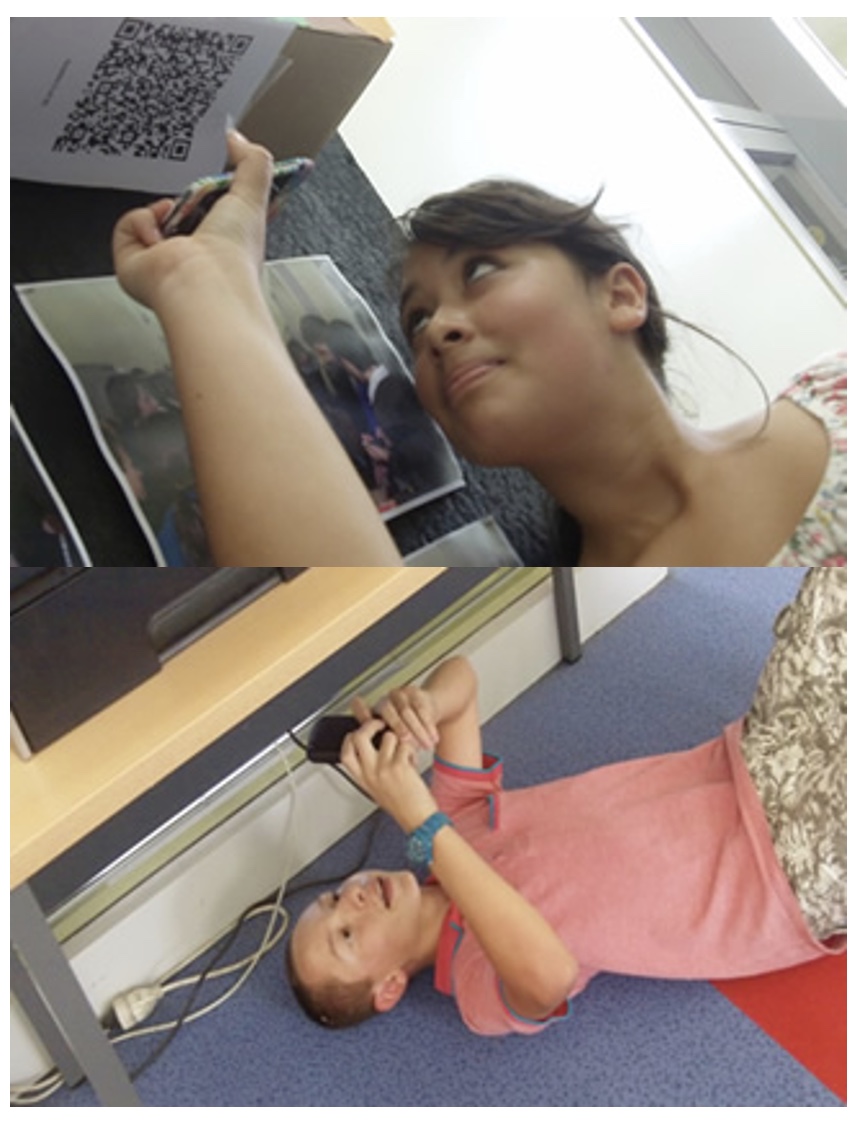
1. Arrange students into groups. Each group needs at least ONE person who has a mobile device.
2. If their phone camera doesn't automatically detect and decode QR codes, ask students to
4. Cut them out and place them around your class / school.
1. Give each group a clipboard and a piece of paper so they can write down the decoded questions and their answers to them.
2. Explain to the students that the codes are hidden around the school. Each team will get ONE point for each question they correctly decode and copy down onto their sheet, and a further TWO points if they can then provide the correct answer and write this down underneath the question.
3. Away they go! The winner is the first team to return with the most correct answers in the time available. This could be within a lesson, or during a lunchbreak, or even over several days!
4. A detailed case study in how to set up a successful QR Scavenger Hunt using this tool can be found here.
Question | Answer |
| 1. This Black American historian is the creator of Black History Month. | Carter G. Woodson | 2. February was chosen for Black History Month to coincide with the birthdays of these two men. | Frederick Douglass and Abraham Lincoln | 3. This civil rights organization was founded in 1909. | NAACP (National Association for the Advancement of Colored People) | 4. This Black American inventor created the three-way traffic signal in 1923, he was also the first black man in Cleveland to own a car. | Garrett Morgan | 5. This man was the first Black American to serve in the U.S. Supreme Court, serving from 1967 to 1991. | Thurgood Marshall | 6. This woman was the first self-made Black American woman millionaire. | Madame C.J. Walker | 7. In 1739, in South Carolina this revolt became the largest slave revolt in colonial America. | The Stono Rebellion | 8. This township is the first all-black California township, founded and financed by African-Americans. | Allensworth | 9. In 1921, a white mob destroyed the Black neighborhood in the Greenwood District in this American city, known as Black Wall Street due to its thriving Black owned businesses and banks. | Tulsa, Oklahoma | 10. This man was the first Black American ever elected to the U.S. Senate in 1870, representing Mississippi. | Hiram Rhodes Revels | 11. This woman was the first Black American woman elected to the U.S. House of Representatives in 1968, representing New York. She was also the first woman U.S. presidential candidate 1972. | Shirley Chisholm | 12. This teenager was arrested in 1955, for refusing to give up her seat on the bus to a white woman. Before Rosa Parks. | Claudette Colvin | 13. This Black American man invented the light bulb filament. Without this, light bulbs could not have been mass-produced. | Lewis Latimer | 14. In 1966, this Black American woman invented the first home security system. | Marie Van Brittan Brown | 15. It might not be the picture you’ll get from watching movies or TV shows, but at least 25% of this group of people were Black. | Cowboys | 16. Seneca Village is thought to have been Manhattan’s first stable community of African American property owners from 1825 to the mid-1850s. It was located on the land that is now this popular park. | Central Park | 17. On November 14, 1960, this then six year old became the first Black child to attend an all-white elementary school in Louisiana. | Ruby Bridges | 18. On February 9, 1995, this former NASA astronaut was the first Black American to perform a spacewalk during his 2nd space shuttle flight. | Bernard Anthony Harris Jr. | 19. Due to segregation laws, many talent Black American baseball players were not able to play major league baseball. As a result this baseball league was created on February 13, 1920. | Negro National League | 20. List 5 inventions from Black Americans that we still use today. |

Question 1 (of 20)
Question 2 (of 20)
Question 3 (of 20)
Question 4 (of 20)
Question 5 (of 20)
Question 6 (of 20)
Question 7 (of 20)
Question 8 (of 20)
Question 9 (of 20)
Question 10 (of 20)
Question 11 (of 20)
Question 12 (of 20)
Question 13 (of 20)
Question 14 (of 20)
Question 15 (of 20)
Question 16 (of 20)
Question 17 (of 20)
Question 18 (of 20)
Question 19 (of 20)
Question 20 (of 20)