
PREMIUM LOGIN
ClassTools Premium membership gives access to all templates, no advertisements, personal branding and many other benefits!
| Username: | ||
| Password: | ||
|
Submit
Cancel
|
||
| Not a member? | ||
PREMIUM LOGIN
ClassTools Premium membership gives access to all templates, no advertisements, personal branding and many other benefits!
| Username: | ||
| Password: | ||
|
Submit
Cancel
|
||
| Not a member? | ||
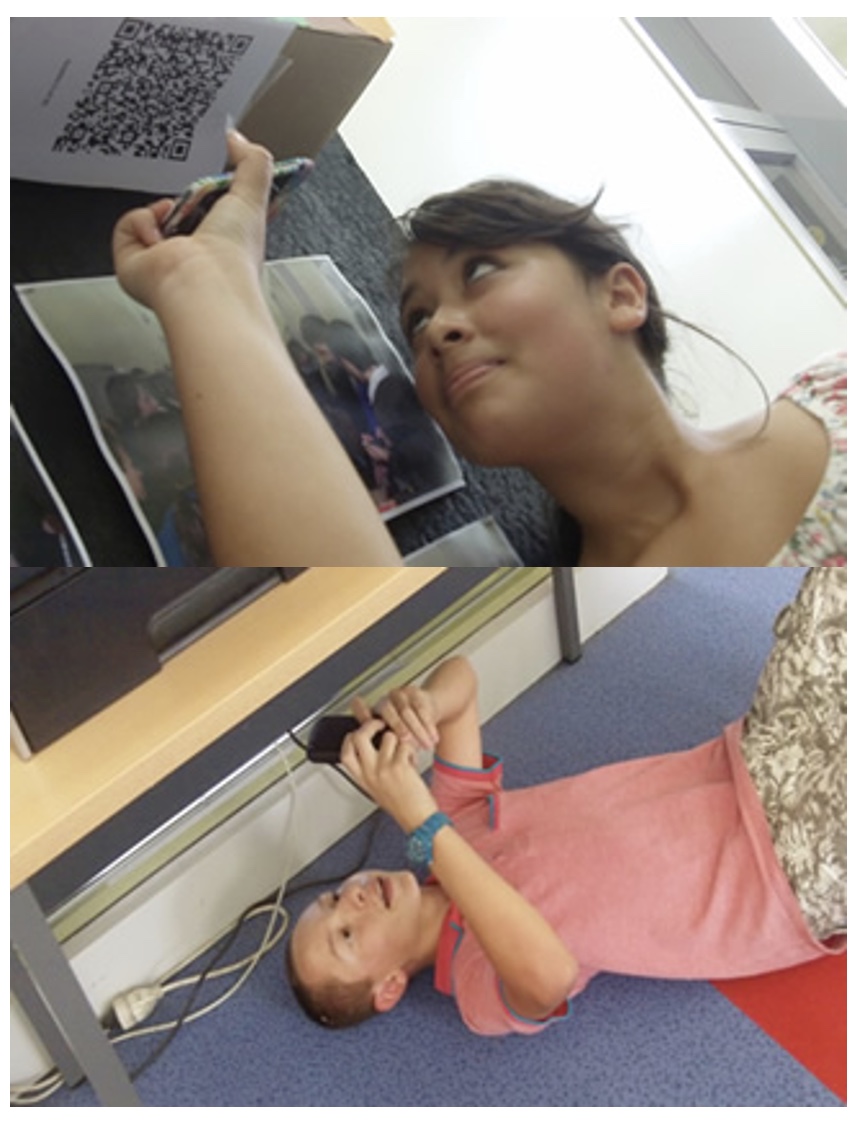
1. Arrange students into groups. Each group needs at least ONE person who has a mobile device.
2. If their phone camera doesn't automatically detect and decode QR codes, ask students to
4. Cut them out and place them around your class / school.
1. Give each group a clipboard and a piece of paper so they can write down the decoded questions and their answers to them.
2. Explain to the students that the codes are hidden around the school. Each team will get ONE point for each question they correctly decode and copy down onto their sheet, and a further TWO points if they can then provide the correct answer and write this down underneath the question.
3. Away they go! The winner is the first team to return with the most correct answers in the time available. This could be within a lesson, or during a lunchbreak, or even over several days!
4. A detailed case study in how to set up a successful QR Scavenger Hunt using this tool can be found here.
Question | Answer |
| 1. What is the term that describes the long-term weather in a particular region? | climate | 2. What is an ice age? | Cold periods lasting from hundreds to millions of years when glaciers cover much of Earth | 3. What is a drought? | it is a period with below-average precipitation | 4. What is the term for gases that absorb Earth's outgoing thermal energy | Greenhouse gases | 5. How are climates classified? | Wladimir Köppen created a system based on temperature, precipitation, and vegetation | 6. What is a dry climate? | It is a climate with hot summers and cooler winters, and it has very low precipitation | 7. How does the ocean affect climate? | the ocean absorbs, store, and transports heat from the sun. ocean affects temp and precipitation of area. when temp is lower then seawater's, the ocean transports heat to lower atmosphere | 8. Why is one climate different from another? | They have different temperatures and due to the location on the Earth, different amounts of sunlight and environment, as well as different plants and animals. | 9. What is the term for a warm period that occurs during an ice age? | Interglacial | 10. What causes seasons? | The tilt of the Earth's axis | 11. What is a microclimate? | a localized climate that is different from the larger area surrounding it. | 12. What is the term for a wind circulation pattern that changes direction with the seasons? | Monsoon | 13. What is a tropical climate? | It is a climate that is warm year-round with high precipitation. | 14. What is the term for the large-scale cutting and/or burning of forests? | deforestation | 15. What is a rain shadow? | An area of low rainfall on the downwind slope of a mountain. | 16. What is the term for the amount (joules) of thermal energy needed to raise the temperature of 1 kg of a material by 1 degree Celsius? | Specific Heat | 17. What type of climate is a climate where it is cold year round and there is minimal precipitation? | A polar climate | 18. How can human activities affect climate? | Greenhouse gases, deforestation, natural sources, aerosols, pollution, etc. | 19. What is the combined ocean and atmospheric cycle that results in weakened trade winds across the Pacific Ocean? | El Niño/Southern Oscillation | 20. What is a continental climate? | A climate where there are warm summers and cold winters and there is moderate precipitation. | 21. What is the term for the rise in Earth's average surface temperature during the past 100 years? | Global Warming | 22. What is a mild climate? | It is a climate with warm summers, and mild winters, and has high precipitation and is very humid. |

Question 1 (of 22)
Question 2 (of 22)
Question 3 (of 22)
Question 4 (of 22)
Question 5 (of 22)
Question 6 (of 22)
Question 7 (of 22)
Question 8 (of 22)
Question 9 (of 22)
Question 10 (of 22)
Question 11 (of 22)
Question 12 (of 22)
Question 13 (of 22)
Question 14 (of 22)
Question 15 (of 22)
Question 16 (of 22)
Question 17 (of 22)
Question 18 (of 22)
Question 19 (of 22)
Question 20 (of 22)
Question 21 (of 22)
Question 22 (of 22)