
PREMIUM LOGIN
ClassTools Premium membership gives access to all templates, no advertisements, personal branding and many other benefits!
| Username: | ||
| Password: | ||
|
Submit
Cancel
|
||
| Not a member? | ||
PREMIUM LOGIN
ClassTools Premium membership gives access to all templates, no advertisements, personal branding and many other benefits!
| Username: | ||
| Password: | ||
|
Submit
Cancel
|
||
| Not a member? | ||
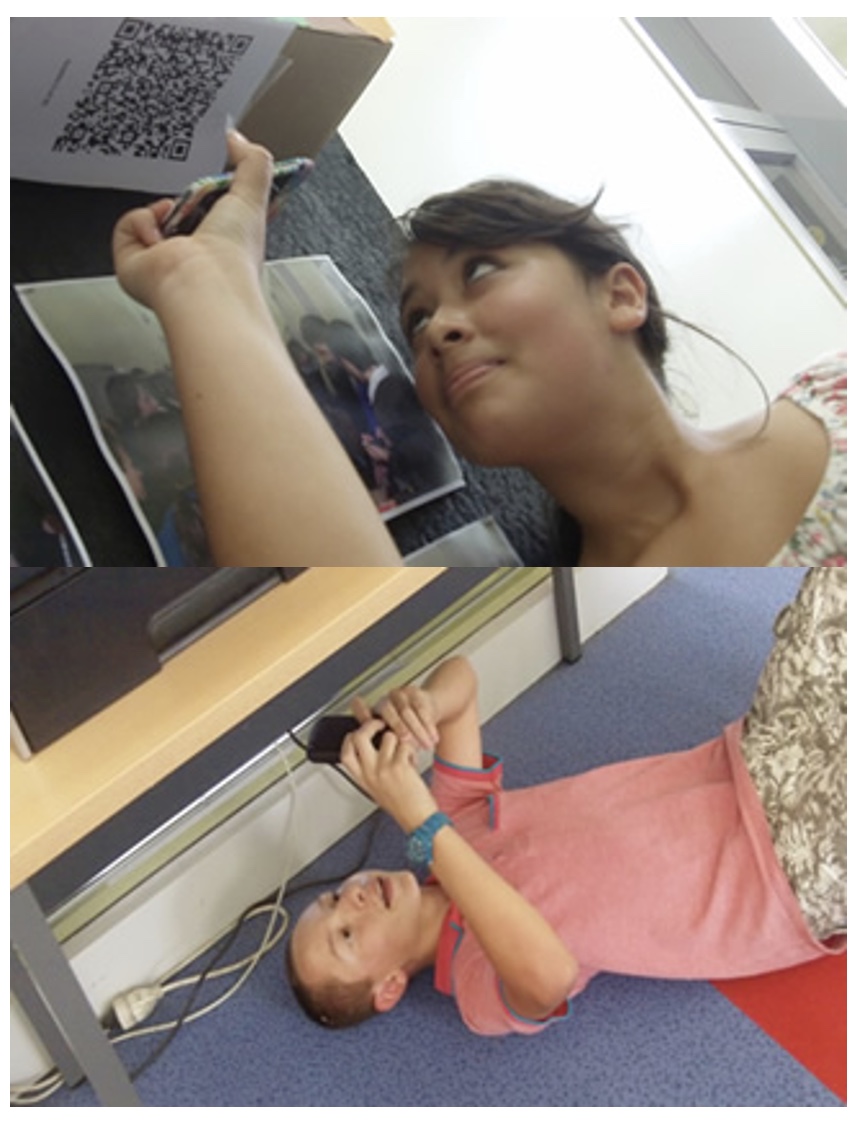
1. Arrange students into groups. Each group needs at least ONE person who has a mobile device.
2. If their phone camera doesn't automatically detect and decode QR codes, ask students to
4. Cut them out and place them around your class / school.
1. Give each group a clipboard and a piece of paper so they can write down the decoded questions and their answers to them.
2. Explain to the students that the codes are hidden around the school. Each team will get ONE point for each question they correctly decode and copy down onto their sheet, and a further TWO points if they can then provide the correct answer and write this down underneath the question.
3. Away they go! The winner is the first team to return with the most correct answers in the time available. This could be within a lesson, or during a lunchbreak, or even over several days!
4. A detailed case study in how to set up a successful QR Scavenger Hunt using this tool can be found here.
Question | Answer |
| 1. What particle has a positive charge? | protons | 2. What particle has a negative charge? | electrons | 3. What particle has a neutral charge? | neutrons | 4. The strength of Electric force depends on what two factors? | amount of charge and distance between charges | 5. The lesser the distance between charges the ____________ the force | greater | 6. Like charges ___________ and opposite charges ___________ | repel and attract | 7. What is the area around a charged object called? | electric field | 8. When objects are rubbed together, wiping electrons between them is called what? | friction | 9. The type of charge that takes place when two objects do not touch is called what? | induction | 10. When two objects touch, passing charge between them it is called what? | conduction | 11. The idea that when you charge something charges are not created or destroyed, but only transferred is called what? | conservation of charge | 12. A material that allows electricity to flow freely is called a what? | conductor | 13. A material that does not allow electricity to flow freely is called a what? | insulator | 14. In what type of material are electrons densely packed? | insulator | 15. In what material are electrons allowed to move easily? | conductor | 16. The build-up of electric current on an object is called what? | static electricity | 17. The release of static electricity is called what? | electric discharge | 18. A complete path through which electricity can flow is called a what? | circuit |

Question 1 (of 18)
Question 2 (of 18)
Question 3 (of 18)
Question 4 (of 18)
Question 5 (of 18)
Question 6 (of 18)
Question 7 (of 18)
Question 8 (of 18)
Question 9 (of 18)
Question 10 (of 18)
Question 11 (of 18)
Question 12 (of 18)
Question 13 (of 18)
Question 14 (of 18)
Question 15 (of 18)
Question 16 (of 18)
Question 17 (of 18)
Question 18 (of 18)