
PREMIUM LOGIN
ClassTools Premium membership gives access to all templates, no advertisements, personal branding and many other benefits!
| Username: | ||
| Password: | ||
|
Submit
Cancel
|
||
| Not a member? | ||
PREMIUM LOGIN
ClassTools Premium membership gives access to all templates, no advertisements, personal branding and many other benefits!
| Username: | ||
| Password: | ||
|
Submit
Cancel
|
||
| Not a member? | ||
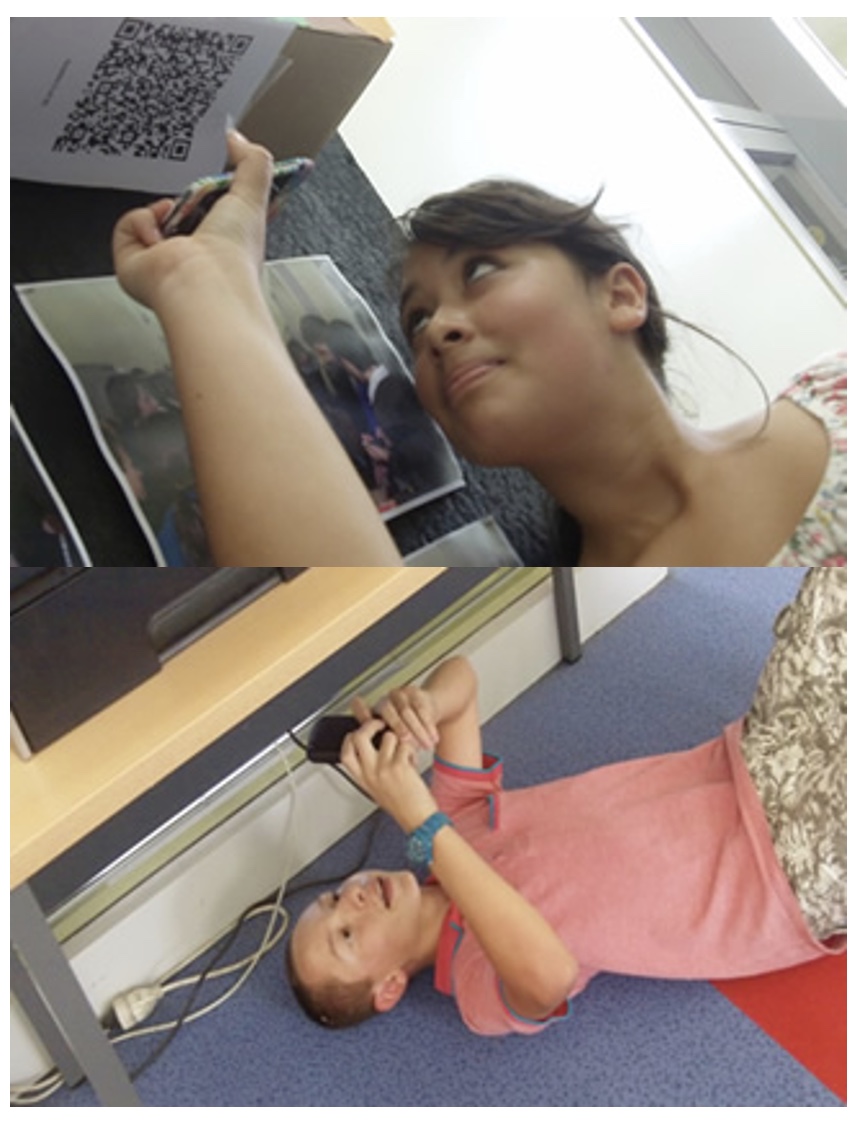
1. Arrange students into groups. Each group needs at least ONE person who has a mobile device.
2. If their phone camera doesn't automatically detect and decode QR codes, ask students to
4. Cut them out and place them around your class / school.
1. Give each group a clipboard and a piece of paper so they can write down the decoded questions and their answers to them.
2. Explain to the students that the codes are hidden around the school. Each team will get ONE point for each question they correctly decode and copy down onto their sheet, and a further TWO points if they can then provide the correct answer and write this down underneath the question.
3. Away they go! The winner is the first team to return with the most correct answers in the time available. This could be within a lesson, or during a lunchbreak, or even over several days!
4. A detailed case study in how to set up a successful QR Scavenger Hunt using this tool can be found here.
Question | Answer |
| 1. 1) ___________ is defined as a variety of life. | Biodiversity | 2. 2) Forest fires, floods, droughts, and hurricanes are examples of (short, long) term environmental changes. | short | 3. 3) Ice age, global warming, and urbanization are examples of (short, log) term environmental changes. | long | 4. 4) Short-term environmental changes impacts (subsequent populations, organisms immediately). | immediately | 5. 5) Long-term environmental changes impact (subsequent populations, organisms immediately) | subsequent | 6. 6) (Short-term, Long-term) environmental changes occur slowly and gradually | long | 7. 7) (Short-term, Long-term) environmental changes occur quickly | short | 8. | a) all 3 populations would increase | 9. 8) True or False An aquarium with fish living in the water is an example of an ecosystem. | True | 10. 9) Which ecosystem has more biodiversity? (corn field, tropical rain forest). | rainforest | 11. 10) Which ecosystem will be more sustainable if the environment changes (corn field, tropical rainforest)? _____________- | tropical rainforest | 12. 11) An _______________________ is a non-native organism that out competes other native organisms for food and space, and has no natural predators, which makes it very difficult to contain the population growth. | invasive species | 13. 12) List some examples of how humans negatively impact the biodiversity of an ecosystem | deforestation, urbanization, overfishing | 14. 13) The Industrial Revolution impacted the Peppered Moth population (immediately, in subsequent populations) | subsequent populations | 15. 14) Water, sunlight, and dirt are examples of (biotic, abiotic) factors. | abiotic | 16. 15) Salinity, wind, carbon dioxide, and oxygen are examples of (biotic, abiotic) factors. | abiotic | 17. 16) High tide and low tide are examples of (biotic, abiotic) factors. | abiotic | 18. 17) Under a tree in a forest is best described as a ________ in the ecosystem. | microhabitat | 19. 18) Slow and gradual change to an ecosystem that impacts subsequent populations, which allow organisms to adapt with the changing environment (short term, long-term environmental change) | long-term environmental change | 20. 19) Plants, grass, fungus are examples of (biotic, abiotic) factors | biotic | 21. 20)A community of organisms that interact with their abiotic environment is best described as a (biotic factor, abiotic factor, population, ecosystem) | ecosystem | 22. 21) Place the following term in order from smallest to largest (ecosystem, population, organism, community) | organism, population, community, ecosystem | 23. 22) ________________ is described as: Only the organisms that are best suited to survive will live well, reproduce, and pass those traits onto the next generation. | natural selection | 24. 23) An animal eating a plant is a (predator-prey, producer-consumer, parasite-host) relationship. | producer-consumer | 25. 24) Is a rabbit born with a genetic mutation, which produced brown fur in an arctic (snowy) environment best suited for survival? | No | 26. 25) True or False Organisms that are able to adapt to their changing environment have the best chance at survival, reproducing, and passing those traits onto the generation when an environment changes. | True |

Question 1 (of 26)
Question 2 (of 26)
Question 3 (of 26)
Question 4 (of 26)
Question 5 (of 26)
Question 6 (of 26)
Question 7 (of 26)
Question 8 (of 26)
Question 9 (of 26)
Question 10 (of 26)
Question 11 (of 26)
Question 12 (of 26)
Question 13 (of 26)
Question 14 (of 26)
Question 15 (of 26)
Question 16 (of 26)
Question 17 (of 26)
Question 18 (of 26)
Question 19 (of 26)
Question 20 (of 26)
Question 21 (of 26)
Question 22 (of 26)
Question 23 (of 26)
Question 24 (of 26)
Question 25 (of 26)
Question 26 (of 26)