
PREMIUM LOGIN
ClassTools Premium membership gives access to all templates, no advertisements, personal branding and many other benefits!
| Username: | ||
| Password: | ||
|
Submit
Cancel
|
||
| Not a member? | ||
PREMIUM LOGIN
ClassTools Premium membership gives access to all templates, no advertisements, personal branding and many other benefits!
| Username: | ||
| Password: | ||
|
Submit
Cancel
|
||
| Not a member? | ||
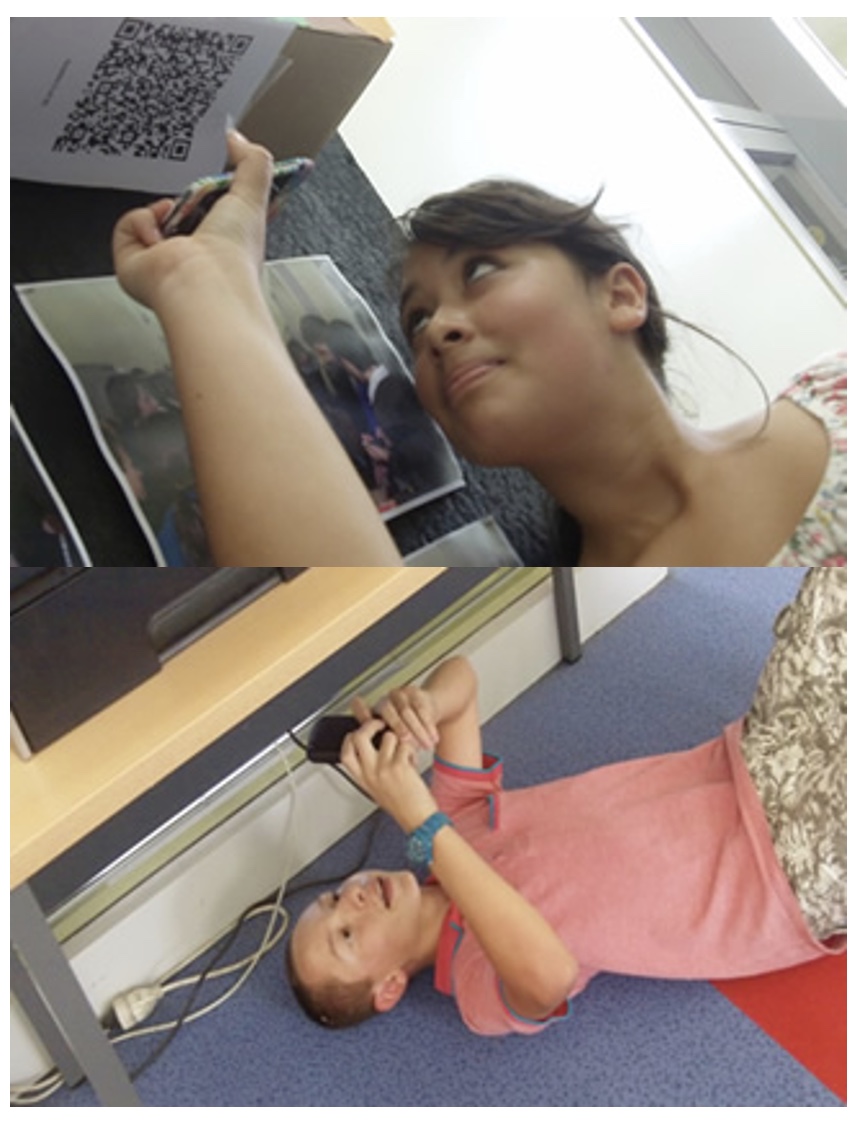
1. Arrange students into groups. Each group needs at least ONE person who has a mobile device.
2. If their phone camera doesn't automatically detect and decode QR codes, ask students to
4. Cut them out and place them around your class / school.
1. Give each group a clipboard and a piece of paper so they can write down the decoded questions and their answers to them.
2. Explain to the students that the codes are hidden around the school. Each team will get ONE point for each question they correctly decode and copy down onto their sheet, and a further TWO points if they can then provide the correct answer and write this down underneath the question.
3. Away they go! The winner is the first team to return with the most correct answers in the time available. This could be within a lesson, or during a lunchbreak, or even over several days!
4. A detailed case study in how to set up a successful QR Scavenger Hunt using this tool can be found here.
Question | Answer |
| 1. Studies have shown that GBL in education has been most efficient in certain situations. Which of these situations have led to high efficiency or effect size in this regard? a) Use of online games in larger size classes. b) Use of non-digital games in smaller class sizes. c) Hybrid application of high technology usage digital games and highly immersive non-digital games.d) Digital games are more efficient than non-digital games in all educational settings | B | 2. DGBL is associated with certain disadvantages or concerns that may make lecturers and students reluctant to use them in learning-teaching practices. Identify two common concerns from the dual phrase sets provided. a) Games are boring. Rules are difficult to follow. b) Encouraging aggressive behaviour. Leading to game burnout. c) Extreme competition. Emergence of addictive behaviour. d) Games are time-consuming to play. They tend to move away from the module purpose | C | 3. A third year pharmacology lecturer used a virtual Escape Room game design to teach clinical concepts in Toxicology. This was a very successful exercise from the students’ perspective. So, the lecturer decided to use the same design to facilitate learning in six other major third year content areas. What does this strategy have the potential to cause? a) High student satisfaction levels at the end of the year. b) Highly immersive experiences with passive learning. c) Loyal student engagement but failure to attain learning outcomes. d) Gaming fatigue | D | 4. GBL activities differ with regards to the extent of technology usage and ability to create immersive experiences for the player. ComPharm® is an advanced computer software programme that simulates a community pharmacy setting. Students play the game by navigating their way around the virtual pharmacy and interacting with patients in a realistic way. How would you categorise this game in terms of technology usage and player immersive experience? a) High technology usage; high immersive experience b) High technology usage; low immersive experience c) Low technology usage; high immersive experience d) Low technology usage; low immersive experience | A | 5. When did humanity start playing games? There is evidence of the Royal Game of Ur being played by Kings and Queens in Mesopotamia.a) more than 4600 years ago.b) 150 BC. c) 2.6 million years ago. d) during the early 1400's | A | 6. Which of the following elements, despite the platform or genre of game, is not common in most games: a) Uncertainty of outcome/element of chance.b) competition. c) Storyline d) Elements of reward/enjoyment | C | 7. Which of the following options is a stick-fighting game made popular by boys herding livestock in the rural areas of South Africa? a) Morobaraba. b) Kgati. c) Lintonga. d) Jugskei | C | 8. Which learning theory states that learning is a process of connecting symbols in a meaningful & memorable way? a) Behaviourism. b) Constructivism. c) Social teaching theory. d) Cognitivism | D | 9. A pharmacist rewards an intern with a coffee voucher for a well-designed, comprehensive CPD entry. In operant conditioning, what type of stimulus is this action known as? a) Positive reinforcement. b) Negative reinforcement. c) Positive punishment. d) Negative punishment | A | 10. A newly qualified pharmacist's assistant (basic) (PAB) is able to capture an invoice for a Schedule 6 medicine on the stock management software with the assistance of a more experienced pharmacist's assistant (post-basic). Which learning area are they considered to be in in terms of constructivist theory? a) Zone of proximal development. b) Scaffolding. c) Intersubjectivity. d) Guided learning | A | 11. Which learning theory is founded on the belief that knowledge is actively constructed through interaction with people? a) Behaviourism. b) Operant conditioning. c) Social constructivism. d) Cognitivism | C | 12. Which of the following is considered a failure of game design in a game that has competition as an aesthetic? a) Players feel like enemies. b) Players feel they can win. c) Players can't measure their progress. d) Players get emotional during game play | C | 13. Which of the following is an example of a game dynamic? a) Social Framework. b) Make believe. c) Obstacle course. d) Random variable | D | 14. Which of the following is an example of a gamification element? a) Board game. b) Leaderboard. c) Feedback system. d) Problem solving | B | 15. There are many different types of games ranging from board games, pen and paper, card games, war games and role playing. Which of the following examples falls under the role-playing game type? a) Tetris. b) Tic Tac Toe. c) Dungeons and Dragons. d) Kgati | C | 16. Which of the scenarios below best reflect the attitude of an educator? a) A pharmacists presenting educational material about prevention of heart diseases at an old age home, followed by informal chats with each member of the audience. b) A school assistant helping a child with his homework. c) A pharmacists providing reading material to a PBPA in preparation for a quiz, followed by assessing the PBPA knowledge two weeks later. d) A pharmacists joining the CPD events to enhance his knowledge | A | 17. Where does the need for a personalised approach in educating patients come from? Choose the most accurate statement. a) Each person is unique - culture, values, upbringing, personal believes also adds to the way they respond to the stress that comes with being sick. b) We are the rainbow nation. c) Individuals have different level of cognition and different learning styles. d) Patients not paying attention to pharmacy staff and being distracted by external factors | A | 18. What is meant by the statement “teachers can become educators”? a) Teachers can further their studies in becoming educators. b) Teachers should focus on the desired outcomes to guide the students in reaching their goals. c) Teachers can be the people that are educated by others. d) Teachers can enhance their personal soft skills and start focusing more on the overall development of their pupils | D | 19. Patient education is: a) The sole responsibility of the patient. b) Responsibility of the patient and the doctor. c) Responsibility of the patient and the pharmacist. d) None of the answer reflects the real meaning of “patient education” | D | 20. Which of the following is a game mechanic in a board game that uses dice to determine how many spaces a player moves forward on a board? a) Quantity. b) Spatial. c) State. d) Action | B |

Question 1 (of 20)
Question 2 (of 20)
Question 3 (of 20)
Question 4 (of 20)
Question 5 (of 20)
Question 6 (of 20)
Question 7 (of 20)
Question 8 (of 20)
Question 9 (of 20)
Question 10 (of 20)
Question 11 (of 20)
Question 12 (of 20)
Question 13 (of 20)
Question 14 (of 20)
Question 15 (of 20)
Question 16 (of 20)
Question 17 (of 20)
Question 18 (of 20)
Question 19 (of 20)
Question 20 (of 20)