8th October 2017
Making “Top Trumps” work in the classroom: use WORDS, not RATINGS
Overview Because “Top Trumps” is a simply game format to understand and play, this does not necessarily translate into an educationally [...]
8th October 2017
Triominoes Revision
Overview Here’s a great idea from Karen Knight (@KKNTeachLearn) that was shared to the #historyteacher hashtag on Twitter recently: Taking it further [...]
8th October 2017
“Quote them out of context”: a ‘Fake News’ exercise for evaluating sources
Overview Newpaper reports inlcuding extracts from political speeches and interviews are often used as primary source material in the history classroom. To [...]
23rd September 2017

Using “unlock the chest!” puzzles to develop out-of-class learning
Overview Obtain a date padlock (day / month / year), and set it to the exact date of a particular historical event. Use this to lock a chest, inside of [...]
18th September 2017
Using a “Mysterious Moment” lesson starter to develop questioning skills
Overview The ‘mysterious moment’ approach is a great way to engage students at the beginning of a lesson and to generate some interesting questions. It [...]
11th September 2017
Using “relationship webs” to map change and continuity over time
Overview Charting the changing relationship between nations and individuals over time is an important part of identifying key turning points as well as [...]
6th September 2017
Using the ‘chatshow challenge’ to substantiate arguments more effectively
Overview Substantiating assertions forcefully and with evidence is a valuable skill for young historians to develop. The “chatshow challenge” [...]
2nd September 2017

“Which One Doesn’t Belong?”: a starter activity to highlight connections, contrasts and comparisons
Overview Students are presented with four simple images (or statements) and challenged to give a reasoned answer to the question “Which one doesn’t [...]
16th June 2017

Educational Escape Rooms: Case Study 1 – Larger groups / younger students
Overview For an introduction to the Escape Room format and how it can be used in the classroom, please consult this earlier blogpost. This post is designed [...]
3rd June 2017

Educational Escape Rooms: Case Study 2 – Smaller groups / older students
A. Overview For an introduction to the Escape Room format and how it can be used in the classroom, please consult this earlier blogpost. This post is [...]
3rd June 2017
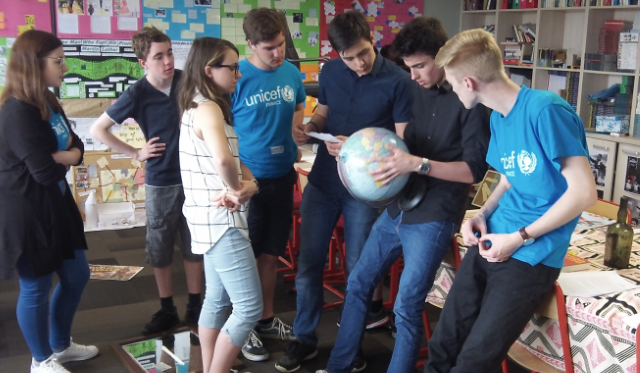
Design educational “escape rooms” for your students!
A. Overview: What is an “Escape Room”? An escape room is, according to Wikipedia, “a physical adventure game in which players solve a series of [...]
30th May 2017

“Brilliance or Baloney?”: A quiz format to develop substantiated judgements
Overview In subjects like history it is important that students form, express and substantiate their judgements on central issues. One efficient way of [...]
17th May 2017

Turn a timeline into an interactive quiz for student revision
Overview In subjects like History it is important for students to have firm chronological understanding. To help them develop a solid grasp of the order in [...]
13th May 2017
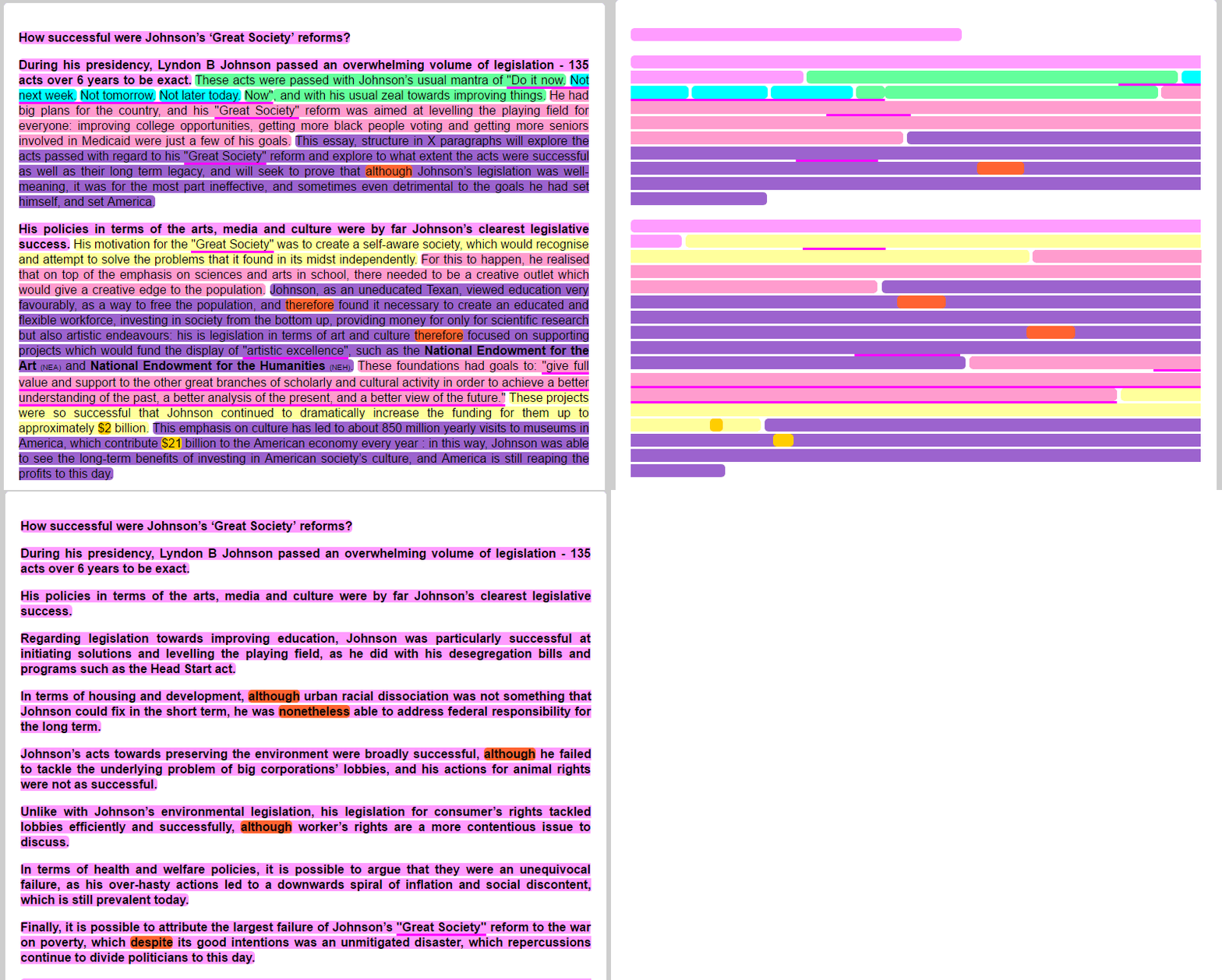
Using “EyeSay!” to give visual feedback on student essays
Overview “EyeSay!” is a new tool I have coded at www.classtools.net to help students and teachers get a useful visualisation of essay style and [...]
19th April 2017
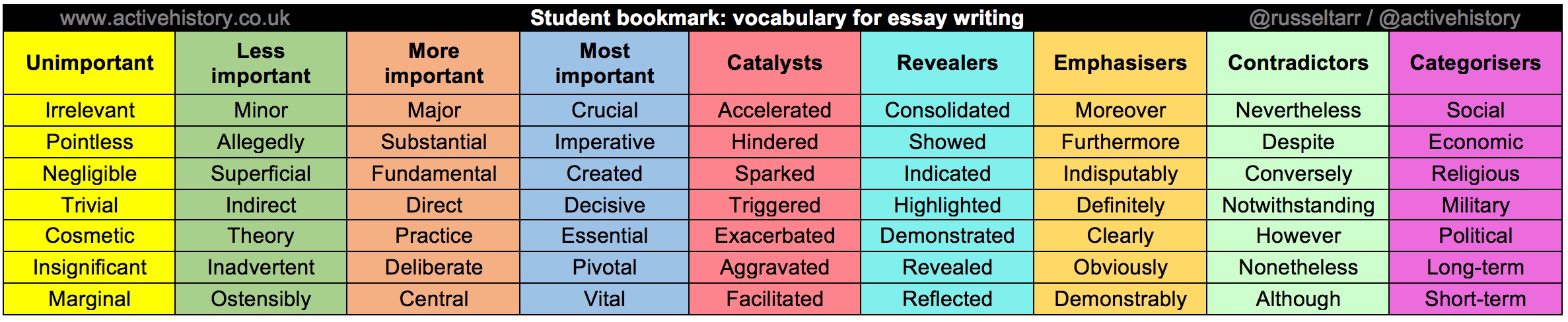
Student Bookmark: vocabulary for essay writing
Overview In order to help students develop a wider range of vocabulary for their extended writing, I have produced the following bookmark which can be [...]
3rd April 2017

“History in your pocket”: Coins as sources
Overview This great idea was developed from an idea shared by @histHartford. This photo comes from Mr. Atkinson (@AtkoHistory) and was shared to the [...]
8th March 2017

Develop persuasive vocabulary with a ‘biased words knockout challenge’
Overview One important literacy skill is for students to use (and, increasingly, to spot) writing which is designed to persuade rather than merely inform. [...]
7th March 2017
Design “Tubular Timeline Towers” for chronological understanding
Overview As a ‘choose your own homework‘ option, suggest to students that they consolidate their chronological understanding by constructing a [...]
23rd February 2017
Writing “Dialogue Poems” to compare and contrast viewpoints
Overview Dialogue poems are designed to compare and contrast the perspectives of the same event or situation from the point of view of different parties [...]
9th February 2017
Using Plutchik’s Wheel of Emotions to improve the evaluation of sources
25th January 2017
Alphabet Challenge: know the topic from A-Z!
Overview Challenge students to produce a list of words from A-Z, each of which has something to do with the topic being consolidated or revised. If time is [...]
10th January 2017
How to help students design educational board games
4th January 2017
Data-driven history lessons: “How could geographers help us to answer this question?”
Overview In a subject like history, a common pitfall for students is to make sweeping assertions which are not backed up with hard data. This is often the [...]
12th December 2016